
Table of Contents
Meta’s new “AI-built apps” strategy sounds revolutionary. But it’s the same playbook that killed Slingshot, Lasso, and a dozen others—with one dangerous twist.
The Déjà Vu Nobody’s Talking About
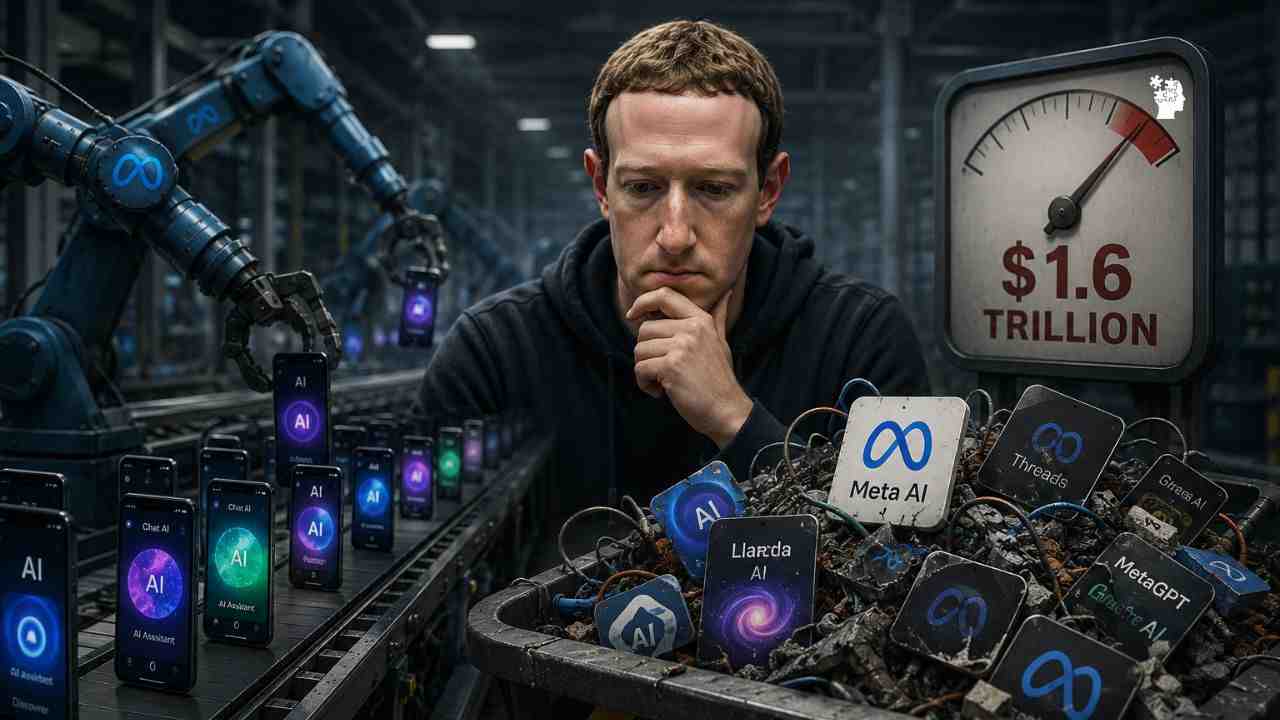
Mark Zuckerberg stood before investors this week and promised something extraordinary: Meta will use AI to build and ship consumer apps at a pace “previously impossible.” New standalone apps are already rolling out—Instagram Instants, Forum, Seller—with more “releasing soon.”
The tech press nodded approvingly. AI-powered development! LLM-native recommendations! The future of app creation!
But here’s what nobody in the room seemed to remember: Meta has tried this exact playbook before. Twice. And it failed catastrophically both times.
In 2014, Zuckerberg launched Creative Labs, an internal incubator designed to “experiment” with standalone apps. The result? Slingshot (a Snapchat clone), Paper (a news reader), Rooms (anonymous group chat), Riff (collaborative video), and Mentions (for celebrities). All dead within two years.
In 2019, he tried again with the NPE Team (New Product Experimentation). The result? Hobbi (Pinterest clone), Tuned (couples app), Collab (music video app), Hotline (Q&A platform), BARS (rap app), and more. Most shut down. A few absorbed into existing products. None became meaningful standalone businesses.
Now, in 2026, Zuckerberg is back with the same promise—but this time, AI is the magic ingredient.
The question isn’t whether AI makes app development faster. The question is: Does faster development fix the problem that killed the last two attempts?
The Real Problem Was Never Engineering Speed
Meta’s past app failures had nothing to do with how quickly they were built. They failed because of a fundamental misunderstanding of why people adopt new apps.
Table
| What Meta Assumed | What Actually Happened |
|---|---|
| “Build it and users will come” | Users stayed on Instagram/Facebook |
| “Clone successful apps with our scale” | Clones felt inauthentic and derivative |
| “Iterate fast based on data” | Killed apps before they found product-market fit |
| “Use our distribution advantage” | Couldn’t overcome network effects of incumbents |
Slingshot wasn’t slower to build than Snapchat. It was less fun, less sticky, and arrived too late. Lasso wasn’t technically inferior to TikTok. It was a copycat without cultural relevance.
AI makes the build phase faster. It does nothing for the adoption phase.
And the adoption phase is where Meta keeps losing.
The Threads Exception That Proves the Rule
Zuckerberg himself points to Threads as proof the strategy works: 500 million monthly active users, fueled by AI recommendations.
But Threads isn’t a success story of AI-built apps. It’s a success story of crisis-driven adoption.
Threads launched in July 2023, at the peak of Elon Musk’s chaotic Twitter/X takeover. Millions of users were actively searching for an alternative. Meta had the infrastructure ready (it piggybacked on Instagram accounts). The moment was perfect.
Strip away that context, and Threads looks very different:
- Growth has plateaued since the initial exodus
- Engagement per user remains far below Twitter/X at its peak
- Cultural relevance is minimal—no viral Threads moments, no breaking news, no creator economy
- Monetization is still unclear
Threads succeeded because of timing and distribution, not because it was AI-optimized. If Zuckerberg believes AI recommendations were the key driver, he’s learning the wrong lesson.
The LLM Trap: When “Smarter” Means “More of the Same”
CFO Susan Li revealed something fascinating during the call: Every Reel and Feed post on Instagram is now automatically processed through an LLM for topic and tone analysis, improving recommendations.
This sounds impressive. But consider the implication:
Meta is using the most sophisticated language models in history to do exactly what its old algorithm already did—show you content you’ll engage with. The LLM understands “topic and tone” better, sure. But the fundamental mechanic hasn’t changed: optimize for engagement, optimize for time-on-platform, optimize for ad impressions.
The risk isn’t that AI makes Meta’s apps worse. The risk is that AI makes them more efficient at the wrong thing.
We’ve already seen this movie:
- Facebook’s algorithm optimized for engagement → amplified misinformation and division
- Instagram’s algorithm optimized for Reels → killed photo sharing and creator reach
- TikTok’s algorithm optimized for watch time → created an addiction engine
Now LLMs will optimize for “topic and tone” at scale. What could go wrong?
More precise targeting of divisive content. More sophisticated emotional manipulation. More effective addiction loops. The AI doesn’t know “good” engagement from “bad” engagement. It just knows what keeps you scrolling.
The Standalone App Paradox: Why Meta Can’t Escape Its Own Gravity
Here’s the deepest contradiction in Zuckerberg’s strategy:
Meta wants to build standalone apps that succeed independently. But every standalone app it builds is parasitically dependent on Instagram and Facebook for distribution.
- Threads requires an Instagram account
- Forum (the Groups app) likely pulls from Facebook Groups data
- Seller (the Marketplace app) probably connects to existing Marketplace listings
- Instagram Instants is literally named after Instagram
These aren’t standalone apps. They’re feature extractions from the mothership, dressed up as independent products.
And that’s the problem. True standalone apps need their own reason to exist. They need unique value propositions, distinct cultures, and organic growth engines. Meta’s apps have none of these. They have Meta’s recommendation engine, Meta’s user data, and Meta’s advertising model.
Zuckerberg said it himself: “We are planning to build out more ideas and use our recommendation systems to scale them.”
Translation: We’ll build apps, then force-feed them through our existing algorithm.
That’s not innovation. That’s platform imperialism.
The AI App Factory: Faster Production, Faster Failure
Let’s game out what happens when AI makes app development 10x faster:
Table
| Before AI | After AI |
|---|---|
| 6 months to build an app | 6 weeks to build an app |
| 12 months to test product-market fit | 6 weeks to test product-market fit |
| 18 months to decide to kill or scale | 3 months to decide to kill or scale |
| 2-3 app experiments per year | 10-15 app experiments per year |
| High cost per experiment, careful selection | Low cost per experiment, spray-and-pray |
Faster development means more experiments, faster failure, and less learning per failure. Meta’s NPE Team already shut down apps within months of launch. With AI, that cycle compresses further.
The risk isn’t that Meta builds bad apps. The risk is that Meta builds so many apps so quickly that none of them get the time, attention, or iteration needed to succeed.
Innovation requires deep work, not just fast work. AI excels at the latter. It can’t replace the former.
What This Means for the Tech Industry
Meta’s AI app strategy isn’t just a Meta story. It’s a preview of how every major platform will approach product development in the next 3-5 years.
Three predictions:
1. The “app glut” is coming. When AI makes app development trivial, we’ll see an explosion of mediocre apps. The App Store and Google Play will be flooded with AI-generated clones, variations, and experiments. Discovery will become impossible. The winners won’t be the best apps—they’ll be the ones with the best distribution (i.e., the platforms themselves).
2. “AI-native” will become meaningless. Every app will claim to be “AI-native” or “LLM-powered.” The term will lose all differentiation, just as “mobile-first” did a decade ago. What will matter is what the AI actually does—not whether it’s present.
3. The real innovation will happen outside the giants. Startups without Meta’s distribution advantage will be forced to build genuinely new experiences, not algorithmic clones. The next TikTok or Snapchat won’t come from an AI app factory. It will come from a small team with a weird idea and the patience to iterate.
The Bottom Line
Zuckerberg’s AI app factory is technically impressive and strategically predictable. It will produce more apps, faster, cheaper, and with better recommendations than ever before.
But it won’t solve the problem that killed Creative Labs and the NPE Team: Meta doesn’t know how to build apps that people love. It only knows how to build apps that people use because they have to.
AI can optimize development. It can’t manufacture desire.
And until Zuckerberg figures out that distinction, his AI app factory will keep producing the same result: more apps, more users briefly, more shutdowns, more déjà vu.
Is Meta’s AI app strategy genius or just faster failure? Share your take below.
Recommended for you :