
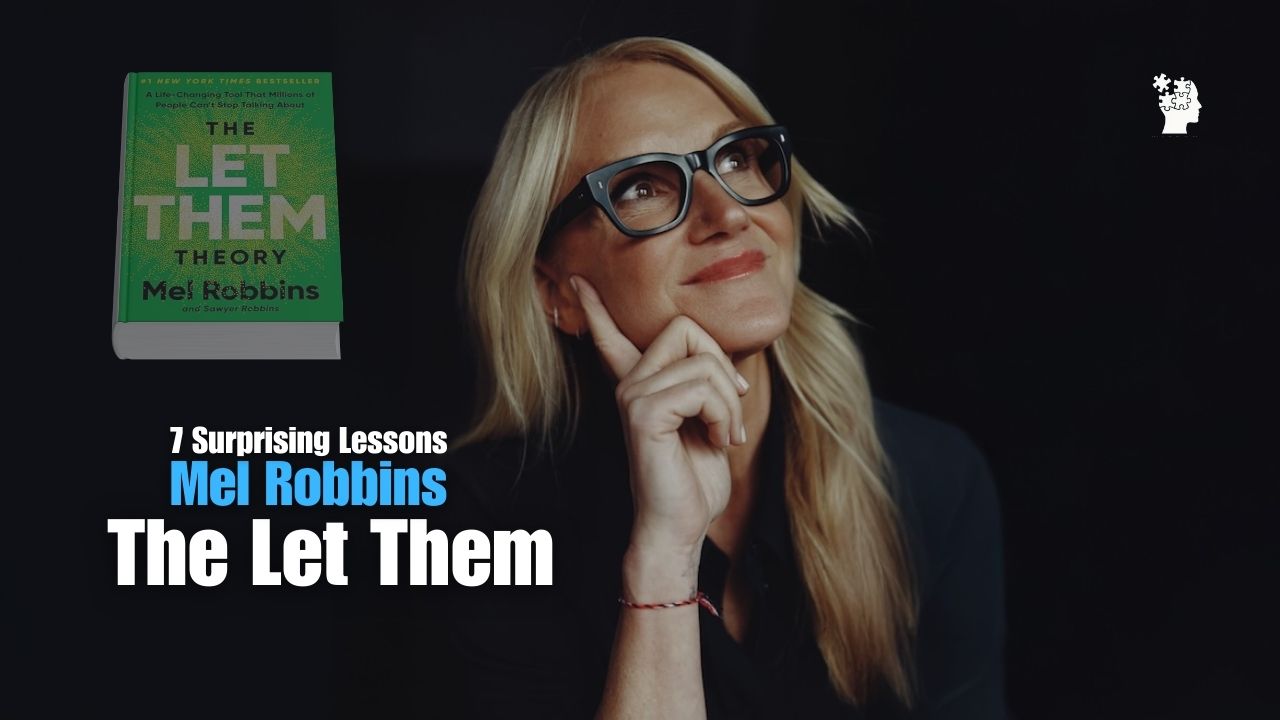
If you’ve ever felt the sheer exhaustion that comes from trying to manage other people’s choices, orchestrate outcomes, and generally keep all the world’s plates spinning, you’re not alone. It’s a draining, full-time job that no one signed up for. Tapping into this universal burnout is a simple, two-word phrase that has dominated conversations and social media feeds: “Let Them.”
This mantra is the core of The Let Them Theory, a book co-authored by Mel Robbins and her daughter, Sawyer Robbins. The phenomenon began as a TikTok sound bite that accumulated hundreds of millions of views before becoming a bestseller. Its origin traces back to a lightning-bolt moment when Sawyer, witnessing her mother’s stress over a chaotic prom plan, told her to simply “let them” handle it. But beyond the viral catchphrase lies a practical system for reclaiming your energy and focus. This article distills the most impactful and surprising takeaways from a theory that’s more than a trend—it’s a tool for a more focused life.
Table of Contents
1. It’s Not One Mantra, It’s a Two-Step Dance: “Let Them” & “Let Me”
The most common misconception about the “Let Them Theory” is that it’s about passive acceptance or simply giving up. In reality, that’s only half the story. “Let Them” is the first part of the equation: releasing the need to control others’ choices, opinions, and behaviors. It’s about accepting that you cannot manage another person’s journey.
The second, crucial step is “Let Me.” This transforms the philosophy from passive permission into active propulsion. It’s where you actively redirect the energy you’ve saved from “letting them” and invest it in your own goals. It’s not a vague wish for well-being; it’s a specific, action-oriented pivot: let me launch the side hustle, let me rest, let me ask for the raise. This dynamic duo turns a simple mantra into an everyday practice that strengthens resilience and fuels forward momentum.
2. Boundaries Aren’t Walls, They’re Bridges to Better Relationships
Many of us view boundaries as a fortress we build to “shut them out” and protect our peace. The theory presents a counter-intuitive frame: a well-placed “let them” prevents resentment from building up, which ultimately keeps relationships “honest and breathable.”
Consider the silent score-keeping that poisons connections, like always being the one to plan group vacations. Instead of stewing in the bitterness of “I always plan everything!” you “let them” choose—even if they pick a cringe-worthy Airbnb. This act of release eliminates the source of your resentment, creating space for genuine conversation instead of the silent stewing that erodes trust. As the book notes, with this approach, the bridge to the other person stays open; the toll is just your need to control.
3. It’s a Tool for Your Brain, Not Just Your Feelings
There’s neuroscience behind this simple phrase. Chronic micromanagement and worry keep the amygdala—the brain’s “alarm bell”—on constant high alert. This isn’t just a feeling; it’s a physiological state of stress.
Neuroscience and relationship studies highlighted in the theory reveal a startling fact: seven in ten adults live in near-constant stress because they’re busy policing everyone else’s choices. When you consciously decide to “let them,” it acts as a switch. It signals to your nervous system that there’s no immediate threat to fight or flee from, allowing your brain to shift back into its rational, prefrontal-cortex mode. This calms your nervous system and allows for clearer, more proactive thinking.
4. Practice Makes Peace, So Start with “Micro-Drills”
Applying this theory doesn’t mean starting with a high-stakes family confrontation. Instead, the book advocates for building the “let them” muscle gradually through low-stakes “micro-drills.” These are small, everyday opportunities to practice non-interference.
A few examples include:
• Let the barista remake the wrong coffee without a lecture.
• Let your partner load the dishwasher however they please.
• Let your teenager wear the neon outfit to dinner.
Each small repetition trains your brain to tolerate the mild discomfort of letting go. This practice prepares you to handle more significant challenges with greater calm and resilience, like letting a team member run a client presentation solo without breaking a sweat.
5. It Frees Up Your Most Valuable Resource: Emotional Bandwidth
The energy you previously spent on worry, control, and micromanagement doesn’t just disappear—it becomes available for other pursuits. This is the “emotional bandwidth dividend,” and its return is profound. Energy once spent on worry is suddenly free for wonder.
Readers of the book report using this reclaimed mental space to learn guitar, reboot side hustles, or simply get a better night’s sleep. Every “let them” earns you a shot at something personally meaningful.
“So much time and energy is wasted on forcing other people to match our expectations.”
6. It’s a Modern Take on an Ancient Idea
What makes Robbins’ formulation so potent—and controversial—is its masterful repackaging of ancient wisdom for a digital generation. Critics and supporters alike note that the theory’s principles have deep roots in Stoicism, which for centuries has taught focusing only on what is within our control (our actions and responses) and accepting what is not (other people’s behavior).
The debate raging in online forums captures this tension perfectly. Some call the theory “a watered-down baby formula version of stoicism,” arguing that it oversimplifies profound philosophical concepts. Yet others praise it for the exact same reason, celebrating that Robbins has made these complex ideas “digestible” and created “usable tools for the average person” who isn’t likely to pick up a volume of Epictetus. It’s both successful and criticized for turning timeless wisdom into something “saccharine for Gen Z” in an era desperate for practical mental health tools.
7. The Theory Itself Has a Controversial Backstory
The cultural conversation around The Let Them Theory isn’t without complexity. Critics and former fans have pointed out that the phrase “Let Them” was first popularized in a viral 2022 poem of the same name by Cassie Phillips.
The criticism, detailed across online forums and in book reviews, is sharp. Commenters accuse Robbins of having “plagiarized” and “monetized the trend without crediting Phillips,” with one reviewer calling it “blatant erasure.” The most pointed critique alleges that Robbins is “trying to trademark the phrase ‘Let Them’ so she can ‘own’ it.” While this context doesn’t invalidate the book’s advice, it adds an important layer of controversy for anyone seeking to understand the full story behind this cultural phenomenon.
Conclusion: Trade Your Control for Clarity
Ultimately, the “Let Them Theory” resonates so deeply because it offers a direct answer to our era of collective burnout. In a world that demands constant management, it provides a powerful trade: swapping the exhausting burden of control for the clarity that comes with focusing on yourself. It’s a two-part system designed not for apathy, but for reclaiming personal agency in a culture obsessed with external validation. By releasing your grip on what you can’t control, you free your hands to build a life that is truly your own.
What is one thing you’re trying to control this week that you could “let them” handle, and what would you do with that reclaimed time and energy?
Recommended for You