
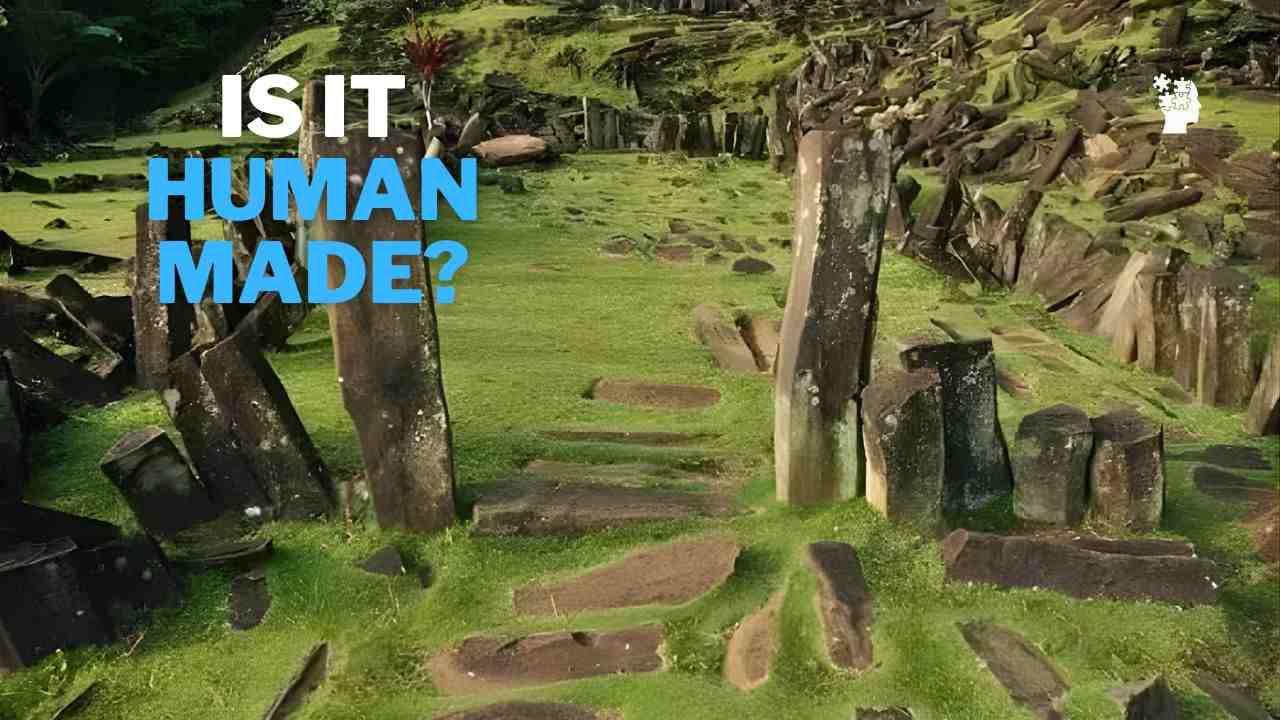
Gunung Padang, meaning “Mountain of Enlightenment,” is a megalithic site located in Karyamukti village, Campaka district, Cianjur Regency, West Java, Indonesia. Perched atop an extinct volcano at about 885 meters (2,900 feet) above sea level, the site features a series of five terraced platforms — one rectangular and four trapezoidal — connected by a central stairway of 370 andesite steps. These terraces are bordered by retaining walls made of massive polygonal volcanic stone columns, giving the hill a stepped, pyramid-like appearance.
For centuries, local communities have regarded Gunung Padang as a sacred place. It was officially recognized as a provincial cultural heritage site in 1998. The visible structures, with their neatly arranged columnar basalt rocks (often hexagonal due to volcanic cooling), have long fascinated visitors and researchers.
Table of Contents
The Explosive Claim: A 25,000-Year-Old Man-Made Pyramid?
The controversy exploded in late 2023 when geologist Danny Hilman Natawidjaja (from Indonesia’s National Research and Innovation Agency – BRIN) and his team published a paper in the journal Archaeological Prospection. Using ground-penetrating radar (GPR), seismic tomography, core drilling, and radiocarbon dating of soil samples, they proposed that Gunung Padang is not just a natural hill modified by humans — but a multi-layered, man-made pyramid built in four distinct phases:
- Phase 1 (deepest layer, ~25,000–14,000 years ago): A natural lava hill allegedly “sculpted” into a basic pyramid form during the Paleolithic era, predating agriculture and settled societies.
- Phase 2 (~7900 BCE): Addition of columnar rock layers.
- Phase 3 (~6000 BCE): Smoothing and further construction.
- Phase 4 (~2000–1100 BCE): Final masonry and terracing visible today.
The team reported hidden chambers (potentially rectilinear voids detected via geophysics) and argued this implies an advanced prehistoric civilization capable of massive stonework — far earlier than known sites like Göbekli Tepe (~9600 BCE) or Egypt’s Djoser Step Pyramid (~2630 BCE, officially the oldest confirmed pyramid per Guinness World Records).
If true, this would rewrite human history, suggesting complex monumental architecture existed during the last Ice Age, when most humans were hunter-gatherers living in simple shelters.
The Scientific Backlash and Retraction
Mainstream archaeologists and geologists quickly challenged these claims. Key criticisms include:
- The oldest radiocarbon dates (up to ~27,000 years) came from soil organics, not artifacts, charcoal, bones, or other direct evidence of human activity.
- No hallmarks of construction (tools, pottery, burials) appear in the deepest layers.
- Many features, including the columnar rocks, are natural volcanic formations (polygonal jointing from lava cooling), not human-placed.
- Volcanologist Sutikno Bronto described the site as the neck of an ancient volcano.
- Archaeologists like Flint Dibble (Cardiff University) and Bill Farley (Southern Connecticut State University) noted the absence of evidence for Ice Age advanced societies in the region.
In March 2024, the publisher Wiley retracted the 2023 paper, stating the radiocarbon dating was misapplied to non-anthropogenic soil, rendering the “ancient pyramid” interpretation invalid. The authors, including Natawidjaja, strongly disputed the retraction, calling it unfair and insisting on the data’s validity.
As of late 2025, the debate continues. Recent Indonesian government-led restoration and research (started in phases this year under the Ministry of Culture) confirm the visible terraces date to around 6,000 BCE (or later, ~3000–4000 years ago for upper layers per some teams), with no new confirmation of 25,000-year-old human construction. Officials emphasize gradual excavation, lidar surveys, and international collaboration, while some local reports describe it as a traditional punden berundak (stepped sanctuary) from megalithic times.
Why the Controversy Persists
Gunung Padang attracts global attention partly due to popular media, including Graham Hancock’s Netflix series Ancient Apocalypse, which highlights it as evidence of a lost Ice Age civilization. Supporters see it as proof of underestimated prehistoric ingenuity, especially in Sundaland (the now-submerged region connecting Indonesia during lower sea levels).
Critics label it pseudoarchaeology, arguing extraordinary claims require extraordinary evidence, which is lacking for the deepest layers. The site remains a legitimate megalithic treasure, but the “world’s oldest pyramid” title is unverified and widely disputed.
Conclusion
Gunung Padang is undeniably ancient and impressive, a testament to Indonesia’s rich prehistoric heritage. Whether it’s a natural volcanic hill enhanced by later cultures or something far more extraordinary remains an open question. Ongoing restoration and scientific studies in 2025 may provide clearer answers, but for now, it stands as one of archaeology’s most polarizing mysteries.
What do you think: groundbreaking discovery or overhyped natural formation?