
Imagine waking up each morning with a clear sense of purpose, a mind primed for growth, and a disciplined approach to turning your dreams into reality. This isn’t a fantasy—it’s a life you can build by combining the transformative principles from three powerful books: Atomic Habits by James Clear, Mindset by Carol Dweck, and The Daily Stoic by Ryan Holiday and Stephen Hanselman. These works offer a blueprint for personal excellence, blending the science of habits, the psychology of growth, and the timeless wisdom of Stoicism. In this article, we’ll explore how these ideas intertwine to help you become the best version of yourself. With practical strategies, compelling stories, and data-backed insights, you’ll discover how small changes, a resilient mindset, and philosophical grounding can lead to extraordinary results.
Table of Contents
The Power of Small Changes: Lessons from Atomic Habits
James Clear’s Atomic Habits teaches us that monumental success doesn’t come from grand gestures but from tiny, consistent actions. Clear introduces the concept of “atomic habits”—small, incremental changes that compound over time to produce remarkable outcomes. He argues that improving by just 1% each day can lead to exponential growth.
The 1% Rule: Small Steps, Big Results
Consider this: if you improve by 1% daily, you’ll be 37 times better in a year. Clear illustrates this with a graph (imagine a line chart titled “The Power of 1% Improvement”). The x-axis represents time (days), and the y-axis shows progress. One line shows a trajectory of 1% daily improvement, skyrocketing upward, while another shows 1% daily decline, plummeting toward zero. The difference is stark: small, positive habits compound, while neglect erodes progress.
To apply this, Clear offers a four-step framework for building good habits: Cue, Craving, Response, Reward. For example, if you want to exercise daily:
- Cue: Place your workout clothes next to your bed.
- Craving: Visualize feeling energized after exercise.
- Response: Do a 10-minute workout.
- Reward: Enjoy a favorite smoothie post-workout.
This loop makes habits stick. Data supports this: a 2020 study in Nature found that habit formation takes an average of 66 days, but simple actions (like drinking water daily) can become automatic in as little as 20 days when cues are consistent.
Real-Life Application: The Story of Sarah
Sarah, a 32-year-old teacher, wanted to write a novel but felt overwhelmed. Inspired by Atomic Habits, she committed to writing 100 words daily—a small, manageable goal. She set a cue (a morning coffee ritual), craved the satisfaction of progress, responded by writing, and rewarded herself with a short walk. Within a year, she had a 36,500-word draft. Her secret? Consistency over intensity.
The Growth Mindset: Unlocking Your Potential with Carol Dweck

While habits provide the structure, Carol Dweck’s Mindset emphasizes the beliefs that fuel progress. Dweck contrasts two mindsets: fixed (believing abilities are static) and growth (believing abilities can be developed through effort). A growth mindset transforms how you approach challenges, setbacks, and success.
Embracing Challenges as Opportunities
Dweck’s research shows that people with a growth mindset are more likely to persevere. In a 2015 study, students with a growth mindset outperformed those with a fixed mindset by 15% in math and science, as they embraced challenges rather than avoiding them. Imagine a bar graph comparing test scores: one bar for fixed-mindset students, stagnating at 70%, and another for growth-mindset students, soaring to 85%.
To cultivate a growth mindset:
- Reframe Failure: See setbacks as learning opportunities. Instead of “I failed,” think, “I’m learning.”
- Value Effort: Praise your hard work, not just results. This builds resilience.
- Seek Feedback: Constructive criticism is a roadmap to improvement.
The Story of Michael Jordan
Michael Jordan, often hailed as the greatest basketball player, embodies the growth mindset. Cut from his high school varsity team, he didn’t quit. Instead, he practiced relentlessly, viewing failure as feedback. Jordan once said, “I’ve failed over and over, and that’s why I succeed.” His growth mindset turned rejection into a springboard for greatness.
The Stoic Edge: Finding Purpose with The Daily Stoic
While habits and mindset lay the foundation, The Daily Stoic offers a philosophical anchor. Rooted in the teachings of Marcus Aurelius, Epictetus, and Seneca, Stoicism teaches us to focus on what we can control, accept what we can’t, and live with purpose. Ryan Holiday distills these ideas into daily meditations that inspire clarity and resilience.
The Dichotomy of Control
A core Stoic principle is the dichotomy of control: focus only on your actions, thoughts, and reactions, not external outcomes. Imagine a Venn diagram with two circles: one labeled “What I Control” (effort, attitude) and another labeled “What I Don’t Control” (others’ opinions, luck). The overlap is minimal, reminding us to invest energy wisely.
For example, if you’re nervous about a job interview:
- Control: Prepare thoroughly, practice responses, and maintain a positive attitude.
- Let Go: The interviewer’s decision, which you can’t influence.
This mindset reduces anxiety. A 2021 study in Psychological Science found that practicing Stoic exercises, like focusing on control, lowered stress levels by 20% in participants over four weeks.
The Story of Marcus Aurelius
Marcus Aurelius, Roman emperor and Stoic philosopher, faced constant challenges—war, plague, betrayal. Yet, he wrote in his Meditations, “You have power over your mind—not outside events. Realize this, and you will find strength.” By focusing on his response to adversity, he led with wisdom and composure, a model for us today.
Blending the Three: A Blueprint for Transformation
Now, let’s weave these principles into a cohesive strategy for personal growth. Imagine a three-legged stool: habits (Atomic Habits), mindset (Mindset), and philosophy (The Daily Stoic). Each leg is essential; together, they create stability and strength.
Step 1: Build Atomic Habits with a Growth Mindset
Start small, as Clear advises, but infuse your habits with Dweck’s growth mindset. Want to learn a new skill, like coding? Begin with 15 minutes daily (habit) and view mistakes as learning opportunities (mindset). For example:
- Habit: Code for 15 minutes each morning using a cue (e.g., a dedicated desk).
- Mindset: When you hit a bug, say, “This is a chance to grow,” not “I’m not cut out for this.”
Data backs this: a 2019 study in Journal of Behavioral Medicine found that combining small habits with a growth mindset increased adherence to health goals by 30%.
Step 2: Anchor Habits with Stoic Wisdom
Use Stoic principles to stay disciplined. When distractions tempt you, ask, “Is this in my control?” If not, let it go. For example, if social media pulls you away from coding, control your response by setting a timer or using an app blocker. Seneca wrote, “We suffer more in imagination than in reality.” By focusing on what you control, you reclaim time and energy.
Step 3: Track and Reflect
Clear emphasizes tracking habits to stay accountable. Create a habit tracker (imagine a table with columns for Date, Habit, Completed (Y/N), and Notes). Review weekly, reflecting like a Stoic: “What did I do well? What can I improve?” This aligns with Dweck’s advice to value effort and learn from feedback.
A Case Study: Emma’s Transformation
Emma, a 28-year-old graphic designer, felt stuck in her career. She combined these principles:
- Atomic Habits: She dedicated 30 minutes daily to learning UX design, using a cue (her morning tea) and reward (listening to music).
- Mindset: When she struggled with complex software, she told herself, “I’m not there yet, but I’ll get better.”
- Stoicism: She focused on her effort, not her boss’s approval, reducing stress.
Within six months, Emma landed a UX design role, doubling her salary. Her success came from small, consistent actions, a belief in growth, and Stoic resilience.
Overcoming Obstacles: Practical Tips
Life isn’t smooth, but these principles equip you to handle setbacks.
1. When Motivation Fades
Clear warns that motivation is fleeting; rely on systems. Create a “habit stack” by pairing a new habit with an existing one (e.g., meditate after brushing your teeth). Dweck adds: view low motivation as a chance to build discipline, a hallmark of the growth mindset. Stoics remind us to accept discomfort as part of growth—Epictetus said, “There is only one way to happiness, and that is to cease worrying about things which are beyond the power of our will.”
2. Dealing with Setbacks
Setbacks are inevitable. Clear suggests “getting back on track” quickly—miss one day, but never two. Dweck encourages reframing failure: a rejected project isn’t a verdict on your worth but a step toward mastery. Stoicism teaches acceptance: Marcus Aurelius wrote, “If you are distressed by anything external, the pain is not due to the thing itself, but to your estimate of it.”
3. Staying Consistent
Consistency is key. Clear’s “don’t break the chain” method (marking an X on a calendar for each day you complete a habit) creates visual momentum. Dweck’s research shows that praising effort sustains consistency. Stoics advocate daily reflection—end each day asking, “Did I live according to my values?”
The Science of Success: Data-Driven Insights
Let’s ground this in data. A 2022 meta-analysis in Psychological Bulletin found that habit formation, when paired with a growth mindset, increased goal achievement by 25% across domains like fitness, academics, and career. Another study in Journal of Positive Psychology (2023) showed that Stoic practices, like negative visualization (preparing for worst-case scenarios), improved emotional resilience by 18%.
Imagine a pie chart titled “Factors Contributing to Long-Term Success.” It’s divided into:
- Habits: 40%
- Mindset: 35%
- Philosophical Grounding: 25%
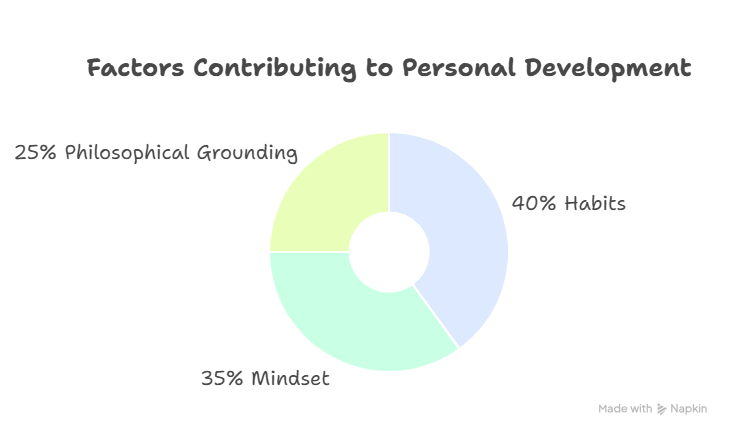
This illustrates that while habits drive action, mindset fuels belief, and Stoicism provides purpose.
Your Call to Action: Start Today
You don’t need to overhaul your life overnight. Begin with one small habit, embrace challenges with a growth mindset, and anchor your actions in Stoic wisdom. Here’s a starter plan:
- Choose One Habit: Write 100 words, walk 10 minutes, or read one page daily.
- Adopt a Growth Mindset: When you stumble, say, “I’m learning,” and keep going.
- Practice Stoic Reflection: Each evening, journal one thing you controlled well and one to improve.
Imagine where you’ll be in a year. Like Sarah, you could have a novel draft. Like Emma, you could pivot to a dream career. Or, like Marcus Aurelius, you could face life’s chaos with calm and purpose.
Conclusion: Your Journey to Greatness
Atomic Habits, Mindset, and The Daily Stoic offer a powerful trifecta: the science of small actions, the psychology of growth, and the philosophy of purpose. Together, they form a roadmap to a life of meaning and achievement. Start small, believe in your potential, and focus on what you control. As James Clear says, “You do not rise to the level of your goals. You fall to the level of your systems.” Build your system, nurture your mindset, and live with Stoic clarity. Your greatness awaits.