
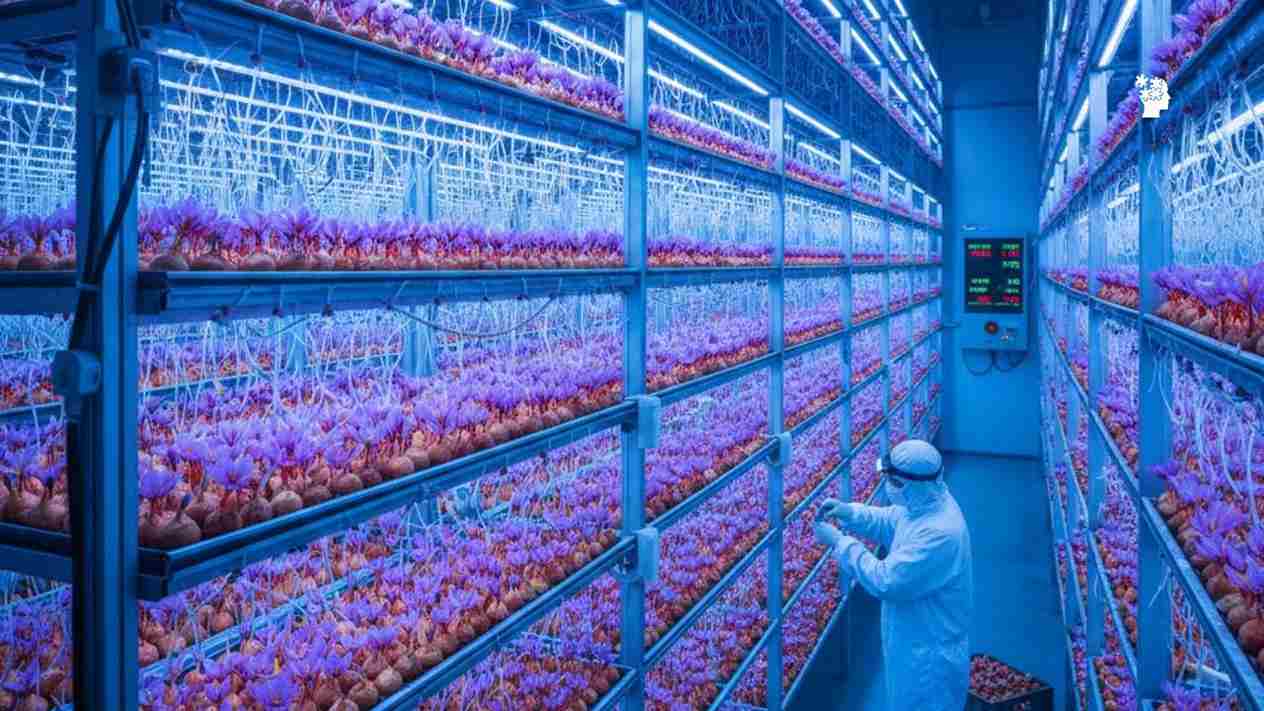
In 2013-14, a brutal drought in Karnataka’s Chikkamagaluru district wiped out Vivek Raj’s entire 5,000-acre ginger crop, delivering a devastating financial blow to his company, Panama Nature Fresh Pvt Ltd. A decade later, the same entrepreneur is channeling Rs 214 crore (about $25 million) into what he calls the ultimate revenge: AI-powered hydroponic farming that promises to make crops “guaranteed” not to die — even in the face of worsening climate extremes.
Wisdom Imbibe Insight
- Vivek Raj, hit by 2013-14 drought losses, is investing ₹214 crore in AI-hydroponic farming via Panama Hydro-X in Karnataka.
- The venture features four patented AI technologies for early disease detection and optimized growth, targeting saffron, ginger, and medicinal plants.
- Trials show triple yields (1,200 vs 400 bags/acre) and three annual cycles, with first commercial harvest planned for June 2027.
Announced on the sidelines of the India AI Impact Summit 2026 in New Delhi, Raj’s latest venture through Panama Hydro-X (a limited liability partnership backed by his Panama Corporation) is turning heads. The company has already sunk Rs 146 crore into R&D, resulting in four patented AI technologies — secured in the UK, Germany, and Australia — designed to supercharge controlled-environment agriculture.
But is this bold pivot from drought victim to high-tech farming pioneer a game-changer for Indian agriculture, or an expensive gamble in a sector full of hype?
Table of Contents
The Personal Backstory That Fuels the Vision
Raj’s story starts with loss. The 2013-14 drought didn’t just destroy his ginger fields; it exposed the fragility of traditional rain-fed farming in a warming world. Instead of retreating, he pivoted to hydroponics — growing plants in nutrient-rich water instead of soil — and layered on artificial intelligence for precision control.
Over 10+ years, Panama Corporation (and now Panama Hydro-X) has built AI systems that:
- Detect crop diseases before visible symptoms appear (via leaf color analysis using a Diffused Concurrent Convolutional Neural Network, or DCCNN, with cameras).
- Optimize artificial lighting for photosynthesis (smart LED systems).
- Monitor overall farm health in real time (AI-enabled smart farming monitors).
- Specifically target issues in high-value crops like hydroponic saffron.
These aren’t theoretical; Raj claims successful trials, with patents granted internationally as proof of originality.
The Scale-Up Plan: 16 Acres, Triple Yields, Year-Round Harvests
Panama Hydro-X has acquired 16 acres in Moodbidri, near Mangalore in Karnataka. Construction of the hydroponic infrastructure is targeted for completion by the end of 2026, with the first commercial harvest slated for June 2027.
Crop allocation:
- 5 acres each for saffron and ginger (both high-value export targets for cosmetics, pharmaceuticals, and food industries).
- Remaining 6 acres for nine medicinal plants, including turmeric and ashwagandha (primarily for the domestic market).
Trial results are eye-catching: AI-hydroponic ginger reportedly produced 1,200 bags per acre (60 kg each) versus 400 bags in traditional outdoor farming — a threefold increase. Plus, the controlled environment allows three crop cycles per year instead of one.
Raj’s bold guarantee: “One thing I can guarantee is the crop will not die.” The system uses AI to maintain perfect nutrient, light, temperature, and humidity levels, eliminating weather risks entirely.
The company plans to hire 37 engineers in Mangalore to run operations, signaling a tech-heavy rather than labor-intensive model.
Why This Could Work — And Why Skeptics Are Watching Closely
The Upside:
- Climate resilience — Hydroponics uses up to 90-95% less water and is immune to droughts, floods, or erratic monsoons — critical as India faces more frequent climate shocks.
- High-value focus — Saffron (often called “red gold”) and premium medicinal herbs command export prices that could justify the heavy upfront costs.
- AI edge — Early disease detection and optimized growth could reduce losses and boost quality/consistency, appealing to pharma and cosmetic buyers who demand traceability.
- Proven patents — International approvals from UK, Germany, and Australia suggest the tech has passed rigorous scrutiny.
The Risks and Questions:
- Massive capital intensity — Rs 214 crore for 16 acres is steep. Scaling beyond trials to profitable commercial volumes will be the real test.
- Energy costs — Indoor LED lighting and climate control demand significant electricity — a challenge in India unless renewable sources are heavily used.
- Market reality — While yields triple in trials, real-world export competition (e.g., Iranian saffron) and domestic price volatility for medicinal plants could squeeze margins.
- Execution hurdles — Building and operating sophisticated AI-hydroponic facilities requires flawless integration; any tech failures could be costly.
The Bigger Picture: A Template for India’s Agri-Tech Future?
Raj’s move aligns with India’s push toward climate-smart, tech-driven agriculture. With the India AI Mission emphasizing applications in farming, and global interest in vertical/controlled-environment growing, this could inspire more entrepreneurs to blend AI with agrotech.
If Panama Hydro-X delivers on its promises — triple yields, disease-proof crops, reliable exports — it could prove that personal tragedy can spark scalable innovation. Raj isn’t just rebuilding what drought took away; he’s betting AI can make traditional farming obsolete for high-value segments.
Whether this ₹214 crore wager pays off remains to be seen. But in an era of unpredictable weather and rising demand for premium, sustainable produce, entrepreneurs like Vivek Raj are forcing agriculture to evolve — one controlled environment at a time. The first harvest in 2027 will tell the tale.
Recommended for you: