

Microsoft has begun notifying suppliers and project developers that it is pausing future purchases of carbon removal credits, according to multiple reports including Heatmap News. The move comes as a potential shock to the nascent carbon dioxide removal (CDR) sector that the tech giant has single-handedly dominated for years.
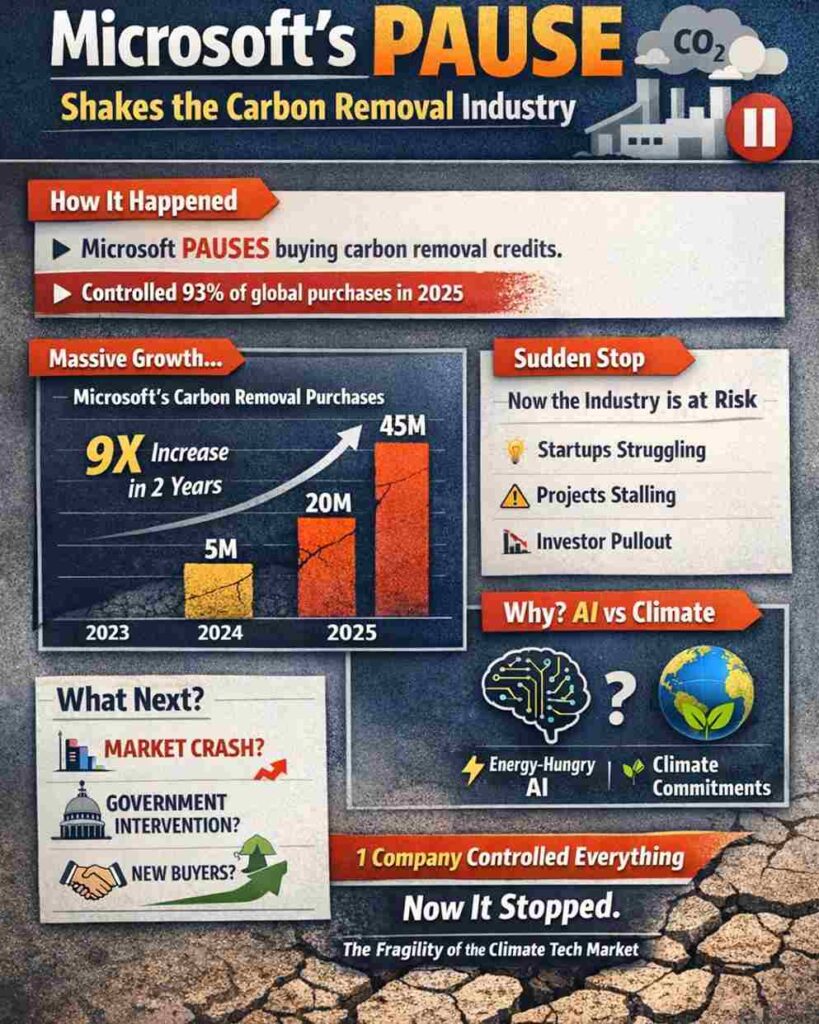
In 2025, Microsoft accounted for approximately 93% of all global carbon removal credit purchases, according to BloombergNEF and other industry trackers. The company has contracted around 45 million tonnes of carbon removal to date — dwarfing the next largest buyer, the Frontier coalition (led by Stripe and others), which sits at roughly 1.8 million tonnes.
This extreme concentration has turned Microsoft into the de facto anchor buyer for durable CDR technologies like biochar, BECCS (bioenergy with carbon capture and storage), direct air capture, and enhanced weathering. Without its demand, the total contracted volume in the market would collapse dramatically, highlighting a classic “single-buyer risk” in an industry still in its infancy.
Table of Contents
The Hidden Risk Nobody Noticed
This situation exposes a dangerous truth:
The carbon removal industry isn’t just young — it’s fragile.
When a single company controls demand, the entire ecosystem becomes vulnerable. Startups, research projects, and climate initiatives all depend on consistent funding to survive. Without Microsoft’s aggressive buying:
- Many early-stage companies could struggle to stay afloat
- Innovation could slow down
- Investor confidence may drop
This isn’t just a slowdown — it could trigger a chain reaction.
A Sudden Shift After Aggressive Expansion
The timing feels particularly abrupt. Just days before the pause was communicated to partners, Microsoft announced a 626,000-tonne deal with an Indigenous-led BECCS project in Saskatchewan, Canada. Earlier in 2026, the company signed a 1-million-tonne biochar agreement with Liferaft and kicked off the year with nearly 5 million tonnes in new commitments across multiple projects.
These moves aligned with Microsoft’s long-standing pledge to become carbon negative by 2030 — not just offsetting current emissions but removing more CO₂ than it emits — and to address all historical emissions since its 1975 founding by 2050.
However, the pause reflects growing real-world tensions. Microsoft’s massive investments in AI infrastructure have driven explosive growth in data center energy demand. While the company achieved 100% renewable electricity matching in 2025 through 40 GW+ of new clean energy procurements, the sheer scale of AI training and inference is pushing emissions higher and forcing tough prioritization between renewable energy matching, efficiency gains, and expensive carbon removal.
AI vs Climate: The Real Conflict
So why would Microsoft step back now? One possible answer lies in its rapid expansion into artificial intelligence. As AI demand explodes, data centers require massive amounts of energy. This creates a growing tension between:
- Climate commitments
- Energy-hungry AI infrastructure
Microsoft has pledged to become carbon negative by 2030. But at the same time, it is investing billions into AI systems that significantly increase its carbon footprint.
This raises a critical question:
Is Microsoft pausing climate spending to sustain its AI growth?
If true, it reflects a larger global dilemma — balancing technological progress with environmental responsibility.
A Microsoft spokesperson pushed back against claims of an indefinite halt, stating: “We continually review and assess our carbon removal portfolio along with market conditions for the optimal balance on our path to carbon negative.”
Existing contracts appear to remain intact, but new forward purchases are on hold while the company reassesses.
Why This Pause Threatens the Broader CDR Ecosystem
The carbon removal industry is still fragile. Most projects rely on long-term offtake agreements for financing, and Microsoft’s dominance meant many developers built business plans around its demand signal.
Industry observers note that this creates “concentration risk” — a sudden pullback from the biggest player leaves a vacuum that’s hard to fill quickly. Other corporate buyers (including Frontier, Amazon, Google, and Meta) are stepping up, but their volumes remain a fraction of Microsoft’s.
On the policy side, the picture is mixed under the current U.S. administration. The Trump administration has redirected or declined to spend certain previously authorized funds for carbon removal, with some DOE resources reportedly shifted toward supporting aging coal plants. However, Congress provided a counterbalance in the 2026 federal spending package, allocating over $116 million for CDR research, development, demonstration, and a federal purchasing pilot program.
This federal support could help bridge the gap, but it may not fully offset a slowdown from the private sector’s leading buyer.
A Necessary Reality Check or Setback for Climate Goals?
Here’s added value and fresh angle: This pause isn’t necessarily a retreat from climate ambition — it could be a pragmatic recalibration.
A Wake-Up Call for Climate Tech
Microsoft’s move may not signal the end of carbon removal — but it does expose its biggest weakness.
An industry built on one buyer is not sustainable.
For climate technology to truly succeed, it needs:
- Diverse funding sources
- Strong government support
- Broader corporate participation
Otherwise, even the most promising solutions can collapse overnight.
AI is transforming every industry, but its energy appetite is unprecedented. Tech giants face a trilemma: scale AI responsibly, keep electricity affordable and reliable for customers and communities, and deliver on aggressive net-zero or carbon-negative timelines. Prioritizing cost-effective renewable energy procurement and efficiency improvements (Microsoft has targeted significant water-use reductions too) while pausing high-cost removal credits makes short-term financial sense, especially as CDR prices remain elevated for durable, high-quality tonnes.
That said, the move underscores a deeper truth about the CDR market: it cannot depend on one hero buyer forever. For the industry to reach the gigatonne scale scientists say is needed by mid-century (to complement aggressive emissions cuts), we need:
- Broader corporate adoption — more companies treating durable CDR as a core part of their decarbonization strategy, not just an optional ESG checkbox.
- Policy certainty and incentives — stable federal and state support, clearer accounting rules, and mechanisms to de-risk early projects.
- Cost reduction through innovation — as more projects scale, prices for engineered removals should fall, making them accessible beyond Big Tech budgets.
- Diversification — a healthy mix of nature-based (with strong safeguards) and durable engineered solutions.
Microsoft’s earlier flurry of deals in 2025–early 2026 helped prove that large-scale offtakes are possible and accelerated technology development. A temporary pause might force the market to mature faster by encouraging other buyers to step up and developers to focus on cost-competitiveness and deliverability.
What Happens Next?
The future of the carbon removal industry now depends on what happens next. There are three possible scenarios:
🟥 Worst Case: Market Collapse
If no major buyers step in, the industry could shrink rapidly, with projects shutting down and investments drying up.
🟨 Middle Ground: Government Intervention
Public funding and policy support could stabilize the market and reduce dependence on a single company.
🟩 Best Case: New Corporate Buyers
More companies may enter the space, creating a healthier and more balanced ecosystem.
The industry will be watching closely for any clarification on the pause’s duration or resumption triggers. If Microsoft resumes purchases after optimizing its portfolio, this could be viewed as a healthy “digestion” period rather than a reversal.
In the meantime, smaller buyers, governments, and innovative CDR startups have an opportunity — and a responsibility — to fill the demand gap. The ultimate test for carbon removal won’t be whether one company buys 90%+ of the market, but whether the technology becomes a reliable, scalable tool in humanity’s toolkit against climate change.
The AI boom and the climate imperative are colliding. How companies like Microsoft navigate that collision in 2026 and beyond will shape not just their own sustainability reports, but the future trajectory of an entire industry.
What do you think — is this pause a smart strategic reset or a worrying signal for CDR momentum? Share your views in the comments.
Recommended for you: