
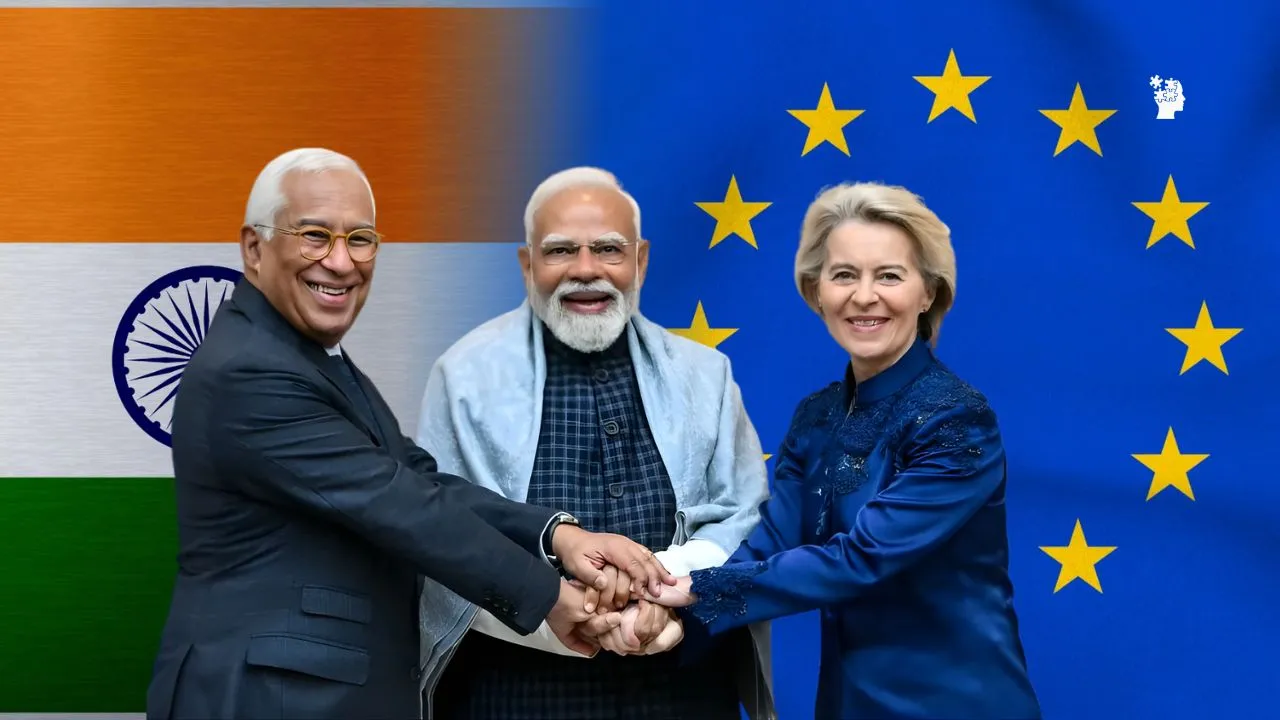
On January 27, 2026, India and the European Union concluded negotiations on what European Commission President Ursula von der Leyen called the “mother of all deals” — a landmark Free Trade Agreement (FTA) creating a combined market of nearly two billion people and roughly a quarter of global GDP. After nearly two decades of on-and-off talks, accelerated in recent months amid global trade disruptions, the pact promises to eliminate or reduce tariffs on over 96% of traded goods by value, potentially doubling EU exports to India by 2032 and opening massive opportunities for Indian sectors like textiles, leather, marine products, gems, jewelry, chemicals, and plastics.
Yet, the most striking reactions have come not from Brussels or New Delhi, but from Washington. The Trump administration’s top officials offered sharply contrasting takes, revealing internal tensions and inadvertently underscoring how “America First” policies may be reshaping global alliances — in ways that sideline the US.
Table of Contents
Washington’s Divided Response: Praise Meets Sharp Rebuke
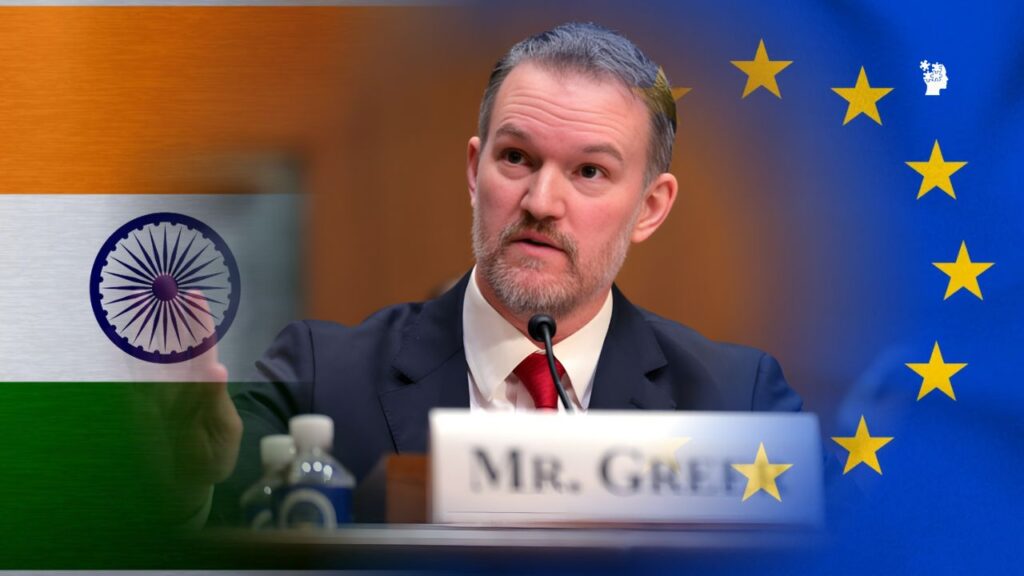
U.S. Trade Representative Jamieson Greer, in an interview with Fox Business, provided the administration’s first official assessment of the deal. He acknowledged India’s strategic gains, stating that after reviewing the details, “India comes out on top, frankly.” Greer highlighted greater market access for India into Europe, noting low-cost labor advantages and potential mobility provisions for Indian workers (echoing comments from von der Leyen on worker mobility). “They get more market access into Europe… India is going to have a heyday with this,” he said.
Greer framed the EU-India alignment as a direct consequence of President Trump’s trade strategy: by prioritizing domestic production and imposing “fees” (tariffs) for access to the U.S. market, other countries are seeking alternative outlets for their overproduction. “The EU is doubling down on globalization when we’re trying to fix some of the problems of globalization here in the U.S.,” he added. In essence, Greer’s comments admit — perhaps unintentionally — that aggressive U.S. tariffs have acted as a catalyst, pushing the EU and India closer together.
Contrast this with Treasury Secretary Scott Bessent‘s blistering critique on ABC News. Bessent accused European nations of indirectly “financing the war against themselves” by purchasing refined oil products from India — products derived from Russian crude. “We have put 25% tariffs on India for buying Russian oil. Guess what happened last week? The Europeans signed a trade deal with India,” he said. “The Russian oil goes into India, the refined products come out, and the Europeans buy the refined products.”
Bessent defended the U.S. approach, noting that tariffs (totaling up to 50% on Indian goods, including a penalty for Russian oil imports) have already reduced India’s reliance on discounted Russian crude. He argued the U.S. has made “much bigger sacrifices” than Europe in decoupling from Russian energy and pushing for an end to the Russia-Ukraine conflict under Trump’s leadership.
These dueling perspectives expose a core tension: while one senior official sees India’s FTA as a pragmatic response to U.S. pressure (and even a win for New Delhi), another views it as undermining Western security goals by perpetuating loopholes in energy sanctions.
The Deal Basics: Asymmetrical Wins in a Massive Market
The FTA’s terms reveal why Greer leaned toward calling India the bigger beneficiary in key areas:
- India’s gains: Duty-free or reduced access for 99% of exports to the EU, covering high-value sectors like textiles, apparel, marine products, leather, footwear, chemicals, plastics, sports goods, toys, gems, and jewelry (previously facing tariffs up to 17%).
- EU’s gains: Elimination or reduction on 96.6% of exports to India, including machinery, electrical equipment, automobiles (tariffs phased down to 10% over years, with quotas), wines, spirits, olive oil, confectionery, and agri-products — though sensitive Indian sectors like dairy, poultry, rice, and sugar remain protected.
- Broader elements: Rules of origin aligned with recent EU deals, self-certification for businesses, regulatory cooperation, and privileged access in services (e.g., financial and maritime).
The combined effect could save European exporters billions in duties annually while boosting India’s manufacturing and export competitiveness. Implementation is expected in 2026 after legal vetting and ratification.
The Bigger Picture: Trump’s “America First” as Global Trade Catalyst
This FTA arrives amid stalled U.S.-India trade talks, where 50% tariffs persist (25% reciprocal + 25% linked to Russian oil). Greer noted India has “made a lot of progress” on reducing Russian purchases due to proximity discounts waning under pressure, but “they still have a way to go.”
The irony is stark: Trump’s tariffs, intended to protect U.S. interests and force concessions, appear to accelerate multipolar realignments. India gains leverage with Europe as a hedge, while the EU diversifies away from U.S. market risks. Bessent’s oil critique highlights perceived hypocrisy in Europe’s stance on Ukraine, yet it also underscores how interconnected global supply chains defy simple decoupling.
Looking Ahead: Pressure for U.S. Concessions?
Could this deal force Washington’s hand? With India now locked into a massive alternative market, New Delhi may negotiate from strength in future U.S. talks — perhaps pushing for tariff relief as Russian oil imports continue declining. For the Trump team, the EU-India pact serves as both validation (tariffs drive diversification) and warning (they risk isolating the U.S. in a fragmenting world).
In a multipolar era, this “mother of all deals” isn’t just about tariffs — it’s a blueprint for how nations adapt when one power plays hardball. Whether it boomerangs fully on U.S. policy remains to be seen, but the administration’s mixed signals suggest the trade war playbook is producing unexpected plot twists.