
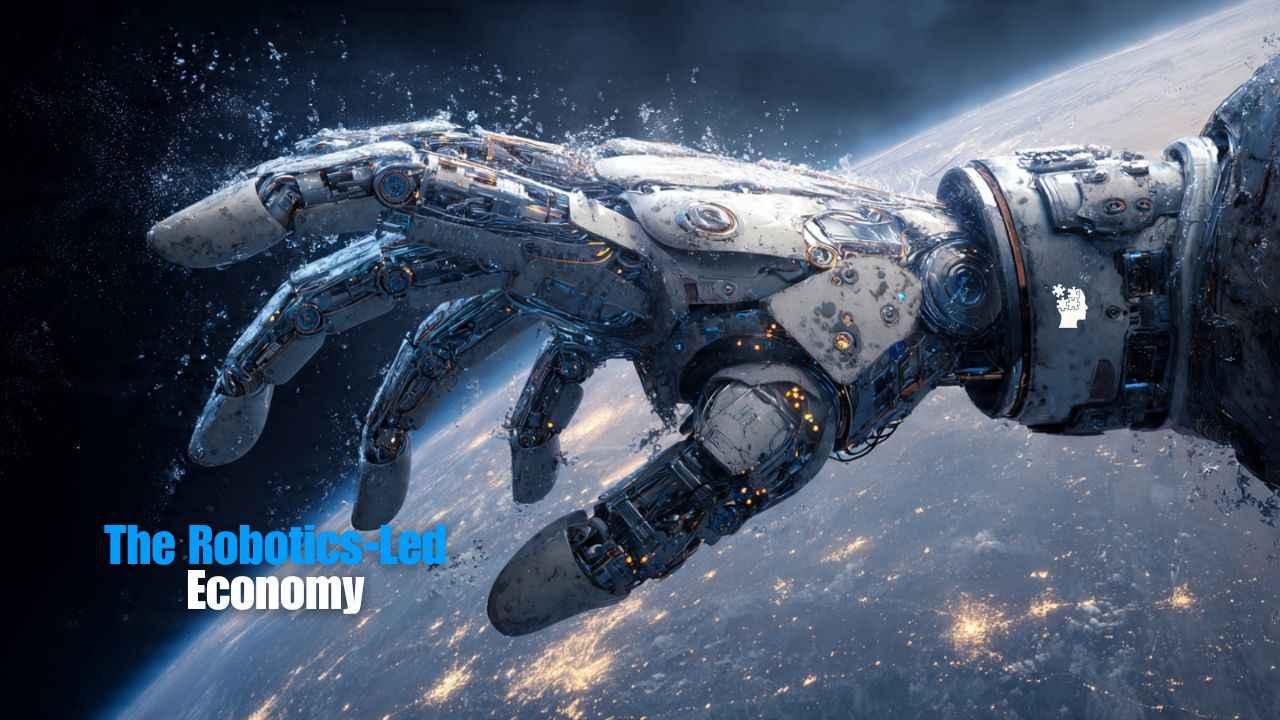
A once-in-a-century economic transition is underway, reshaping how value is created, scaled, and distributed. What’s unfolding is not a productivity boost—but a fundamental rewrite of the rules of growth itself.
Table of Contents
1. The Paradigm Shift: From Labor Constraints to the Deflationary Force of Intelligence
The 2026 Davos dialogue signals the terminal stage of the labor-constrained era. We are currently witnessing a collapse of the traditional deployment-to-market lifecycle, transitioning from a global economy defined by scarcity to one driven by an unprecedented expansion of robotic productivity. This is not merely an industrial upgrade; it is the most significant macroeconomic transformation in human history. We are pivoting from “narrow” growth—restricted by the finite bandwidth of human cognition and physical labor—to a “broad” abundance where the cost of intelligence and utility plummets toward zero.
This shift is underpinned by a fundamental rewrite of the economic output equation:
Economic Output = Average Productivity per Robot × Number of Robots
By decoupling GDP from human demographics, this formula renders traditional labor-based constraints obsolete. This represents a Deflationary Force of Intelligence; as AI companies aggressively scale to capture global market share, the marginal cost of labor-intensive goods and services will approach the cost of electricity. We are no longer focused on the marginal alleviation of poverty, but on the engineering of universal abundance. As we move from theoretical productivity to physical deployment, the hardware catalyst—humanoid robotics—becomes the primary engine of capital allocation.
2. The Hardware Catalyst: Scaling Billions of Humanoid Units

The transition to a robot-led economy is predicated on the rapid scaling of humanoid platforms like Tesla’s Optimus. The strategic mandate is the migration of these units from controlled industrial environments to the public consumer market. This requires a level of reliability and safety that mirrors the “Full Self-Driving” (FSD) evolution.
The Intelligence and Deployment Timeline
The roadmap for intelligence and hardware integration is accelerating at a pace that demands immediate institutional attention:
• EOY 2026: AI is projected to be smarter than any individual human. In the industrial sector, humanoid units will transition from simple repetitive tasks to complex, multi-stage industrial operations.
• 2027: Humanoid robots reach public commercial availability. These units will possess high-functionality ranges, capable of autonomous task execution in unconstrained human environments.
• 2030–2031: AI is projected to be smarter than all of humanity collectively. By this point, the number of humanoid robots will likely exceed the human population, saturating all human needs for goods and services.
Demographic Mitigation and Service Alpha
Humanoid robotics offer a high-conviction solution to the “demographic time bomb.” By solving the “young people vs. old people” imbalance through low-cost, high-reliability elderly care and childcare, robotics will decouple societal well-being from birth rates.
The FSD model serves as our primary data precursor. With supervised FSD approvals expected in Europe and China as early as next month, we are seeing the “no-brainer” catalyst for mass adoption. When insurance carriers offer half-price premiums for AI-driven systems, the cost of risk is halved, creating a massive incentive for rapid transition. However, this hardware scale reveals a critical infrastructure bottleneck: electrical power.
3. Infrastructure Bedrock: Solving the Energy and Compute Bottlenecks
While AI compute is scaling exponentially, global power generation is stagnant at 3% to 4% annual growth. This discrepancy identifies electrical power as the fundamental limiting factor for civilization-scale AI. Solving this is a matter of physical solvability, making the current lack of progress a clear indicator of policy failure and a Regulatory Arbitrage Opportunity for nations that lean into solar at scale.
| Metric | Strategic Data Point |
|---|---|
| Primary Bottleneck | Electrical Power (Massive shortfall vs. AI compute demand) |
| Physical Solvability | 100 miles x 100 miles of solar powers the entire United States |
| China Energy Dominance | 1,500 GW solar capacity; 1,000+ GW/year deployment; 100 GW nuclear under construction |
| Tesla/SpaceX Target | 100 GW/year of US-manufactured solar within 3 years |
The “100 miles x 100 miles” proof-of-concept exposes that energy scarcity is a choice, not a geographic reality. To unlock the hundreds of terawatts required for the coming era, we must bypass current tariff barriers that artificially inflate deployment costs in the West. While terrestrial solar is the immediate play, the ultimate “Alpha” for compute and energy lies in the orbital plane.
4. Orbital Arbitrage: Space as the Ultimate Compute and Power Frontier
SpaceX’s Starship is the “profound invention” that rewrites orbital economics through full reusability. By treating rockets like aircraft—requiring only refueling rather than replacement—Starship achieves a 100x cost reduction. This brings the cost of access to space below $100 per pound, making orbital freight cheaper than terrestrial air freight.
The Space-Based AI Data Center
Relocating AI data centers to orbit is a “no-brainer” strategic move that will begin within the next 2 to 3 years due to three physical advantages:
1. 5x Solar Efficiency: Space-based panels avoid atmospheric attenuation (30% power gain) and the day/night/seasonal cycles, providing constant 24/7 energy.
2. The Radiator Cooling Solution: Terrestrial data centers struggle with heat rejection. In the 3-degree Kelvin vacuum of space, AI clusters can use massive radiators facing away from the sun to achieve near-perfect heat dissipation.
3. Environmental Decoupling: Space offers unlimited scale, allowing civilization to expand its intelligence footprint without consuming Earth’s land or impacting its sensitive biosphere.
5. Investment Conclusion: The Compounding Returns of Sustainable Growth
The transition from “science fiction” to “science fact” is best illustrated by the divergence in compounding returns. While institutional stalwarts like BlackRock have delivered 21% since their IPO, Tesla’s 43% compounded return reflects the massive alpha inherent in frontier engineering. National and pension funds must shift toward this growth-oriented “Frontier Alpha” to ensure solvency in an era where traditional labor-capital ratios are becoming irrelevant.
The Long-Tail Alpha: Biological Engineering
As we master the engineering of robotics, we also unlock the engineering of biology. The “synchronizing clock” of aging across 35 trillion cells is a solvable engineering problem. While robotics solves the labor crisis, biological reversal represents the ultimate long-tail alpha, potentially ending the ossification of society and extending the vibrancy of human consciousness.
The Mandate for Optimism
In a landscape of accelerating intelligence, the only viable strategic stance is one of extreme optimism. To be “optimistic and wrong” is to still drive the execution that eventually yields breakthroughs; to be “pessimistic and right” is to preside over stagnation.
Ultimately, the drive toward a multiplanetary, robot-augmented civilization is the ultimate risk-mitigation strategy for the “light of consciousness.” We are entering an era of amazing abundance where wealth is no longer a zero-sum game, but an engineering inevitability.
The future belongs to those who allocate capital toward the expansion of consciousness and the decoupling of productivity from the constraints of the Earth.
You can Also watch the video of 2026 dialogue at the World Economic Forum between Elon Musk and the CEO of BlackRock regarding the future of global civilization. Musk outlines his vision for sustainable abundance, predicting that humanoid robotics etc. , here
Recommended for you