
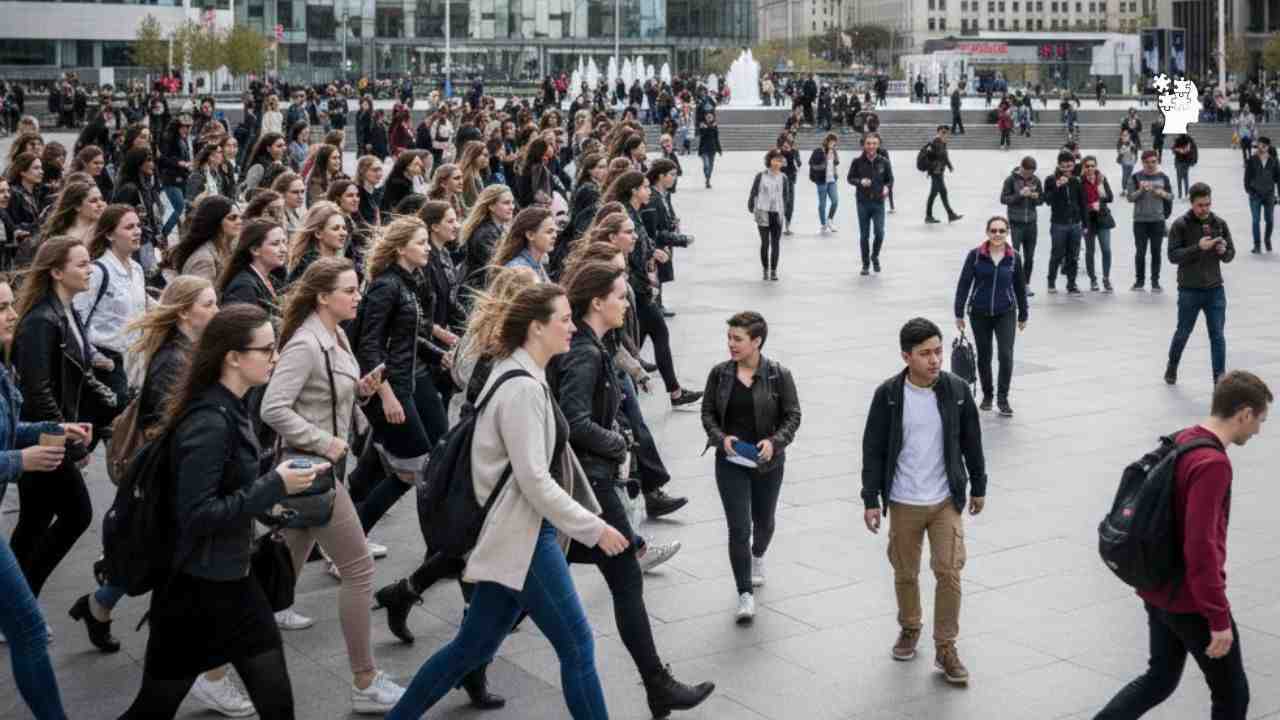
A striking and accelerating political gender divide has emerged among people under 30 in Western democracies – and the numbers are now too large to dismiss as a passing cultural moment.
According to consistent tracking by the Financial Times and several major polling organisations (most recently the 2024–2025 aggregated youth surveys), the ideological gap between young men and young women has roughly doubled in the past decade in the United States, United Kingdom, Canada, Australia, Germany, and several Nordic countries.
The pattern is remarkably consistent:
- Young women (18–29) have moved substantially further left since roughly 2014–2016
- Young men in the same age bracket have either remained relatively stable or moved only modestly left – in some countries even drifting slightly right compared with their position a decade ago
The result: in many Western nations the ideological distance between 18–29-year-old men and women is now larger than the distance between any other comparable age or demographic split.
What the Data Actually Shows (2024–2025 snapshot)
| Country/Region | Young Women identifying as liberal/left | Young Men identifying as liberal/left | Approximate ideological gap |
| United States | 58–62% | 38–42% | ~20–24 points |
| United Kingdom | 54–59% | 36–41% | ~18–23 points |
| Canada | 61% | 41% | ~20 points |
| Germany | 52–56% | 37–41% | ~15–19 points |
| Australia | 57% | 39% | ~18 points |
(Sources: aggregated youth polls 2024–early 2025 – Financial Times youth tracker, YouGov, Ipsos, Cooperative Election Study, European Social Survey youth subsample)
Table of Contents
Three Main Explanatory Lenses – None of Which Fully Explains It Alone
1. Biology & Psychology (the most politically radioactive explanation)
Decades of research in evolutionary psychology and neuroscience have documented average sex differences in traits that plausibly influence political orientation:
- Women score higher, on average, on measures of empathy, harm avoidance, and disgust sensitivity toward social out-groups (Baron-Cohen, Haidt, Graham et al.)
- Men score higher, on average, on systemising, pattern-detection, and tolerance for competition & risk
These differences appear cross-culturally and manifest very early (observable in toddlers and even in some non-human primates).
Many researchers argue that modern hyper-moralised political discourse – especially around identity, social justice, climate anxiety, and interpersonal harm – activates these psychological predispositions more strongly in the average young woman than the average young man.
2. Structural Incentives & the Expanding Role of the State
Since the mid-1990s, Western societies have dramatically expanded safety-net programs disproportionately utilised by women, single mothers, and female-headed households:
- No-fault divorce laws → dramatically increased female-initiated divorces
- Child-support & alimony enforcement → turned the state into the most reliable “provider” for many women post-separation
- Generous maternity leave, subsidised childcare, housing assistance, education grants, healthcare access → all create a stronger perceived alignment of interests between women and an activist state
Meanwhile, young men who still comprise the overwhelming majority of workplace fatalities, dangerous manual labour, military service, and homelessness, have not experienced a comparable expansion of state-provided security nets tailored specifically to their circumstances.
When the state increasingly acts as “husband/provider substitute” for a growing share of women, the political incentives shift accordingly.
3. Cultural & Media Ecosystem Effects
The past decade has seen an unprecedented saturation of progressive moral language across the platforms and institutions that most strongly shape the worldview of adolescent girls and young women:
- TikTok / Instagram Reels / YouTube Shorts algorithms
- secondary & tertiary education humanities & social sciences faculties
- mainstream entertainment & streaming content
- influencer culture
Young men, by contrast, have migrated in large numbers toward very different digital ecosystems (Twitch, certain Reddit communities, YouTube long-form commentary, certain podcast networks, gaming culture) that tend to be far more sceptical of institutional moral narratives.
The Fertility & Civilisational Warning Light
Perhaps the most sobering implication is demographic.
Countries where the ideological gender gap among young adults is largest are also experiencing:
- the steepest collapses in birth rates
- the latest average age of first birth
- the highest rates of childlessness among women 35+
Peer-reviewed longitudinal studies (Journal of Marriage and Family, Demography, European Journal of Population) have repeatedly shown that women who remain strongly left-leaning through their 20s and early 30s are significantly more likely to delay or forgo motherhood – even after controlling for education and income.
When large cohorts of women move left while large cohorts of men do not, the pool of ideologically compatible partners shrinks – especially at the higher-education, middle-class level where partnering and fertility decisions are most delayed.
Bottom Line
We are witnessing something historically unusual: a rapid, substantial, and cross-nationally consistent polarisation by sex among the people who will shape the next 40–50 years of politics, culture, family formation, and economic productivity.
Whether one attributes the phenomenon primarily to evolved psychological differences, changing incentive structures created by the welfare-regulatory state, or divergent media diets – or some combination of all three – the trend is real, it is large, and it is continuing to widen.
The open question now is whether democratic societies can (or even should) attempt to respond to this growing divide – or whether we simply accept that the sexes are increasingly voting, believing, partnering, and reproducing from two increasingly separate ideological planets.
The early signs suggest that ignoring the phenomenon will not make it disappear.