
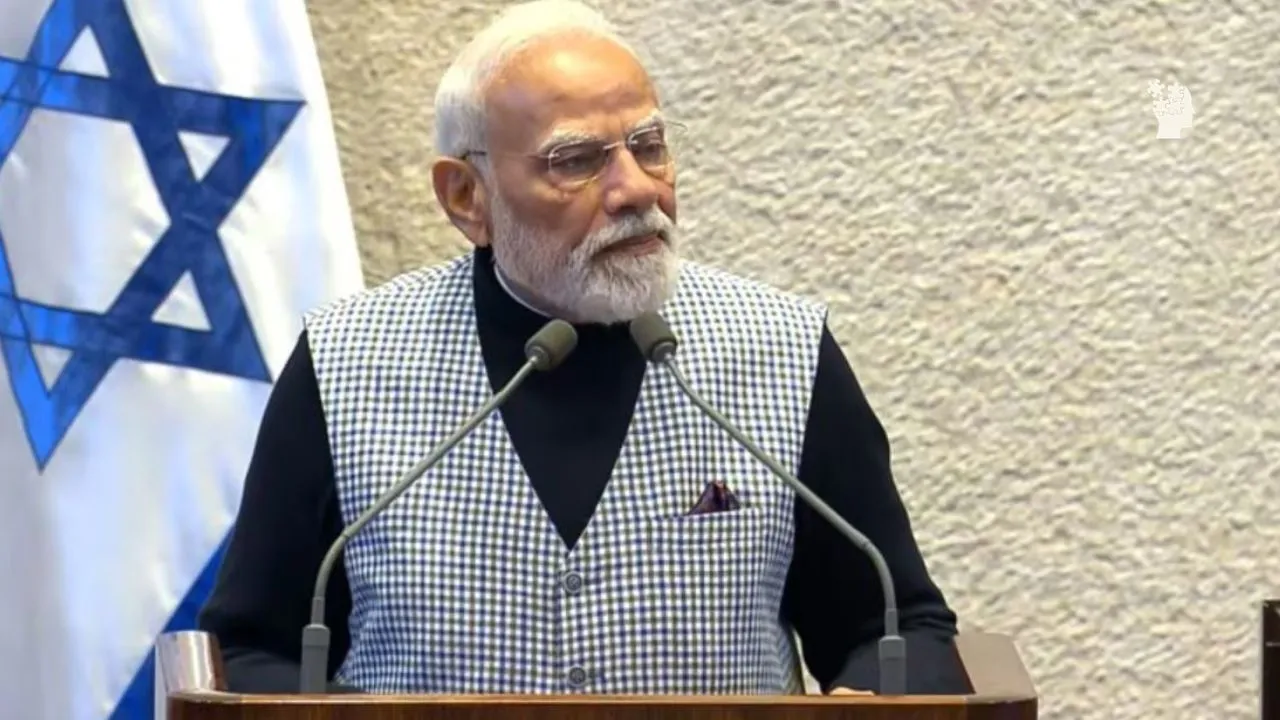
In the hallowed halls of the Knesset, where the air usually hums with the sharp intensity of Israeli parliamentary debate, a rare visual poetry recently unfolded. The building was bathed in saffron, white, and green—a “wonderful gesture” of hospitality that Prime Minister Narendra Modi noted as he became the first Indian premier to address this august body. Standing before the representatives of the Israeli people, Modi did not speak merely as a head of government; he spoke as the voice of one civilizational state greeting another. Representing 1.4 billion souls, his address was an exercise in the longue durée of history, weaving a narrative that transcends modern realpolitik to reveal a shared geopolitical destiny.
Table of Contents
1. A Date with Destiny: The September 17th Connection
In the world of global affairs, we often look for strategic alignments in white papers and treaties. However, Modi revealed a “counter-intuitive” personal alignment that suggests the India-Israel bond was written in the stars long before it was signed on parchment. He noted that his own entry into the world was synchronized with the formal birth of this bilateral relationship.
“I was born on the same day that India formally recognized Israel—September 17, 1950.”
This personal synchronicity serves as a powerful symbolic bridge. For a Cultural Historian, such a detail elevates the relationship from a bureaucratic arrangement to a “date with destiny,” suggesting that the Prime Minister’s own life journey is inextricably linked to the trajectory of India-Israel relations.
2. Hudu and the Talmud: The 2,000-Year-Old Paper Trail
While contemporary analysts often narrow their focus to 21st-century defense contracts, Modi reminded the Knesset that the “paper trail” of this partnership spans two millennia. By citing ancient texts, he moved the narrative beyond “defense and security” into a realm of deep-rooted civilizational respect.
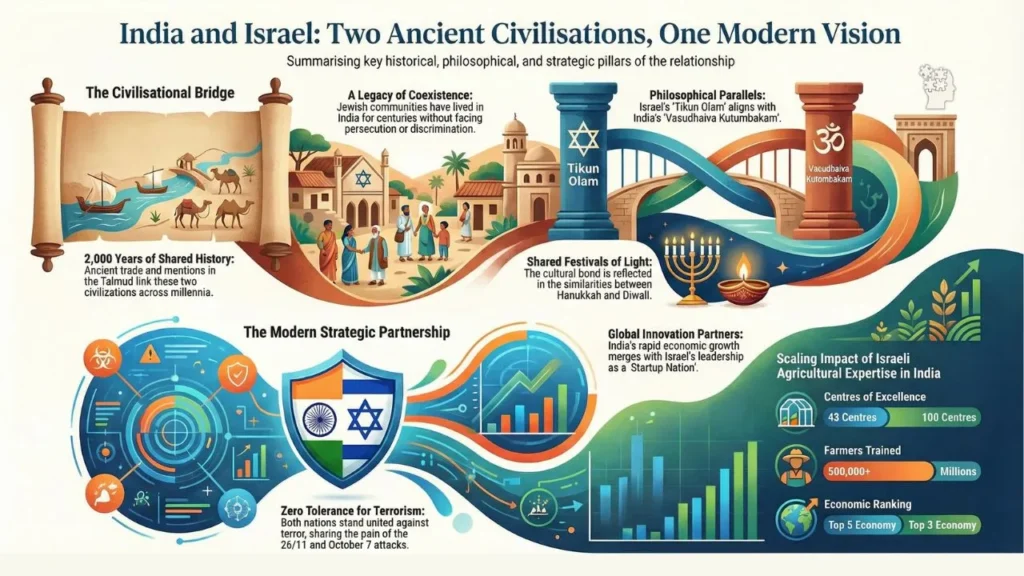
He specifically referenced the Book of Esther, which identifies India as “Hudu,” and noted that the Talmud records trade with India in ancient times. These are not merely dusty citations; they are proof that Jewish merchants once navigated the sea routes between the Mediterranean and the Indian Ocean, seeking—and finding—opportunity and dignity. This historical depth transforms the current partnership from a modern convenience into the restoration of an ancient, natural bond.
3. A Record of Zero Persecution: The Motherland and the Fatherland
A cornerstone of the address—and a point of immense pride for any cultural historian—was the unique status of India as a sanctuary. For millennia, Jewish communities—the Bene Israel of Maharashtra, the Cochini Jews of Keralam, the Baghdadi Jews of Kolkata and Mumbai, and the Bene Manasi of the Northeast—have been an integral part of the Indian fabric.
The Prime Minister highlighted figures like David Sassoon, who built institutions that still serve Indian society, and the legendary Lt. Gen. J.F.R. Jacob, the 1971 war hero whose military genius remains a point of pride for both nations. He also shared the charming story of the “Best School” in Gujarat, founded by Mr. and Mrs. Best, a Bene Israeli family, and the noble legacy of the Maharaja of Nawanagar (Jam Sahib), who provided refuge to Polish Jewish children during the Holocaust.
Regarding the Indian-origin Jewish community now living in Israel, Modi offered a profound synthesis of identity:
“They hold firmly that Israel is their fatherland and India their motherland. We are proud of them.”
This duality of belonging is underpinned by a historical record that Modi described with unwavering gravity:
“Jewish communities have lived in India without fear of persecution or discrimination. They have preserved their faith and participated fully in society. That record is a source of pride for us.”
4. Written in Blood: From the Hero of Haifa to October 7th
The relationship is also cemented by a “blood bond” that many modern observers may have forgotten. Modi invoked the memory of over 4,000 Indian soldiers who laid down their lives in the region during the First World War. The legendary cavalry charge at Haifa in September 1918, led by Major Thakur Dalpat Singh—the “Hero of Haifa”—remains a sacred chapter in their shared military history.
However, as a Global Affairs Columnist, one must recognize that this historical sacrifice is not isolated from the present. Modi explicitly linked this legacy of valor to the modern scourge of terrorism. He offered his deepest condolences for the lives shattered in the “barbaric terrorist attack by Hamas on October 7,” drawing a direct line to India’s own experience with the 26/11 Mumbai attacks. By asserting a policy of “zero tolerance for terrorism” with “no double standards,” Modi synthesized the blood shed at Haifa with the current security imperatives of both nations, framing the alliance as a vital bulwark against global instability.
5. Philosophical Twins: Tikkun Olam meets Vasudhaiva Kutumbakam
Beyond bullets and business, the address reached a philosophical crescendo. Modi illustrated how the two nations are “philosophical twins,” both believing that faith must be expressed through conduct and duty.
He drew a brilliant parallel between the Hebrew principle of Tikkun Olam (healing the world) and the Indian concept of Vasudhaiva Kutumbakam (the world is one family). Likewise, he compared the guiding practice of Halakha with the Indian concept of Dharma—the moral order that shapes right action. These are not just words; they are the ethical engines of two societies that prioritize action over rhetoric.
The temporal link between these two cultures is perhaps best seen in their shared calendar of light and joy:
“There is an enduring similarity in our festivals as well… You celebrate Hanukkah with the warm glow of candles around the same time we celebrate Diwali, the festival of lights… soon India will celebrate the festival of Holi… and around the same time Israel will also celebrate Purim.”
Conclusion: From Ancient Roots to an AI Future
The transition from the ancient “Hudu” to the modern “AI” was presented not as a leap, but as a continuous thread of human ingenuity. Modi’s vision for the future is as expansive as the history he cited. From the “agricultural miracle” of “per drop, more crop” to the high-tech synergies in quantum computing and semiconductors, the “Startup Nation” and the world’s fastest-growing major economy are now structurally intertwined.
This is evidenced by the robust new frameworks of the I2U2 (India, Israel, UAE, and the US) and the ambitious India-Middle East-Europe Economic Corridor (IMEC), which promises to redefine global trade. As these two “ancient souls” navigate an increasingly “uncertain world,” they do so not just as partners, but as kin.
In the end, the Prime Minister’s address was more than a speech; it was a reaffirmation of a shared spirit. As he closed with the linguistic bridge of “Am Yisrael Chai” and “Jai Hind,” the question left for the world was clear: In an era of shifting shadows, how much stronger will the global order become when guided by the combined light of these two ancient, yet perpetually modern, civilizations?
Recommended for you: