
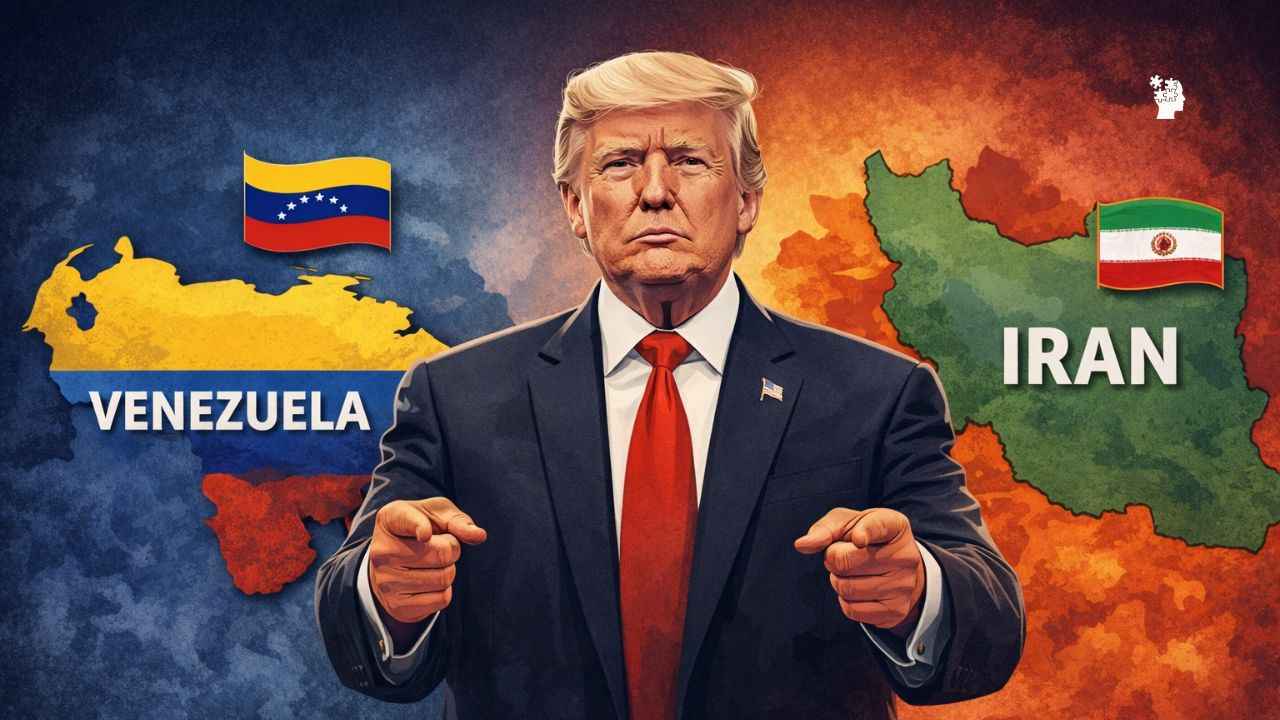
President Donald Trump has outlined a surprisingly pragmatic vision for Iran’s future following the death of Supreme Leader Ayatollah Ali Khamenei in joint U.S.-Israeli strikes that began on February 28, 2026. In a March 1 phone interview with The New York Times, Trump repeatedly praised the “Venezuela model” as “the perfect, the perfect scenario” for managing the political transition in Tehran, even as the ongoing military campaign—known as Operation Epic Fury—enters its early days.
Wisdom Imbibe Insight:
Regime change is easy to declare, hard to design. The “Venezuela model” reflects a modern strategy: remove the head, preserve the machine. But systems built on ideology rarely pivot through surgical strikes alone. Stability without structural reform is illusion. In geopolitics, leadership swaps are tactical — lasting transformation is systemic.
The comments reflect Trump’s preference for a targeted leadership decapitation rather than full-scale regime collapse, but they also highlight deep uncertainties about Iran’s path forward amid active warfare and internal power struggles.
Table of Contents
The Venezuela Blueprint: What Trump Wants to Replicate
Trump’s reference point is the U.S. operation in Venezuela earlier in 2026, where a Delta Force team captured President Nicolás Maduro in a precise strike. According to Trump, the key to that “success” was minimal disruption: “Everybody’s kept their job except for two people.” Maduro’s removal left much of the existing government structure intact under interim leadership (Vice President Delcy Rodríguez assumed a transitional role), with the new arrangement proving more cooperative—or at least pragmatic—with U.S. interests.
Applied to Iran, this model would involve eliminating top figures like Khamenei (and potentially others in the military and clerical elite) while preserving bureaucratic and institutional continuity. The goal: a leadership change that neutralizes threats—particularly Iran’s nuclear ambitions and support for proxy groups—without requiring a messy, prolonged occupation or full societal upheaval.
Trump emphasized this approach in the interview, suggesting it could enable quicker stabilization and even sanctions relief if a successor government demonstrates “pragmatism.” He avoided committing to backing opposition forces seeking outright overthrow, stating, “I’m not making any commitments one way or the other. It’s too early.”
Three “Very Good Choices” — But No Names Yet
When pressed on potential post-Khamenei leaders, Trump claimed to have “three very good choices” in mind but declined to identify them. “I won’t be revealing them now. Let’s get the job done first,” he said. This coyness comes against a backdrop of heavy losses among Iran’s senior ranks: The strikes reportedly eliminated much of the military command, Revolutionary Guard leadership, and other high-profile figures, complicating any immediate succession.
Iran has responded by forming a three-member temporary leadership council (including the president, judiciary chief, and a Guardian Council jurist) to handle supreme leader duties until a permanent replacement is selected. Figures like security official Ali Larijani—who has denied pursuing renewed U.S. talks despite reports—have emerged in public statements, but Trump sidestepped direct comment on him or the council.
Potential internal contenders for supreme leader roles include hard-liners such as Mojtaba Khamenei (the late leader’s son), Ayatollah Ali Reza Arafi, and others tied to the clerical and IRGC establishments. Reformist or moderate names like Hassan Khomeini (grandson of the Islamic Republic’s founder) have also been floated in speculation, though the power vacuum favors entrenched regime elements.
Contradictions and Warnings from Advisers
Trump’s interview revealed competing visions. At times, he predicted Iran’s elite forces would “surrender to the people” or urged ordinary Iranians to seize the moment for change—suggesting popular uprising or regime collapse. At others, he doubled down on the Venezuela-style limited intervention, where core institutions endure under new, more compliant management.
Advisers have cautioned that replicating Venezuela in Iran is “virtually impossible” due to fundamental differences: Iran’s population is roughly three times larger (over 85 million vs. Venezuela’s ~28 million), its clerical-military establishment has decades of experience suppressing dissent since the 1979 revolution, and the country maintains a far more sophisticated military and nuclear infrastructure. A leadership-only swap risks leaving anti-Western hard-liners in control, potentially without meaningful policy shifts.
Analysts describe a “high degree of uncertainty” in the administration’s thinking. The White House appears to lack a fully fleshed-out post-conflict plan, with Trump estimating the campaign could last four to five weeks while sustaining intense operations.
Broader Implications Amid Escalating Conflict
Trump’s embrace of the Venezuela model signals a desire for a swift, low-commitment exit from escalation—avoiding the quagmires of past U.S. interventions in Iraq or Afghanistan. Yet with Iranian retaliatory missile and drone strikes continuing across the region, U.S. casualties mounting (at least three service members killed), and no clear de-escalation in sight, the path to any transition remains fraught.
Whether Trump’s preferred blueprint takes hold—or gives way to deeper regime change, prolonged war, or internal factional fighting—will depend on battlefield developments, Iranian responses, and whether pragmatic voices emerge in Tehran willing to engage Washington. For now, the president is betting that targeted strikes and a light-touch transition can deliver strategic gains without endless entanglement.
Recommended Article: