

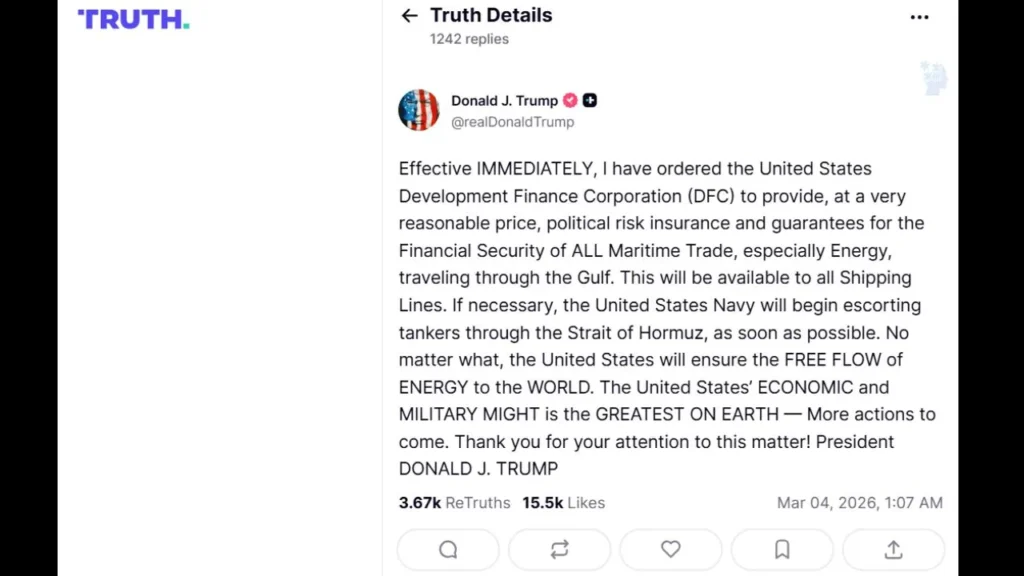
President Donald Trump announced on March 3, 2026, via Truth Social that he has directed the United States Development Finance Corporation (DFC) to immediately offer political risk insurance and financial guarantees for all maritime trade—especially energy shipments—transiting the Persian Gulf and Strait of Hormuz. He described the coverage as available “at a very reasonable price” to all shipping lines, with the explicit goal of ensuring the “FREE FLOW of ENERGY to the WORLD” amid the escalating U.S.-Israeli conflict with Iran (Operation Epic Fury, now in its sixth day).
Wisdom Imbibe Insight:
When 20% of the world’s oil flows through one narrow strait, geography becomes power. Insurance and naval escorts are not just logistics — they are strategic signaling. In modern geopolitics, controlling chokepoints means controlling inflation, markets, and leverage. The Strait of Hormuz is no longer just water. It is economic warfare’s frontline.
Trump added that, “if necessary,” the U.S. Navy will begin escorting tankers through the Strait of Hormuz “as soon as possible,” underscoring U.S. resolve: “The United States’ ECONOMIC and MILITARY MIGHT is the GREATEST ON EARTH — More actions to come.”
Context: Strait of Hormuz Disruptions Amid Iran Conflict
The announcement directly addresses the severe shipping crisis triggered by Iran’s retaliatory actions following U.S. and Israeli strikes that began February 28. Iranian forces have targeted vessels, damaged tankers, and created a de facto halt in traffic through the Strait—a narrow chokepoint handling about 20% of global seaborne oil (roughly 18-20 million barrels per day) and significant LNG flows from Qatar and others.
- Hundreds of ships are stranded, rerouted, or idled due to heightened war risks.
- Insurance premiums for Gulf transits have skyrocketed (some reports cite all-time highs for supertankers), with many commercial insurers withdrawing war-risk coverage entirely.
- Iranian drone and missile attacks have already damaged energy infrastructure and vessels, sending oil prices surging (Brent crude up 15-17% since late February, briefly nearing $85+ per barrel).
These disruptions risk cascading shortages, higher global fuel costs, and inflationary pressure worldwide. Trump’s measures aim to de-risk shipping, encourage vessels to resume passage, and prevent a full-blown energy crisis.
Details of the DFC Measures
The DFC—a U.S. government development finance institution typically focused on emerging markets and infrastructure—will now backstop commercial shipping against political risks like expropriation, war damage, or government interference in the conflict zone. This federal guarantee acts as a de facto insurance backstop, reducing costs for shippers who might otherwise avoid the route.
- Coverage is open to all lines (not just U.S.-flagged), emphasizing broad access.
- Trump highlighted “very reasonable” pricing to make it attractive versus private market rates, which have become prohibitive.
The potential Navy escorts echo historical precedents (e.g., Operation Earnest Will in the 1980s during the Iran-Iraq Tanker War), where U.S. warships protected reflagged Kuwaiti tankers. Implementation would involve naval assets already in the region providing convoy protection, minesweeping if needed, and deterrence against Iranian threats.
Market and Strategic Implications
- Oil prices reacted with partial easing in some sessions on hopes that insured/escorted traffic could restart flows, though volatility remains high pending details on rollout and Iranian responses.
- Analysts view this as a calibrated escalation deterrent: It signals U.S. commitment to global energy security without immediately committing to broader strikes on Iranian assets.
- Critics may see it as subsidizing commercial risks in a war zone, but supporters argue it prevents economic fallout from prolonged closure.
- Broader context includes Trump’s four stated objectives in the Iran campaign (destroy missile/navy capabilities, prevent nuclear breakout, cut proxy arms), with energy flow central to avoiding global recession risks.
This move reflects the administration’s focus on using economic and military tools to maintain open sea lanes during the conflict. Implementation details—exact pricing, eligibility, and escort timelines—remain forthcoming, but the directive has already drawn widespread coverage as a direct response to Iran’s attempts to weaponize the Strait. With the war showing no quick end, these steps aim to stabilize markets and project U.S. dominance in securing critical global chokepoints.
Recommended for you: