
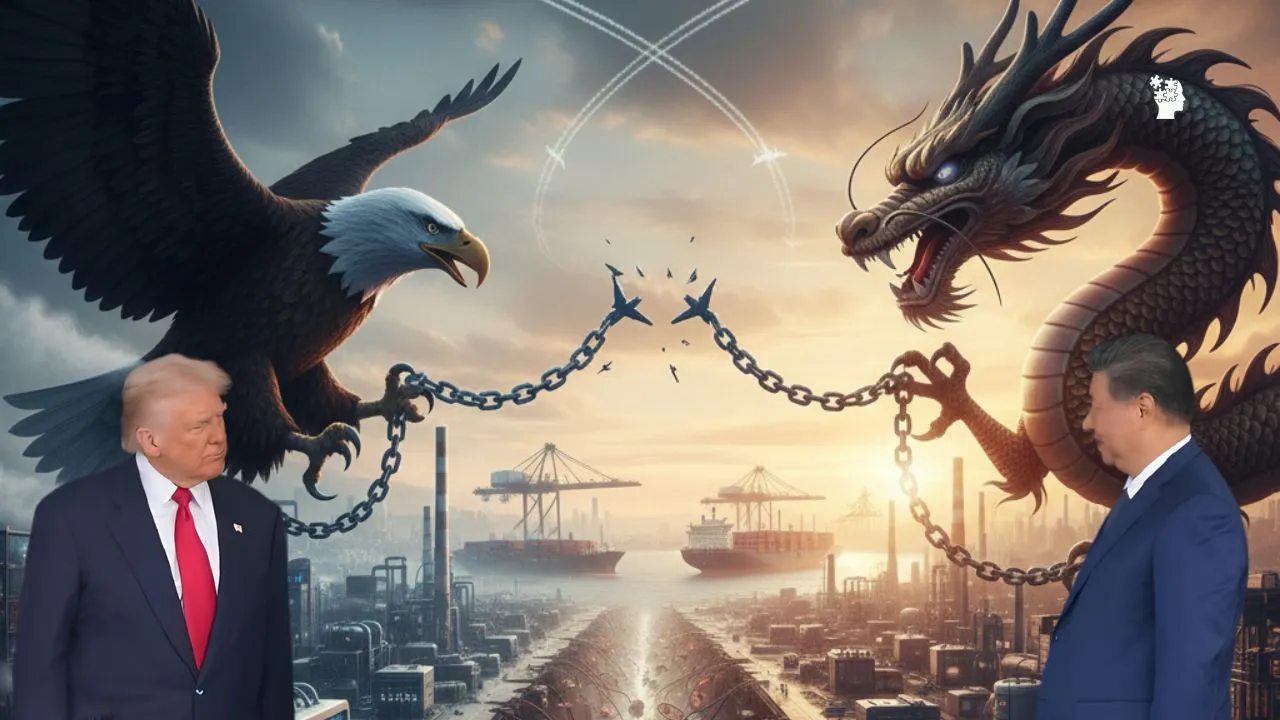
Why are the world’s two largest economies, the United States and China, undergoing a “messy divorce” across critical sectors? The answer lies in a complex interplay of national security concerns, economic self-sufficiency drives, and a fundamental re-evaluation of globalization.
For decades, the economic relationship between the US and China was characterized by deep integration, with China serving as the “world’s factory” and a massive market for American goods. However, recent years have seen a dramatic and systematic untangling of these ties, particularly across vital sectors like semiconductors, food, and energy. This “decoupling,” as many analysts call it, isn’t about severing all commerce, but rather a strategic repositioning driven by a desire for reduced reliance and enhanced security on both sides.
Table of Contents
The Plummeting Trade and Reshaping Global Supply Chains
The most immediate and tangible evidence of this divorce is the drastic reduction in bilateral trade. US imports from China plummeted 28% year-over-year in 2025, while US exports to China dropped an even steeper 38%. This represents one of the sharpest bilateral trade contractions in recent history, effectively reversing two decades of trade integration and taking trade volumes back to levels last seen when China joined the World Trade Organization in 2001.
China’s share of US imports, which stood at 21% in 2017, has now plunged to approximately 9% by mid-2025, even dipping as low as 7.1% in May 2025. This dramatic shift highlights how quickly American manufacturers are scrambling to adjust their supply chains. Companies like Husco, a hydraulics manufacturer, have cut their imports from China by about 80%. Tech giant HP reported that over 90% of its products sold in North America are now being built outside China by the end of 2025. This isn’t necessarily a reshoring of manufacturing to the US, but rather a diversification to other countries to minimize exposure to Chinese supply lines.
China’s Trillion-Dollar Bet on Self-Sufficiency
Beijing views this decoupling as a “dangerous storm” and has responded with an ambitious and costly push for economic self-sufficiency. Since early 2024, China has committed an estimated $1 trillion towards this goal. This massive investment is flowing into key areas:
- Food Security: Funds are being directed to soybean farmers in its northeastern grain belt, aiming to secure vital food supplies and reduce reliance on American agricultural imports. A Chinese official boldly declared that “The Chinese people’s rice bowl is firmly held in their own hands.”
- Semiconductor Independence: China’s “Big Fund” for semiconductors has seen a massive third phase launched in May 2024 with $47.5 billion, larger than its two predecessors combined. The goal is clear: break reliance on Western technology and establish domestic leadership in this critical sector.
- Renewable Energy Infrastructure: Investments are also flowing into renewable energy, further bolstering its energy independence.
This strategic pivot underscores China’s determination to insulate its economy from external pressures and potential future sanctions.
National Security as the Driving Force
While economic factors are evident, both nations openly acknowledge that the primary driver behind this decoupling is national security. The US views its reliance on Chinese supply chains, particularly in high-tech sectors, as a vulnerability. Concerns over intellectual property theft, cyber espionage, and the potential for China to weaponize its economic leverage have fueled the push for de-risking.
Similarly, China perceives American pressure, particularly in technology, as an attempt to stifle its economic and technological ascent. Beijing’s drive for self-sufficiency is a direct response to safeguard its strategic industries and ensure its long-term growth trajectory.
A “Messy Divorce” with Negotiated Terms
Despite the dramatic changes, this isn’t a complete severing of all ties. A November 2025 truce eased some tariff rates, reducing US tariffs on Chinese goods from 145% to roughly 30%, while China lowered duties on American imports to 10%. However, this agreement doesn’t signal a reversal of the decoupling trend. Analysts, including TD Bank, project bilateral trade to shrink to less than half of pre-2017 levels.
Economist Ed Yardeni describes the situation as “not a pleasant sight to witness,” highlighting the inherent friction in this process. While the US seeks to leverage its economic strength, intimidating China will be a significant challenge. Both sides are accepting the reality of this divorce and are now focused on negotiating the terms of a new, less integrated relationship.
The Future Landscape
The “messy divorce” between the US and China is fundamentally reshaping the global economic landscape. It signifies a move away from hyper-globalization towards a more fragmented world, driven by national interests and security concerns. The consequences will be far-reaching, impacting supply chains, technological development, and international relations for years to come. While complete economic separation is unlikely, the era of deep, unbridled integration between the world’s two largest economies appears to be firmly in the past.