
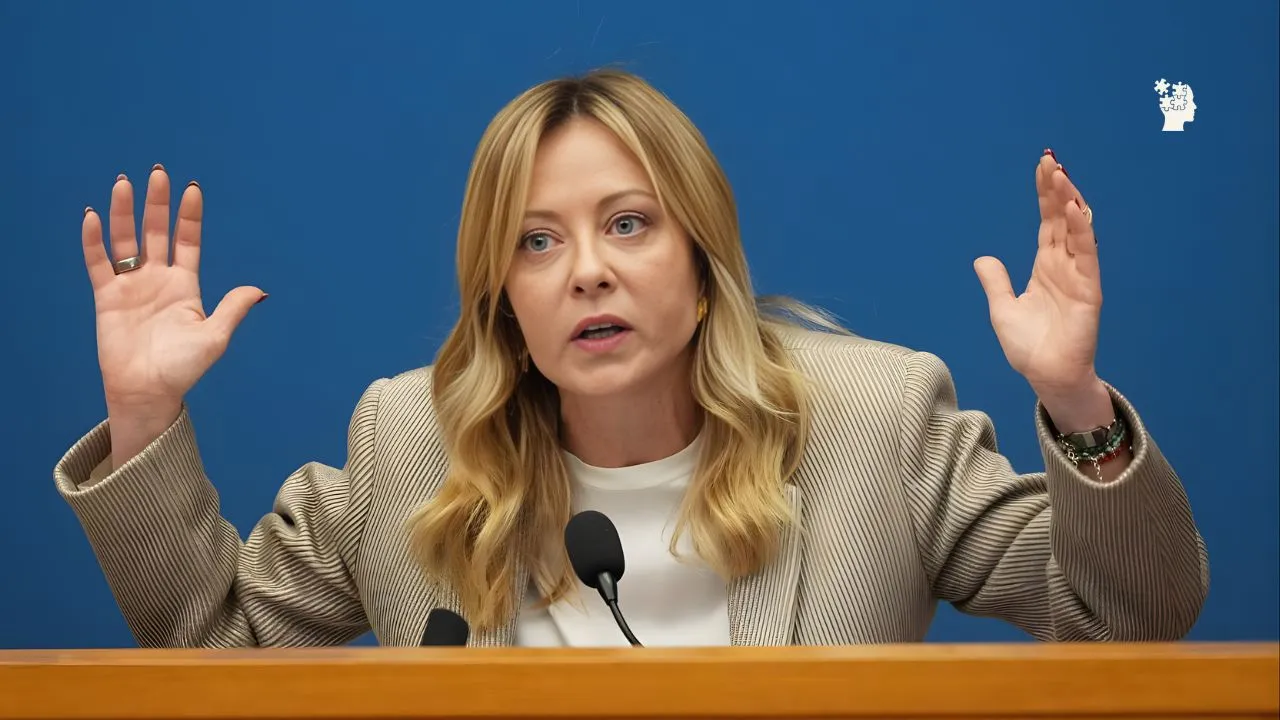
ROME — In a New Year’s press conference on January 9, 2026, that has since gone viral, Italian Prime Minister Giorgia Meloni delivered a sharp, sarcastic rebuke to critics of Europe’s reliance on the United States within NATO. Her comments, captured in a clip that amassed millions of views on social media, highlighted the fragility of transatlantic relations amid renewed U.S. pressures under President Donald Trump. But beyond the quips about storming McDonald’s, Meloni’s address revealed a broader foreign policy vision: one that champions NATO’s unity, dismisses unilateral military adventures, and calls for Europe to step up its own defenses.
The press conference, a traditional annual event held in Rome’s Lower Chamber, lasted over an hour and covered a wide array of topics, from Arctic security to Ukraine’s future and domestic judicial reforms. Meloni, known for her blunt style and as one of Trump’s closest European allies, used the platform to navigate the tensions bubbling up in the alliance. Her remarks came just days after Trump’s reiterated claims that “NATO is zero without America,” echoing his long-standing complaints about European defense spending.
Table of Contents
The Viral Moment: Sarcasm as a Weapon Against Anti-U.S. Sentiment
At the heart of the buzz was Meloni’s pointed sarcasm aimed at NATO detractors within Europe. Responding to questions about U.S. dominance in the alliance and potential rifts, she quipped: “So what do we do? Distance ourselves in the sense that we have to leave NATO, we have to close the American bases, cut trade relations? Or should we attack McDonald’s? I don’t know what we should do.”
This line, delivered with her characteristic flair, wasn’t a direct shot at Trump but rather a dismissal of anti-American voices in the EU who advocate for greater independence from Washington. Social media users quickly amplified the clip, with one X post from user @IndiaTales7 garnering over 5 million views by January 11, framing it as an “iconic power move.” Others clarified that Meloni was targeting EU “leadership” figures critical of the U.S., not the president himself.
Why the sarcasm? Meloni’s intent appears twofold. First, it underscores the absurdity of abandoning NATO amid rising global threats from rivals like Russia and China. Italy, hosting numerous U.S. military bases, benefits immensely from the alliance—economically, militarily, and strategically. Second, it serves as a subtle nudge to European partners: if you’re unhappy with U.S. influence, what’s the alternative? Her rhetoric aligns with her pro-NATO stance, emphasizing that Europe’s security is intertwined with America’s, especially in an era of Arctic competition and ongoing conflicts like Ukraine.
The Greenland Controversy: Dismissing U.S. Force, Pushing NATO Action
A significant portion of Meloni’s comments centered on Greenland, a Danish territory that has become a flashpoint in U.S.-Europe relations. Trump has repeatedly floated the idea of acquiring or controlling Greenland for its strategic Arctic position, rich in rare earth minerals and vital for countering Chinese and Russian influence. In recent months, he’s escalated rhetoric, hinting at potential military options if Denmark doesn’t cooperate.
Meloni firmly rejected any U.S. military intervention, stating, “I continue not to believe in the hypothesis that the United States would launch a military action to take control of Greenland, an option I would clearly not support.” She warned that such a move would have “grave consequences” for NATO, potentially fracturing the alliance. Instead, she advocated for a “serious, significant” NATO presence in the Arctic, including Greenland, to address U.S. concerns without unilateral action.
This position stems from Italy’s own interests. As a NATO member with growing stakes in Arctic routes and resources, Rome sees the region as a priority. Meloni argued that reinforcing NATO there would “reduce pressure for unilateral action by Washington,” positioning Italy as a bridge between U.S. assertiveness and European caution. It’s a pragmatic approach: acknowledge Trump’s grievances on burden-sharing while steering the conversation toward collective alliance strength.
Ukraine, Russia, and Europe’s Role: No Troops, But Dialogue
Shifting to Ukraine, Meloni reiterated Italy’s support but drew firm lines. She highlighted progress in the “Coalition of the Willing”—a group of allies crafting NATO-style security guarantees for Kyiv, inspired by Article 5’s mutual defense clause. However, she ruled out deploying Italian troops, insisting that “the main instrument for peace guarantees is Article 5 of NATO.” This reflects domestic pressures in Italy, where public fatigue over the war and economic strains from sanctions loom large.
Notably, Meloni called for Europe to engage directly with Russia: “I believe the time has come for Europe to speak with Russia.” This isn’t a softening on Moscow but a push for the EU to take a more active diplomatic role, complementing U.S. efforts. She described the EU and NATO as “part of a single, indivisible strategic space,” urging Europe to balance firmness with restraint.
Domestic and Broader Themes: Press Freedom, Judiciary, and Disagreements
Meloni didn’t shy away from home-front issues. She defended press freedom as “a fundamental prerequisite for democracy,” announcing experimental funding for journalist training in 2026. Yet, she launched a pointed attack on Italy’s judiciary, accusing it of overreach—a recurring theme in her administration’s push for reforms.
On personal notes, she admitted not always agreeing with Trump or Italian President Sergio Mattarella, saying, “I don’t always agree with them.” This candor highlights her independent streak, even as she maintains alliances.
She also touched on the EU-Mercosur trade deal, expressing concerns for Italian farmers amid protests, and outlined priorities for 2026: security, growth, and positioning Italy as a “more consequential diplomatic actor.”
Reactions and Implications: A Divided Response
The conference sparked debate online and in policy circles. Supporters hailed Meloni’s “unbothered” persona and pro-NATO zeal, with one X user calling her “Queen Giorgia.” Critics, however, accused her of “all talk and no action,” arguing Europe needs its own army. Broader reactions suggest her words resonate in a Europe grappling with Trump’s “America First” agenda, but they also expose fissures: Can NATO evolve without fracturing?
As 2026 unfolds, Meloni’s presser sets the tone for Italy’s foreign policy—rooted in alliance loyalty but insistent on European agency. In an increasingly multipolar world, her sarcasm might just be the sharpest tool in the diplomatic kit.
Read More: Unmasking the Motives: Trump’s Venezuela Incursion – Drugs, Oil, or a Broader Imperial Agenda?