
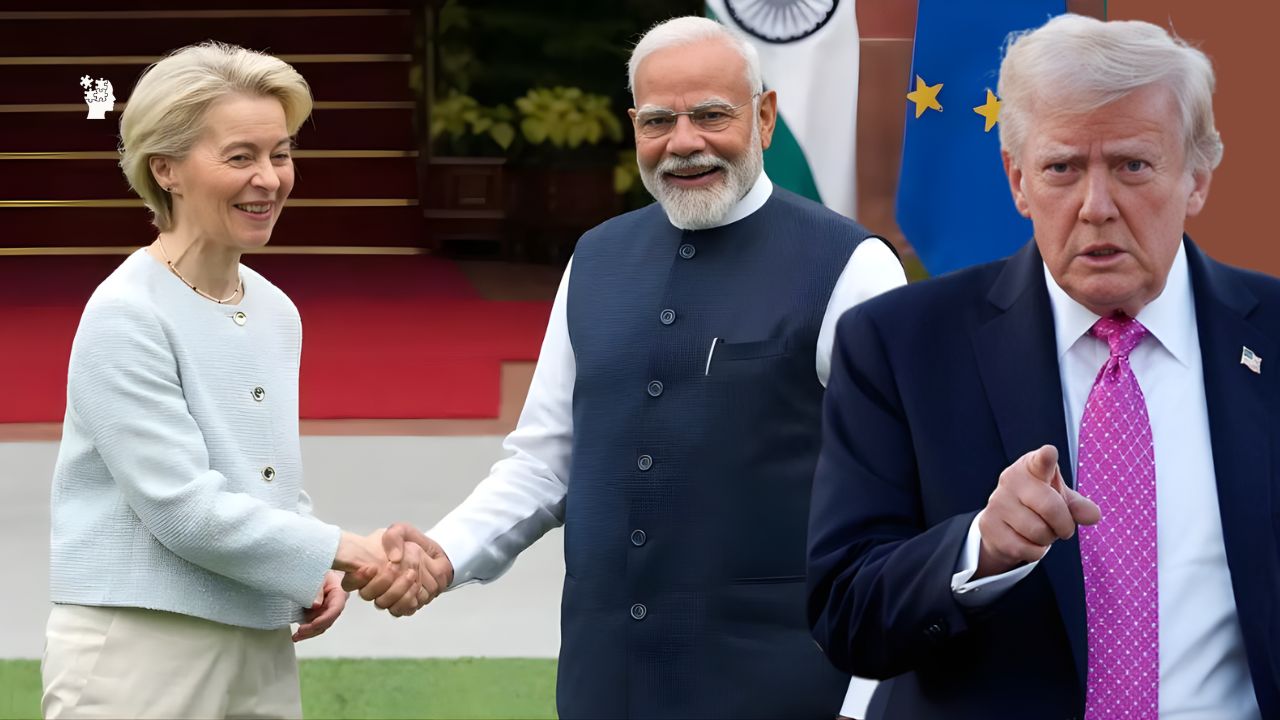
India and the European Union are poised to announce a landmark free trade agreement at the 16th India-EU Summit in New Delhi, a move that could quietly but significantly reshape the global trade balance—and place new pressure on the United States.
Described by European Commission President Ursula von der Leyen as “the mother of all deals,” the agreement would create one of the world’s largest free trade zones, spanning nearly two billion people and close to a quarter of global GDP. While the pact is primarily about strengthening India-EU economic ties, its ripple effects are likely to be felt strongly in Washington.
Table of Contents
A Strategic Shift Away From the U.S. Market
One of the most immediate implications for the United States is India’s effort to reduce its reliance on American trade. Since the U.S. imposed steep tariffs—up to 50 percent—on Indian goods in August 2025, Indian exporters have faced declining competitiveness in the American market. The India-EU free trade deal offers a crucial alternative.
Duty reductions and expanded access to the European market for Indian textiles, electronics, chemicals, and jewellery could help offset losses caused by U.S. trade restrictions. Over time, this may lead Indian exporters to prioritize Europe over the U.S., reducing American leverage in trade negotiations with New Delhi.
Increased Competition for U.S. Exporters
The agreement also threatens to intensify competition for U.S. companies, particularly in sectors where Europe is set to gain preferential access to India. Reduced tariffs on European automobiles, wines, and industrial goods could make EU products more competitive than American exports in the Indian market.
For U.S. firms already struggling with India’s high import duties and regulatory barriers, the deal could further erode market share, especially if American goods continue to face higher tariffs than their European counterparts.
Geopolitical Realignment in Trade and Security
Beyond economics, the deal signals a broader geopolitical realignment that may concern U.S. policymakers. Alongside trade negotiations, India and the EU have agreed to deepen cooperation on maritime security, counterterrorism, and cyber defense—areas traditionally dominated by U.S.-led partnerships.
As Washington’s trade policy grows more protectionist and unpredictable, India and the EU appear increasingly aligned in preserving a rules-based international order, particularly in the Indo-Pacific. This could gradually dilute U.S. influence in shaping global trade norms and strategic alliances.
Carbon Rules Could Widen Transatlantic Friction
The EU’s Carbon Border Adjustment Mechanism (CBAM) remains a sticking point in negotiations, but if resolved, it could set a powerful precedent. Should India adapt to EU carbon standards to secure trade advantages, it may deepen regulatory divergence with the U.S., which has yet to adopt a comparable carbon pricing mechanism.
This divergence could complicate U.S. exporters’ access to both Indian and European markets, while strengthening the EU’s role as a global standard-setter—often at odds with American trade preferences.
What It Means for Washington
While the India-EU free trade deal is not aimed at sidelining the United States, its implications are clear. It underscores India’s intent to diversify its economic partnerships and Europe’s desire to hedge against U.S. unpredictability. For Washington, the agreement serves as a warning: prolonged tariff pressure and unilateral trade policies may push key partners closer together—without the U.S. at the table.
As the deal moves toward ratification in the European Parliament, American policymakers may face renewed pressure to rethink trade relations with India or risk losing influence in one of the world’s fastest-growing markets.