
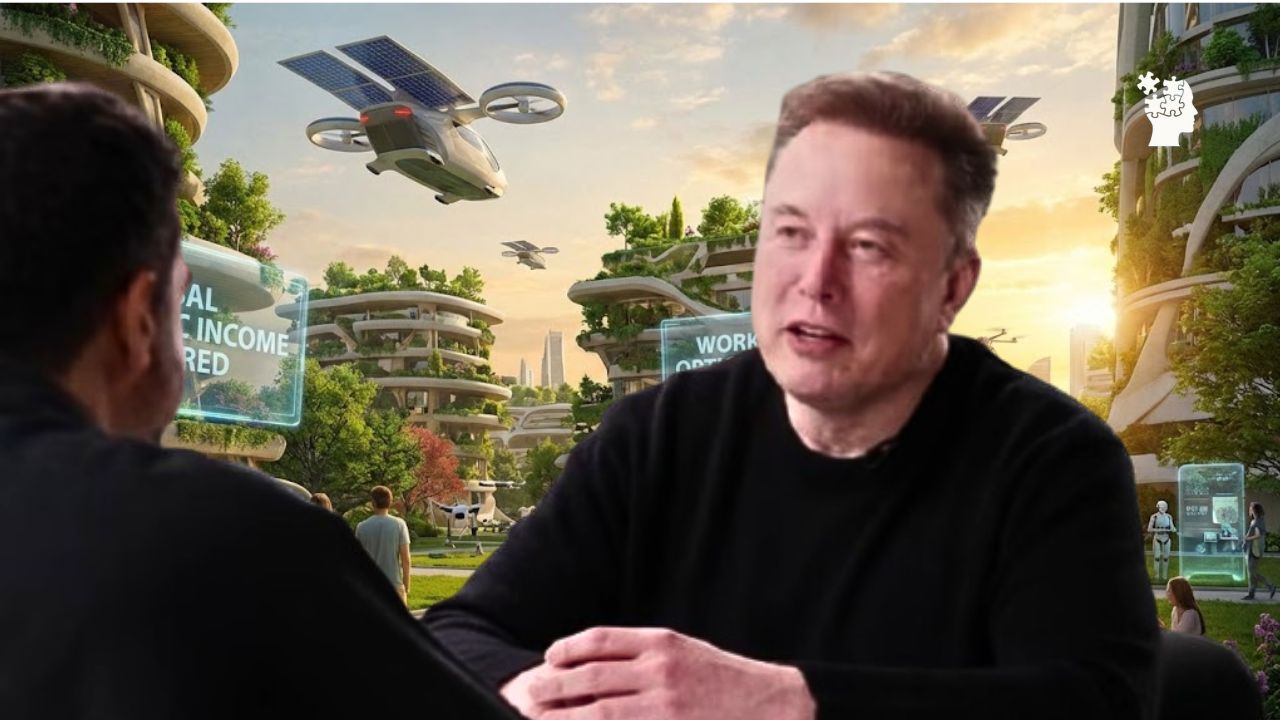
Elon Musk has long been a prophet of technological utopia, but his views on “AI abundance” paint an even bolder picture: a future where artificial intelligence and robotics eradicate scarcity, making traditional work a choice rather than a necessity. This isn’t pie-in-the-sky speculation for Musk—it’s a logical endpoint of exponential tech progress, one he’s been refining in interviews, podcasts, and X posts. Drawing from his recent unfiltered chat with Nikhil Kamath on the People by WTF podcast (November 2025) and earlier remarks, Musk envisions an “Age of Abundance” that could arrive in 10-20 years, transforming society from survival mode to thriving mode. At its core, this abundance stems from AI’s ability to hyper-accelerate production, slashing costs to near-zero and unlocking “universal high income” (UHI) for everyone.
Table of Contents
The Mechanics: How AI and Robots Create Post-Scarcity
Musk’s optimism hinges on two intertwined forces: AI superintelligence and humanoid robotics. He argues that as AI evolves—think Tesla’s Optimus bots or xAI’s Grok scaling to “digital superintelligence”—it will handle everything from manufacturing to elder care, far outpacing human labor. “AI and robotics will drop the cost of goods and services to almost nothing,” Musk told Peter Diamandis at the Abundance Summit, echoing themes from Diamandis’ book Abundance. Imagine a world where a robot army assembles iPhones, grows food, or drives trucks 24/7, without breaks or wages. This isn’t incremental efficiency; it’s a “supersonic tsunami” of productivity that Musk predicts will purge desk jobs first, then ripple into manual ones.
The economic ripple? Deflation on steroids. With infinite supply meeting demand, prices plummet—food, housing, gadgets become as cheap as air. Musk ties this directly to solving global debt crises, like the U.S.’s ballooning $35 trillion tab: “As AI productivity skyrockets, the cost of goods and services will collapse, triggering a massive deflationary period.” Money, in Musk’s view, is just “an information system for labor allocation”—useful now, but obsolete in abundance, where energy (solar, fusion) becomes the real currency. No more inflation-fueled scarcity; instead, a post-scarcity economy where “if you want something, you can just have it.”
| Key Drivers of AI Abundance | Musk’s Take | Timeline Prediction |
|---|---|---|
| AI Superintelligence | Handles complex tasks like coding or strategy; enables “truth-seeking” without bias (e.g., via xAI’s Grok). | 5-10 years for breakthroughs. |
| Humanoid Robots (e.g., Optimus) | Performs physical labor in factories, homes, logistics—10x faster than humans. | Mass deployment in 3-5 years, full integration in 10-15. |
| Energy Abundance | Cheap solar/fusion powers it all, making scarcity a relic. | Already underway; fusion viable by 2030s. |
| Economic Shift | From scarcity-driven markets to distribution-focused systems. | 10-20 years for “optional work.” |
Universal High Income: Beyond UBI to True Prosperity
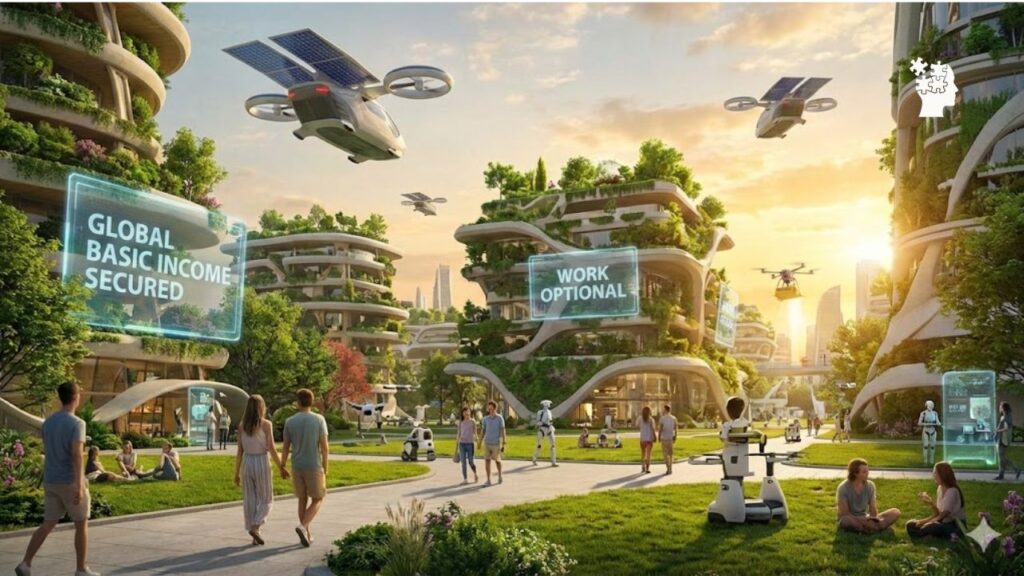
Musk isn’t content with Universal Basic Income (UBI)—the modest safety net he’s supported as a bridge for automation-displaced workers. Instead, he pitches Universal High Income (UHI): a generous stipend ensuring not just survival, but flourishing. “In a good AI future, we will effectively have universal high income, not basic,” he clarified in an October 2024 X reply, responding to a UBI experiment that backfired by increasing debt. Why “high”? Because abundance generates so much wealth that baseline needs (food, shelter) are met effortlessly, leaving room for luxuries like travel or art.
This evolves Musk’s thinking: UBI cushions the transition, but UHI is the destination—a world where poverty ends because “there is essentially one way to make everyone wealthy, and that is through AI and robotics.” Distribution becomes the puzzle: Politics must decide who gets the pie, as Samuel Solomon notes in critiques—Musk agrees, warning of inequality spikes if corporations hoard gains. Yet, he’s bullish: Freed from toil, humans chase meaning—philosophizing like ancient Greeks or building like Renaissance polymaths.
The Human Element: Purpose in a World Without Need
Abundance solves material woes, but Musk frets over the existential ones. “The challenge will no longer be production, but meaning,” he told Kamath, invoking Iain M. Banks’ Culture series—a semi-utopian realm of AI-managed plenty where humans explore passions. Work? “Optional in 10-15 years,” Musk predicts, countering grind-culture advocates like India’s Narayana Murthy. But our caveman brains might rebel—delayed gratification (à la the marshmallow test) and status-seeking could persist, turning hobbies into competitions.
Musk ties this to multi-planetary life: Abundance on Earth is step one; Mars ensures consciousness survives AI risks. It’s not all rosy—he warns of a “digital superintelligence” that could “end humanity” if misaligned, urging “maximum truth-seeking” in AI design.
Challenges and the Road Ahead
Skeptics point to hurdles: Job shocks during transition, political gridlock on UHI, or AI exacerbating divides before uniting us. Musk acknowledges this, advocating regulation like cars or planes—safety nets without stifling innovation. His antidote? Build boldly: xAI for unbiased intelligence, Tesla for robotaxi fleets, SpaceX for off-world backups.
In essence, Musk’s AI abundance isn’t a handout—it’s humanity’s upgrade. As he put it in that Kamath interview: “Working will be optional.” Whether we embrace it as liberation or grapple with newfound freedom, one thing’s clear: The tsunami is coming. The question is, will we surf it or get swept away?