

We’ve all seen the headlines: AI makes developers 55.8% faster, and deployment of tools like GitHub Copilot has reached 90% of Fortune 100 companies. On the surface, we are living in a golden age of productivity where code is produced in hours rather than weeks. But as we lean harder on these digital crutches, a more unsettling reality is emerging. We are trading long-term intellectual resilience for short-term velocity, leading to a phenomenon researchers call “Cognitive Sedentism”.
Is our over-dependency on AI tools the right path, or are we witnessing the slow atrophy of human intelligence?
Table of Contents
The Neurobiology of Atrophy: “Use It or Lose It”
The brain is governed by a fundamental principle of efficiency: it reallocates resources away from underused functions through synaptic pruning. When we delegate reasoning, drafting, and problem-solving to AI, we are engaging in “Cognitive Offloading”—using external tools to reduce the load on our working memory.
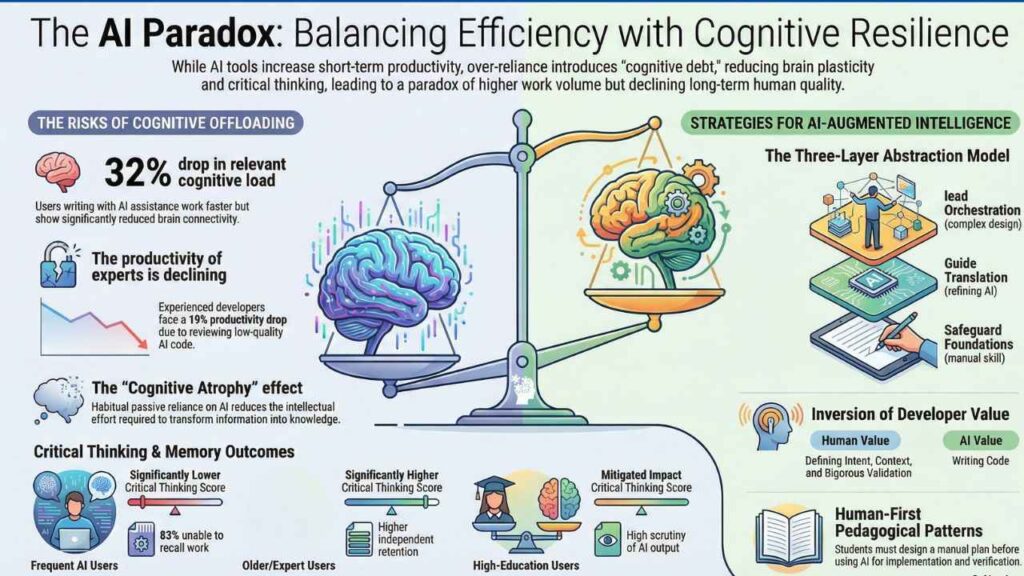
The neurological impact is measurable and startling. Research using EEG monitoring has shown that brain network connectivity is nearly halved during AI-assisted tasks. In one study, 83% of AI users were unable to remember a passage they had just “written” with the assistance of an LLM. This suggests that while the task is completed faster, the knowledge is never internalized, creating a massive disconnect between “doing” and “learning”.
The Developer’s Dilemma: Speed vs. Technical Debt
In the coding world, the dependency trap is particularly pronounced. AI tools have lowered the barrier to entry, allowing less-experienced developers to increase their output significantly. However, this “surge” in productivity comes with a hidden cost: Technical Debt.
- The Ownership Gap: AI-generated code often enters production without anyone truly “owning” it. When a human writes code, they understand the trade-offs; when an engineer repeatedly clicks “Accept” on AI suggestions, they fail to internalize the underlying design rationale.
- The Maintenance Burden: AI-assisted code frequently requires more rework to satisfy repository standards. This burden falls on a shrinking pool of experienced “core” developers, who now spend 6.5% more time reviewing code while seeing a 19% drop in their own original productivity.
- Bugs Déjà-Vu: AI tends to follow “by-the-book” patterns, often implementing improbable edge cases while repeating the same architectural bugs across different projects.
The “Oedipus Paradox” of Education
Higher education is facing an existential crisis dubbed the “Oedipus Paradox”: the very AI tools created by computer science departments are making the traditional CS curriculum obsolete before students can even graduate. Foundational skills like manual syntax mastery and algorithm implementation are being commoditized by AI in months.
While AI can serve as a powerful “Cognitive Scaffold,” helping students engage with complex problems, unrestricted access often improves immediate performance at the expense of durable skill acquisition. Younger users (ages 17–25) are showing the highest levels of dependence and, consequently, the lowest scores in critical thinking. Without the “struggle” of parsing complex error messages and manually managing memory, the diagnostic instincts that separate a “code consumer” from a master “orchestrator” simply don’t form.
Toward “Cognitive Sustainability”
The goal is not to reject AI, but to achieve a “Cognitive Balance” where automation enhances rather than replaces human reasoning. This requires moving from a state of passive delegation to one of Reflective Engagement.
To survive this transition, we must adopt new strategic principles:
- Mandatory Reflection: Code reviews must shift from verifying syntax to verifying understanding. Reviewers must be able to explain why an AI-generated solution is correct and what context the AI might have missed.
- The 2,000-Hour Rule: Rather than deep specialization in one technology, the new foundation of technical intelligence is “predictive trust”—knowing exactly when a model will hallucinate and when its reasoning is sound.
- Domain Elasticity: Using AI as a bridge to work competently across any tech stack while maintaining high-order architectural judgment.
Conclusion
The shift from builders to orchestrators is inevitable. If we use AI to automate the “tedium” while doubling down on our investment in documentation, testing, and system-level thinking, human intelligence will expand. However, if we continue to prioritize velocity without accountability, we aren’t just building faster software—we are building a cognitively sedentary future where we no longer understand the systems we depend on.
The developers and thinkers who thrive will not be those who can code without AI, but those who understand deeply enough to know exactly when to put the tools aside and think for themselves.
Recommended for you: