
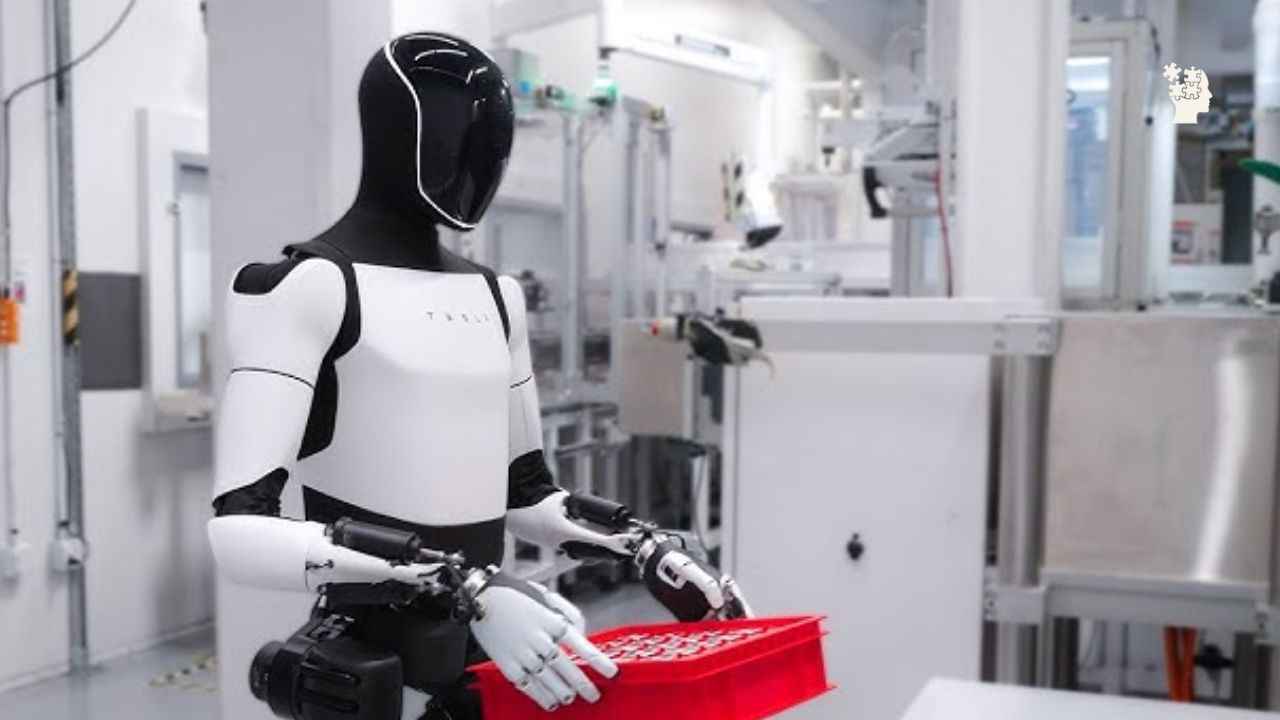
In the rapidly evolving world of artificial intelligence and robotics, Tesla’s Optimus humanoid robot stands out as a beacon of ambition. Conceived by Elon Musk in 2021 as a solution to “dangerous, repetitive, and boring” tasks, Optimus has progressed from a conceptual sketch at AI Day to a fleet of prototypes roaming Tesla factories unsupervised. As of late 2025, with Gen 3 prototypes on the horizon, Musk envisions Optimus not just as a tool, but as the cornerstone of Tesla’s future—potentially accounting for 80% of the company’s value by driving an “age of abundance.” This article dives into Optimus’s evolution, capabilities, challenges, and the seismic implications for industries and society.
Table of Contents
From Prototype to Production: A Rapid Evolution
Tesla’s journey with Optimus has been marked by iterative leaps, blending automotive manufacturing prowess with cutting-edge AI. Announced in August 2021, the initial concept promised a bi-pedal robot standing 5’8″ tall and weighing 125 pounds. By 2023, Gen 2 prototypes demonstrated basic locomotion, including a 30% speed boost to 5 mph, full-body control, and delicate tasks like picking up eggs or performing squats.
The pace accelerated in 2025. In April, Tesla released videos showcasing improved walking gaits with natural torso sway, mimicking human balance. By July, over 1,000 units were deployed internally at factories like Fremont and Giga Texas, handling material transport—albeit at half the efficiency of human workers. Mid-year setbacks included a redesign delay for Gen 3, prompted by the exit of program head Milan Kovac, pushing full production from late 2025 to early 2026.
September brought fanfare with Optimus 2.5 in a golden outfit, featuring enclosed joints for durability and Grok-powered voice interaction. Demos escalated: robots folding laundry, cooking eggs, practicing Kung Fu, and even attending the Tron: Ares premiere—interacting playfully with guests. October updates from Musk tease Gen 3’s “sublime” agility, rivaling an agile human, with prototypes expected by year-end.
Key specs across generations highlight this trajectory:
| Feature | Gen 2 (2023-2024) | Gen 2.5 (2025) | Gen 3 (Expected Late 2025) |
|---|---|---|---|
| Height/Weight | 5’8″ / 125 lbs | 5’8″ / 125 lbs | 5’8″ / ~125 lbs |
| Walking Speed | ~5 mph | ~5 mph | Up to 5 mph (agile human-like) |
| Hand Dexterity | 11 DoF | 11 DoF | 22 DoF (hyper-realistic) |
| Payload Capacity | 20 kg (45 lbs) | 20 kg | 20+ kg |
| Battery Life | 1-2 hours active | 2-4 hours | 4+ hours (improved efficiency) |
| AI Integration | FSD-derived vision | Grok voice | Full autonomy, world modeling |
| Key Demo Tasks | Squats, egg pick-up | Kung Fu, laundry | Factory work, healthcare assist |
Data from Tesla updates and analyst reports.
Production targets reflect Musk’s optimism: several thousand units in 2025 for internal use, scaling to 50,000-100,000 in 2026 and 1 million annually by 2030. A recent $685 million actuator order from supplier Sanhua signals commitment to ~180,000 units soon.
Capabilities: AI-Powered Versatility
Optimus leverages Tesla’s Full Self-Driving (FSD) tech—cameras, neural nets, and Dojo supercomputing—for “vision-only” perception, eliminating costly lidar. Gen 3’s 22-degree-of-freedom hands enable human-like manipulation: from yoga poses to fall detection for elderly care.
Recent demos showcase breadth:
- Factory Tasks: Unsupervised navigation in Palo Alto labs, self-charging, and material handling at Giga Texas.
- Home Assistance: Folding shirts, baking, and conversational AI via Grok—responding to “How was your day?” with charm.
- Advanced Skills: Juggling Rubik’s Cubes (target test), Kung Fu for balance, and public interactions like serving popcorn at Tesla’s Hollywood diner.
Musk hints at world-modeling simulations, akin to NVIDIA’s GR00T Dreams, to generate synthetic training data—scaling learning without endless teleoperation. Priced at $20,000-$30,000, Optimus undercuts rivals like Boston Dynamics’ Atlas ($150,000+).
Challenges: Hurdles on the Path to Scale
Despite hype, Optimus faces scrutiny. Production lags: Only hundreds built by mid-2025, far from the 5,000-unit goal. Efficiency in factories remains subpar, and redesigns have delayed external sales to 2026.
Regulatory and ethical concerns loom: Job displacement in a $218 billion humanoid market by 2030, plus security risks highlighted by vulnerabilities in competitors like Unitree G1. Analysts like those at Bank of America cite execution risks, contributing to Tesla’s Q3 2025 profit miss. Musk acknowledges: “Optimus is a hard problem in engineering, design, and manufacturing.”
Musk’s Vision: Abundance and Beyond
Elon Musk positions Optimus as Tesla’s growth engine, surpassing EVs in significance. “Things are really going to go ballistic next year,” he said in January, forecasting $10 trillion in long-term revenue. By 2040, Musk predicts more robots than humans, enabling Mars colonization (crewed Starship flight possibly by late 2026) and personal companions—your “R2-D2/C-3PO.”
In factories, Optimus could roboticize U.S. manufacturing amid China’s dominance (295,000 industrial robots added last year vs. U.S.’s 34,000). Broader impacts: Healthcare (fall assistance), homes (chores), and even anime-inspired customizations. As Musk quipped, “Wait until you see what Tesla does with Optimus.”
The Road Ahead: Revolution or Hype?
Optimus embodies Tesla’s audacious pivot to “physical AI,” but success hinges on scaling autonomy amid competition from Figure, 1X, and Amazon’s warehouse bots. With TSLA shares volatile post-Q3 earnings, investors weigh Musk’s timelines against history—recall the 2020 robotaxi pledge.
Yet, as prototypes dance at premieres and fold laundry unsupervised, Optimus feels tantalizingly real. If Tesla delivers, it could usher in abundance; if not, another lesson in overpromising. Either way, the humanoid race is on—and Tesla’s leading the charge.
Read More: Tesla’s Cybercab: Redefining Urban Mobility with Autonomous Innovation