
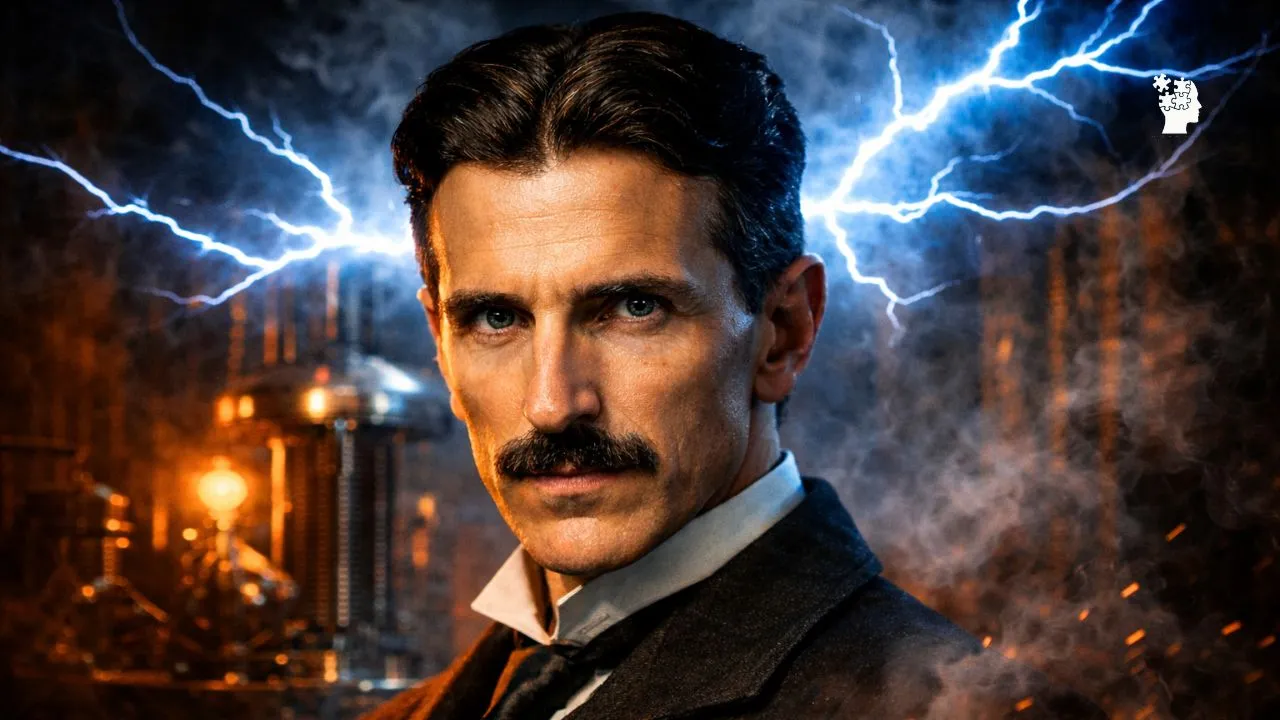
Nikola Tesla’s first biography reveals 5 shocking truths the world ignored. Discover the real story behind the legendary inventor.
Table of Contents
Introduction: Beyond the Myth of the Mad Scientist
When we think of Nikola Tesla, a specific image often comes to mind: the master magician of electricity, a lone genius hurling bolts of lightning in a darkened laboratory. He is the quintessential mad scientist of pop culture, a fabled individual who seemed to belong to the far-distant future or to have come from the mystical realm of the gods. This popular caricature, while compelling, obscures a far more fascinating and complex reality—not just about the devices he invented, but about the very architecture of his mind and the disciplined, almost engineered, principles by which he lived his life.
This common myth, of a man synonymous with magic, hides the disciplined processes and profound personal sacrifices that enabled his world-changing breakthroughs. To truly understand the man who created the modern electrical era, we must look beyond the legend and into the operating system of his genius.
Drawing from Prodigal Genius, the first full-length biography of Tesla, written by his personal friend and Pulitzer Prize-winner John J. O’Neill, we can uncover the truth. O’Neill, whom Tesla said “understood him better than any man alive,” gives us an intimate view into the mind of the inventor. Here are five of the most astonishing truths about the man who saw the future and built it.
1. He Built and Tested Perfect Inventions Entirely in His Mind
Most invention is a messy, physical process of trial and error. An idea is sketched, a prototype is built, it fails, it’s adjusted, and the cycle repeats until it finally works. Tesla’s method was the complete opposite. He possessed an abnormal and powerful faculty for intense, realistic visualization, allowing him to bypass the physical world of tinkering almost entirely.
He could conjure a fully-formed invention in his mind, viewing it in three dimensions from every angle as if it were a solid object before him. This was not mere daydreaming; it was a rigorous engineering process. He mentally constructed machines with perfect dimensions, ran them for weeks to check for signs of wear, and methodically identified and corrected any flaws. Only after this exhaustive mental testing and refinement would he commit the design to paper or have his workmen build the physical model. That first physical version, born from the crucible of his mind, always worked perfectly, without any need for adjustment or preliminary tests.
This faculty is astonishing because it stands in stark contrast to the dogged, experimental method of contemporaries like Thomas Edison. While Edison famously tested thousands of materials for his light bulb filament, Tesla built and perfected his revolutionary motors in the silent, flawless laboratory of his own consciousness.
The immense genius of Tesla resulted from a mind that could see an invention in 3-D, from every angle, within his mind before it was easily built. His dimensions and part sizes were always perfect. He never tested parts; they always worked.
2. His World-Changing AC Motor Was Born From a Sunset and a Poem
Great scientific discoveries are often pictured as “Eureka!” moments happening in a cluttered laboratory. Tesla’s greatest invention, the alternating current (AC) motor, was born not in a lab but from a sublime fusion of nature, poetry, and a flash of cosmic insight.
The scene was a city park in Budapest in February 1882. Tesla was recovering from a near-fatal illness that had left him with hypersensitive senses, an experience that nearly cost him his life. As he walked with a friend at sunset, he began reciting poetry from his favorite work, Goethe’s Faust, which he had memorized in its entirety. As the sun sank below the horizon, painting the sky with “a flamboyant splash of throbbing colors,” he spoke the lines: “The glow retreats, done is the day of toil; It yonder hastes, new fields of life exploring…”
Suddenly, Tesla froze as if in a trance. The solution to the AC motor problem—the principle of the rotating magnetic field, which had eluded scientists for years—appeared before him as a complete and perfect vision. It wasn’t a calculation or a theory, but a functioning machine running in the theater of his mind, projected against the setting sun.
“Don’t you see it?” expostulated the excited Tesla. “See how smoothly it is running? Now I throw this switch—and I reverse it. See! It goes just as smoothly in the opposite direction. Watch! I stop it. I start it. There is no sparking. There is nothing on it to spark.”
He then grabbed a nearby twig and, in the dust of the park path, drew the very diagrams that would form the heart of the modern electrical age, a sublime and simple solution revealed not in a lab, but in a moment of poetic ecstasy. This moment is so profound because it reveals a mind where art, nature, and science were not separate disciplines but deeply interconnected pathways to truth.
3. He Intentionally Engineered Love and Women Out of His Life
More significant than any of his electrical inventions was what his biographer calls his “supreme invention—Nikola Tesla the Superman.” Tesla viewed his own life as his most important engineering project. He designed it on strict principles for a single purpose: to serve as an automaton of discovery, operating with the utmost efficiency for the advancement of human welfare.
This design required a radical and deliberate sacrifice. To maximize his scientific output, he concluded that he had to eliminate what he saw as the greatest impediments to focused, creative work: love, romance, and even close companionship with women. His life was an experiment in creating a “scientific saint,” an isolated, self-sufficient individual who would live entirely as a thinking and working machine.
The author John J. O’Neill presents a stunning paradox. As an invention for producing scientific marvels, Tesla’s “superman” was a magnificent success. It allowed him to achieve a gigantic intellectual stature that pushed the world forward. But as a human being, it was a failure. By engineering love out of his life, he severed the bonds that might have brought him disciples or his own progeny to carry on his work. As a result, he succeeded in imparting to the world only a fraction of the creative products of his prodigious mind.
The superman that Tesla designed was a scientific saint. The inventions that this scientific martyr produced were designed for the peace, happiness and security of the human race… He eliminated love from his life; eliminated women even from his thoughts.
4. His Genius Was Famously Dismissed as “American Humor.”
Soon after arriving in America in 1884, Tesla began working for the one man whose fame as an inventor rivaled his own ambitions: Thomas Edison. The two were a study in opposites. Edison was the master of direct current (DC) and the practical, trial-and-error inventor. Tesla was the champion of alternating current (AC) and the brilliant, calculating theorist. A clash was inevitable.
Working on Edison’s inefficient DC dynamos, Tesla quickly identified ways to dramatically improve their output and economy. He outlined his plan to Edison, who, seeing the value, made a casual promise: “There’s fifty thousand dollars in it for you if you can do it.” This was an immense sum at the time, and Tesla threw himself into the task, working tirelessly for months. He designed 24 new types of dynamos, fundamentally re-engineering them with more efficient short-core magnets and creating new automatic controls to regulate them.
When the months of grueling work were complete and the new designs were proven to be a resounding success, Tesla went to Edison and asked for the promised payment. Edison, shocked that the young immigrant had taken his off-the-cuff remark seriously, laughed it off.
Edison replied, “Tesla, you don’t understand our American humor.”
Tesla, stunned by the dismissal, resigned on the spot. This single incident was more than a dispute over money; it was a clash of worldviews. It set Tesla on an independent path and ignited the famous “war of the currents” between Edison’s DC empire and Tesla’s revolutionary AC system, a battle that would determine the future of electrical power for the entire world.
5. He Sacrificed a Staggering Fortune for a Friend
George Westinghouse, the industrialist and inventor, had the vision that Edison lacked. He saw the immense superiority of Tesla’s AC system and purchased his patents for $1 million cash plus a royalty contract of $1 per horsepower generated. This royalty was poised to make Tesla one of the richest men in the world.
However, a financial depression and a boardroom battle soon put the Westinghouse Electric Company in grave danger. A group of bankers, poised to refinance the company, saw Tesla’s royalty contract as a massive liability. They insisted that Westinghouse get rid of it, calculating that the future payments could total millions and imperil the company’s financial stability. Westinghouse, embarrassed, had to present this dire situation to Tesla, explaining that the fate of the company—and the future of the AC system—was in the inventor’s hands.
For Tesla, the decision was immediate. Recounting Westinghouse’s unwavering belief in him when others had no faith, he made it clear that friendship and the future of his inventions for humanity were far more valuable than any personal fortune. Facing Westinghouse, he did not negotiate or hesitate. He took the contract and performed an act of staggering generosity.
“Mr. Westinghouse, you will save your company so that you can develop my inventions. Here is your contract and here is my contract—I will tear both of them to pieces and you will no longer have any troubles from my royalties. Is that sufficient?”
With those words, Tesla tore up the contract that his biographer estimates was worth at least $12,000,000—a colossal fortune at the time. This act saved the Westinghouse company and ensured that his polyphase AC system would become the standard for the world, but it ultimately left the great inventor to die penniless.
Conclusion: The Man Who Saw the Future
These stories reveal a man who was more than an inventor of devices; he was a unique form of human consciousness, operating on a different plane. He built perfect machines in his mind, found scientific truth in a sunset, engineered his own soul for maximum output, and valued the future of civilization over a personal fortune. Tesla was not just a man of his time, but a vehicle through which, as O’Neill wrote, “the blazing suns of a brighter tomorrow focused their incandescent beams on a world.”
Tesla’s greatest contributions came from seeing the world not as it was, but as it could be, by tapping what he felt was the hidden treasury of Nature’s knowledge. The question he leaves for us is not just who will invent the future, but who has the courage to see it?