
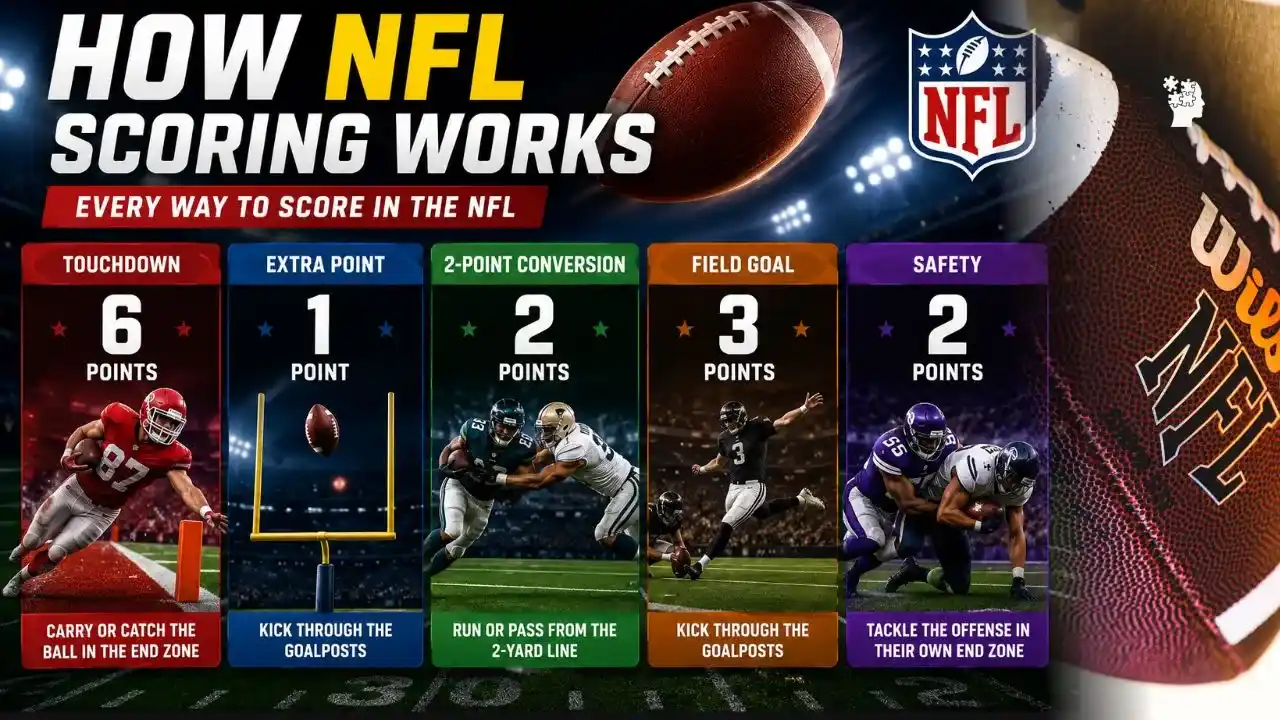
Learn how NFL scoring works with simple explanations of touchdowns, field goals, safeties, extra points, two-point conversions, and scoring rules.
How NFL Scoring Works: Complete Beginner’s Guide
If you’re new to American football, one of the first things you’ll notice is that teams can score in several different ways. Unlike soccer or basketball, the NFL awards different point values depending on how a team scores.
In this guide, you’ll learn:
- How NFL scoring works
- How many points each scoring play is worth
- The difference between touchdowns and field goals
- What safeties are
- Extra points vs two-point conversions
- Scoring strategy used by NFL coaches
- Frequently asked questions
By the end of this article, you’ll understand every way teams score in an NFL game.
How Many Points Is Each Score Worth?
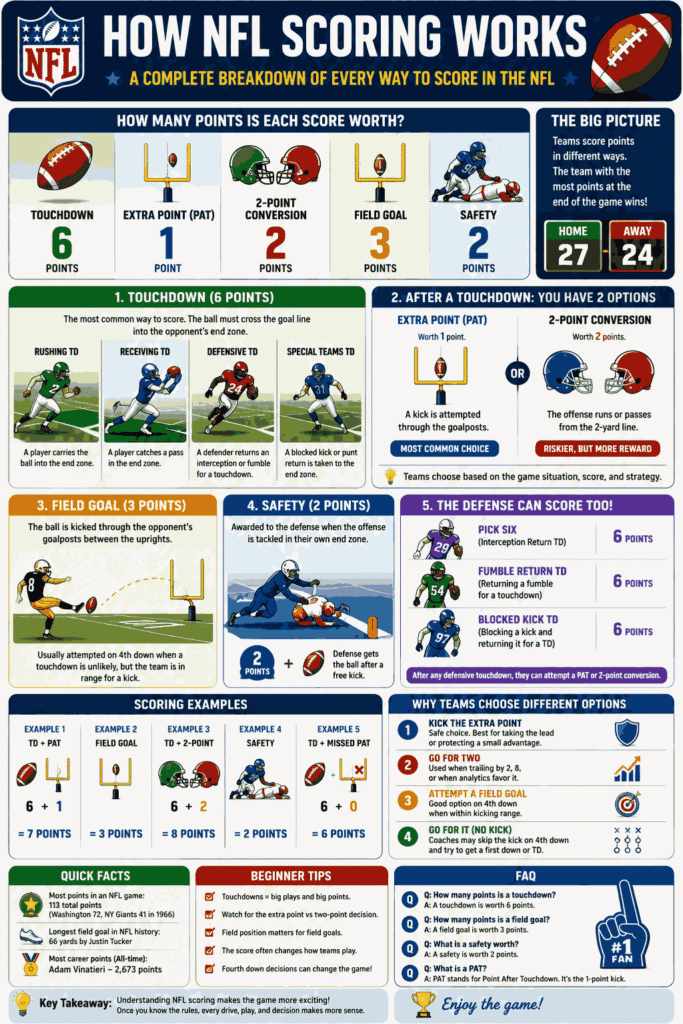
| Scoring Play | Points |
|---|---|
| Touchdown | 6 |
| Extra Point Kick (PAT) | 1 |
| Two-Point Conversion | 2 |
| Field Goal | 3 |
| Safety | 2 |
What Is a Touchdown?
A touchdown is the primary way teams score in the NFL and is worth 6 points.
A touchdown occurs when:
- A player runs the football into the opponent’s end zone.
- A receiver catches the football in the end zone.
- A defender returns an interception or fumble to the end zone.
- A player recovers a loose ball in the opponent’s end zone.
Touchdowns generate the most points in a single play and are the offensive goal on nearly every drive.
Types of Touchdowns
Rushing Touchdown
The ball carrier crosses the goal line while running.
Example:
A running back takes a handoff and rushes 12 yards into the end zone.
Receiving Touchdown
The quarterback throws a completed pass inside the end zone.
Example:
The quarterback finds a wide receiver for a 25-yard touchdown catch.
Defensive Touchdown
The defense can also score.
Examples include:
- Pick Six (interception returned for a touchdown)
- Fumble Return Touchdown
- Blocked Kick Return Touchdown
What Happens After a Touchdown?
After every touchdown, the scoring team has two options.
Extra Point (PAT)
Worth 1 point.
The kicker attempts a short kick through the goalposts.
Advantages:
- Highest success rate
- Safest option
- Used by most teams
Two-Point Conversion (2 Points)
After scoring a touchdown (6 points), a team has the option to go for two instead of kicking the extra point.
To do this:
- The offense gets one play from the 2-yard line.
- They must run or pass the ball into the end zone.
- If they succeed, they earn 2 additional points.
- If they fail, they receive no extra points.
Example
🏈 Touchdown = 6 points
➕ Successful Two-Point Conversion = 2 points
Total Score = 8 Points
Touchdown        = 6 Points
        +
2-Point Conversion = 2 Points
-----------------------------
Total             = 8 Points
When Do Teams Go for Two?
Coaches usually choose a two-point conversion when:
- They need 2 extra points to tie or take the lead.
- They are trailing by 8 points and want to tie the game with one possession.
- Analytics suggest it’s the better strategic choice.
- Weather conditions make kicking difficult.
Tip for Beginners: A two-point conversion is riskier than kicking an extra point because the offense gets only one chance to score from the 2-yard line. However, if successful, it gives the team 2 points instead of 1.
What Is a Field Goal?
A field goal is worth 3 points.
Instead of trying to score a touchdown, teams can kick the football through the goalposts.
Field goals usually happen when:
- The offense reaches the opponent’s 20–35 yard line.
- It’s fourth down.
- Scoring three points is better than risking no points.
How Long Can NFL Kickers Kick?
Elite NFL kickers can make field goals from:
- 30 yards (routine)
- 40 yards (common)
- 50+ yards (difficult)
- 60+ yards (rare)
The NFL record is 66 yards, highlighting how powerful and accurate modern kickers have become.
What Is a Safety?
A safety is worth 2 points.
The defense scores a safety when:
- The offense is tackled with the football inside its own end zone.
- The offense commits certain penalties in its own end zone.
After a safety:
- The defense receives 2 points.
- The scoring team also gets the ball via a free kick.
Safeties are uncommon but can dramatically shift momentum.
Can the Defense Score?
Yes. While the offense scores most of the points in an NFL game, the defense can also score. Defensive touchdowns often create huge momentum swings and can completely change the outcome of a game.
Here are the main ways the defense can score:
1. Pick Six (Interception Return Touchdown)
A Pick Six happens when a defensive player intercepts (catches) a pass thrown by the quarterback and returns it all the way to the opponent’s end zone.
How it works:
- 🏈 The quarterback throws a pass.
- 🛡️ A defender catches the ball before the intended receiver (interception).
- 🏃 The defender runs into the opponent’s end zone.
- 🎉 The defense scores a touchdown worth 6 points.
After the touchdown
Just like an offensive touchdown, the team can choose one of two options:
- Extra Point Kick (PAT) → +1 point
- Two-Point Conversion → +2 points
Total Points
| Scoring Option | Total Points |
|---|---|
| Pick Six + Extra Point | 7 Points |
| Pick Six + Two-Point Conversion | 8 Points |
Example: A cornerback intercepts a pass at midfield and returns it 50 yards for a touchdown. His team scores 6 points, then kicks the extra point to make the score 7 points.
2. Fumble Return Touchdown (Defensive Touchdown)
A Fumble Return Touchdown happens when the offense accidentally loses the football, and the defense takes advantage by scoring.
How It Works
Think of it in four simple steps:
Step 1:
The offensive player is running with the football.
Step 2
The player drops the ball before being tackled. This is called a fumble.
Step 3
A defensive player picks up (recovers) the loose football.
Step 4
The defender runs into the opponent’s end zone and scores a touchdown.
📊 Infographic
🏃 Offensive Player Running
           │
           ▼
      🏈 Ball Dropped
      (FUMBLE)
           │
           ▼
🛡️ Defender Recovers Ball
           │
           ▼
🏃 Defender Runs to End Zone
           │
           ▼
🎉 TOUCHDOWN!
Points Awarded
| Play | Points |
|---|---|
| Fumble Return Touchdown | 6 Points |
| Extra-Point Kick (Optional) | +1 Point |
| Two-Point Conversion (Optional) | +2 Points |
Maximum possible points: 8 points (6 + successful 2-point conversion)
Example
Imagine the Kansas City Chiefs are on offense.
- The running back is carrying the football.
- A defender knocks the ball loose.
- A defender from the opposing team quickly picks up the ball.
- He runs all the way into the Chiefs’ end zone.
Result: The defense scores a 6-point touchdown.
Afterward, the scoring team can choose to:
- 🦵 Kick the extra point for 1 additional point, or
- 🏃 Attempt a two-point conversion for 2 additional points.
Beginner Tip: A fumble return touchdown is often called a “defensive touchdown.” Unlike a normal touchdown scored by the offense, the defense scores because it forces a turnover and returns the loose ball to the end zone. This type of play can completely change the momentum of a game.
3. Blocked Kick Return Touchdown
A Blocked Kick Return Touchdown happens when the defense blocks a kicking play (such as a field goal or a punt) and then returns the loose football to the opponent’s end zone for a touchdown.
How It Happens
🏈 Offense attempts a field goal or punt
            ↓
🛡️ Defender blocks the kick
            ↓
🏈 The football becomes loose
            ↓
🛡️ Another defender picks up the ball
            ↓
🏃 Defender runs the ball into the end zone
            ↓
🎉 TOUCHDOWN!
Example
Imagine Team A is trying to kick a field goal.
- The kicker kicks the ball.
- A defender jumps up and blocks the kick before it goes through the goalposts.
- The ball lands on the field.
- Another defender picks up the loose football.
- He runs all the way to the opposite end zone without being tackled.
Result: The defense scores a touchdown.
Points Awarded
| Play | Points |
|---|---|
| Blocked Kick Return Touchdown | 6 Points |
| Extra Point Kick (Optional) | +1 Point |
| Two-Point Conversion (Optional) | +2 Points |
So the team can score:
- 7 points (Touchdown + Extra Point)
- 8 points (Touchdown + Two-Point Conversion)
📊 Infographic
FIELD GOAL / PUNT ATTEMPT
            🦵
            │
            ▼
      🛡️ DEFENDER BLOCKS KICK
            │
            ▼
      🏈 BALL FALLS LOOSE
            │
            ▼
   🛡️ DEFENDER PICKS UP BALL
            │
            ▼
🏃 RUNS TO THE OPPONENT'S END ZONE
            │
            ▼
     🎉 TOUCHDOWN (6 POINTS)
            │
            ├── Extra Point Kick = +1
            └── Two-Point Conversion = +2

✅ Final Score:
7 Points or 8 Points
Did You Know? A blocked kick returned for a touchdown is one of the most exciting plays in the NFL because it can instantly change the momentum of a game by turning a scoring opportunity for one team into points for the other.
Quick Summary
| Defensive Scoring Play | Base Points | Maximum Total |
|---|---|---|
| Pick Six | 6 | 8 |
| Fumble Return Touchdown | 6 | 8 |
| Blocked Kick Return Touchdown | 6 | 8 |
| Safety | 2 | 2 |
💡 Beginner Tip: Every defensive touchdown is treated exactly like an offensive touchdown. The team first earns 6 points, then gets the chance to score 1 extra point (PAT) or 2 points with a successful two-point conversion. This means a defensive touchdown can result in either 7 or 8 total points.
NFL Scoring Examples
These examples show how the score changes after different scoring plays during a game.
Example 1: Touchdown + Extra Point = 7 Points 🏈
Situation:
A team drives down the field and scores a touchdown.
- Touchdown = 6 points
- Extra Point Kick (PAT) = 1 point
Calculation:
Touchdown      = 6
Extra Point    = 1
-------------------
Total Score    = 7 Points
Example Score:
Chiefs 7 – 0 Bills
This is the most common way teams score in the NFL.
Example 2: Field Goal = 3 Points 🦵
Situation:
The offense gets close to the end zone but cannot score a touchdown. Instead, the kicker successfully kicks the ball through the goalposts.
- Field Goal = 3 points
Calculation:
Field Goal     = 3
-------------------
Total Score    = 3 Points
Example Score:
Cowboys 3 – 0 Eagles
Teams often choose a field goal on fourth down when they’re within kicking range.
Example 3: Touchdown + Two-Point Conversion = 8 Points 🎯
Situation:
A team scores a touchdown and decides to attempt a two-point conversion instead of kicking the extra point.
- Touchdown = 6 points
- Two-Point Conversion = 2 points
Calculation:
Touchdown            = 6
2-Point Conversion   = 2
--------------------------
Total Score          = 8 Points
Example Score:
49ers 8 – 0 Rams
Teams usually attempt a two-point conversion when they need extra points late in the game.
Example 4: Safety = 2 Points 🛡️
Situation:
The defense tackles the offensive player inside their own end zone.
- Safety = 2 points
Calculation:
Safety         = 2
-------------------
Total Score    = 2 Points
Example Score:
Steelers 2 – 0 Ravens
A safety is one of the rarest ways to score in the NFL.
Example 5: Touchdown + Missed Extra Point = 6 Points ❌
Situation:
A team scores a touchdown, but the kicker misses the extra-point attempt.
- Touchdown = 6 points
- Extra Point Missed = 0 points
Calculation:
Touchdown      = 6
Missed PAT     = 0
-------------------
Total Score    = 6 Points
Example Score:
Packers 6 – 0 Vikings
Even if the extra-point kick is missed, the touchdown still counts for six points.
Quick Comparison Table
| Scoring Play | Points Awarded | Typical Final Score Added |
|---|---|---|
| Touchdown + Extra Point | 7 | ⭐ Most Common |
| Field Goal | 3 | Common |
| Touchdown + Two-Point Conversion | 8 | Less Common |
| Safety | 2 | Rare |
| Touchdown + Missed Extra Point | 6 | Occasionally Happens |
📌 Easy Way to Remember
| If a Team Scores… | They Get |
|---|---|
| Touchdown only | 6 points |
| Touchdown + Kick | 7 points |
| Touchdown + 2-Point Conversion | 8 points |
| Field Goal | 3 points |
| Safety | 2 points |
Why Teams Choose Different Scoring Options
NFL coaches constantly make strategic decisions.
Kick the Extra Point (1 Point)
Teams usually choose the extra-point kick because it is the safest and most reliable option after scoring a touchdown.
Teams usually kick the extra point when:
- They want to increase their lead by taking the guaranteed point.
- It’s early in the game, so there is no need to take extra risks.
- The kicker has a high chance of making the kick (NFL kickers make most extra-point attempts).
- One point is enough based on the current score and game situation.
Example:
Your team scores a touchdown.
- Touchdown = 6 points
- Extra-point kick = +1 point
Total Score = 7 Points
Why coaches choose it:
The extra-point kick is successful much more often than a two-point conversion, making it the safest choice in most situations.
Go for Two
When Do NFL Teams Go for a Two-Point Conversion?
Instead of kicking for 1 extra point, a team may try a two-point conversion to earn 2 points after a touchdown.
Teams usually choose this option when:
- 🏈 They are trailing by 2 points – A successful two-point conversion can tie the game.
- 🏈 They are trailing by 8 points – Scoring a touchdown (6 points) plus a successful two-point conversion (2 points) ties the game.
- 🏈 They need to catch up quickly – Late in the game, earning 2 points instead of 1 can improve their chances of winning.
- 🏈 Statistics (analytics) suggest it’s the better choice – Coaches use game data to decide whether attempting 2 points gives their team a higher chance of winning.
Example
Score: Eagles 28 – Chiefs 20
- Chiefs score a touchdown → 28–26
- If they kick the extra point → 28–27 (still losing by 1)
- If they successfully score a 2-point conversion → 28–28 (game tied)
That’s why teams often “go for two” in important late-game situations.
Attempt a Field Goal (3 Points)
A team usually chooses to attempt a field goal when scoring a touchdown seems difficult but they are close enough for the kicker to make the kick.
Teams usually kick a field goal when:
- It’s 4th down and they don’t want to risk losing possession.
- The ball is within the kicker’s range (typically inside the opponent’s 35-yard line).
- A touchdown is unlikely, so earning 3 points is the safer option.
Example
Situation:
- 4th & 8
- Ball on the opponent’s 25-yard line
Instead of trying one more risky play, the team lets the kicker attempt a field goal.
If the kick is successful:
🏈 Field Goal = 3 Points
Simple Tip:
Touchdown if you can. Field goal if you can’t. Coaches often choose the safer 3 points rather than risk coming away with 0 points.
Go for It on Fourth Down
Instead of attempting a field goal or punting the ball away, a team may choose to “go for it” on fourth down. This means the offense tries to gain the yards needed for a first down or score a touchdown. If they succeed, they keep possession of the ball. If they fail, the opposing team takes over at that spot on the field.
Teams usually go for it on fourth down when:
- They are losing late in the game and need to keep the ball to have a chance to score.
- Only a short distance remains (such as 1 or 2 yards) to earn a new first down.
- They have a strong offense and believe they have a good chance of converting.
- A field goal isn’t enough to catch up or win the game.
- They are too far away for a realistic field-goal attempt, making an offensive play the better option.
Example
Situation:
- 4th Down and 1 yard to go
- 2 minutes left in the game
- Team A is trailing 24–20
Instead of kicking the ball away, Team A runs a play to gain 1 yard.
- ✅ If successful: They earn a new first down and continue the drive.
- ❌ If unsuccessful: Team B takes possession of the ball at that spot, making it much harder for Team A to come back.
Quick Tip: Going for it on fourth down is a high-risk, high-reward decision. Coaches usually make this choice when the potential reward of keeping the drive alive is greater than the risk of giving the ball to the opponent.
Common NFL Scoring Records
The NFL has produced some incredible scoring achievements over its long history. These records showcase the greatest performances by players and teams and help put today’s games into perspective.
| Record | Achievement | Why It Matters |
|---|---|---|
| Most Career Points | Adam Vinatieri – 2,673 points | Vinatieri, one of the greatest kickers in NFL history, scored more points than any other player through field goals and extra points over his 24-year career. |
| Longest Successful Field Goal | Justin Tucker – 66 yards | In 2021, Justin Tucker kicked the longest field goal in NFL history from 66 yards away, demonstrating exceptional accuracy and power. |
| Highest-Scoring NFL Game | Washington 72 – New York Giants 41 (113 total points) | Played in 1966, this game holds the record for the most combined points scored by both teams in a single NFL game. |
| Most Points by One Team in a Regular-Season Game | Chicago Bears – 73 points vs. Washington (1940) | The Bears scored 73 points in one game, the highest point total ever recorded by a single team in an NFL regular-season game. |
What These Records Tell Us
These historic records show that NFL scoring can happen in many different ways:
- Kickers can become all-time scoring leaders by consistently making field goals and extra points over many seasons.
- Long field goals can change the outcome of close games and demonstrate extraordinary kicking ability.
- High-scoring games occur when both offenses perform at an exceptional level.
- Dominant team performances can result in record-breaking point totals, although such games are extremely rare.
Did You Know?
- A touchdown is worth 6 points, making it the fastest way to increase a team’s score.
- Field goals are worth 3 points and often decide close games.
- Most NFL games finish with 40–50 total combined points, making games with over 100 combined points exceptionally rare.
Some of the NFL’s most notable scoring achievements include:
- Most career points: Hall of Fame kicker Adam Vinatieri (2,673 points).
- Longest field goal: Justin Tucker, 66 yards.
- Highest-scoring NFL game: Washington 72, New York Giants 41 (113 total points) in 1966.
- Most points by one team in a regular-season game: 73 points, Chicago Bears vs. Washington in 1940.
These records highlight the variety of ways teams can accumulate points over a game or a career.
Beginner Tips for Understanding NFL Scoring
If you’re watching an NFL game for the first time, don’t worry about learning every rule at once. Focus on these simple tips, and you’ll quickly understand how scoring works.
1. Watch What Happens After Every Touchdown
A touchdown is worth 6 points, but the scoring team isn’t finished yet.
After every touchdown, the team gets one more chance to score:
- Extra Point Kick (PAT) = 1 point The team kicks the ball through the goalposts, making the score 7 points in most cases.
- Two-Point Conversion = 2 points Instead of kicking, the offense runs one more play to try to score again. If successful, the team earns 8 total points.
Example:
| Play | Total Score |
|---|---|
| Touchdown | 6 Points |
| Touchdown + Extra Point | 7 Points |
| Touchdown + Two-Point Conversion | 8 Points |
Quick Tip: If you see the scoreboard jump from 14 to 21, the team scored a touchdown and made the extra-point kick.
2. Learn Why Teams Sometimes Go for Two Points
After scoring a touchdown, teams usually kick for 1 extra point because it’s the safer option.
However, coaches may choose a two-point conversion when:
- They need 2 extra points to tie or take the lead.
- The game is close in the final minutes.
- They believe their offense has a good chance of succeeding.
Example:
Your team is losing 20–18 after scoring a touchdown.
Instead of kicking for one point (making it 24–20), the coach may try for 2 points to make it 26–20, giving the team a bigger lead.
Remember: Two-point conversions are riskier, but they can make a huge difference late in the game.
3. Notice How Field Position Affects Field Goal Attempts
A field goal is worth 3 points, but teams can only attempt one when they are close enough to the goalposts.
Think of it like this:
Far from Goalposts ❌
Not a good kicking distance

↓

Closer to Goalposts ✅
Field Goal becomes possible

↓

Very Close to End Zone 🏈
Teams usually try for a Touchdown instead
Example:
- At your own 40-yard line → Too far to kick.
- At the opponent’s 25-yard line → Good field-goal range.
- At the opponent’s 5-yard line → Teams usually aim for a touchdown.
4. Pay Attention to Fourth-Down Decisions
An offense has four chances (downs) to gain 10 yards.
On fourth down, coaches must decide what to do:
- 🏈 Go for it: Try to gain the first down and keep the drive alive.
- 🦶 Kick a Field Goal: Take the chance to score 3 points.
- 🦵 Punt: Kick the ball to the other team to improve field position.
Example:
4th & 2 on the opponent’s 15-yard line
The coach may:
- Kick a field goal (3 points)
- Try to gain 2 yards and continue the drive
Tip: Fourth-down decisions are often the most exciting and strategic moments in an NFL game.
The decision depends on:
- The score
- Time remaining
- Field position
- Distance needed for a first down
Watching these choices helps you understand a team’s strategy.
5. Watch How the Score Changes Late in the Game
The score often determines how teams play in the final minutes.
If a team is leading:
- They may run the ball to keep the clock moving.
- They play more conservatively to protect their lead.
If a team is trailing:
- They pass the ball more often.
- They may go for a two-point conversion.
- They may skip an easy field goal and try for a touchdown.
Example:
| Situation | Likely Strategy |
|---|---|
| Leading by 10 points | Run the ball and use more time |
| Trailing by 3 points | Try to reach field-goal range |
| Trailing by 7 points | Aim for a touchdown |
| Trailing by 8 points | Score a touchdown and attempt a two-point conversion |
Final Tip
Don’t try to memorize every rule before your first game. Instead, focus on these five questions while you watch:
- How did the team score? (Touchdown, Field Goal, or Safety?)
- Did they kick the extra point or go for two?
- How many downs do they have left?
- Are they close enough for a field goal?
- How is the current score affecting their strategy?
After watching just 2–3 NFL games, these scoring rules will start to feel natural, and you’ll be able to follow the action with confidence.
NFL Scoring FAQ
How many points is a touchdown?
A touchdown is worth 6 points.
How many points is a field goal?
A successful field goal is worth 3 points.
How many points is a safety?
A safety awards the defense 2 points.
What is a PAT in football?
PAT stands for Point After Touchdown, the one-point kick attempted after a touchdown.
Why do teams go for two?
Teams attempt a two-point conversion to earn 2 points instead of 1, often when game situations or analytics make it the better choice.
Can a game end 2–0?
Yes. Although extremely rare, an NFL game can end 2–0 if the only score is a safety.
What’s the highest score possible on one possession?
The maximum on a standard scoring drive is 8 points: a touchdown (6) plus a successful two-point conversion (2).
Related Guides
Continue learning with these beginner-friendly NFL articles: