
In the corridors of most Fortune 500 companies, the greatest threat to innovation isn’t a lack of capital or a dominant competitor; it is the “Consensus Trap.” Modern leadership often defaults to a search for the middle ground—a path of least resistance where every stakeholder is comfortable, but the soul of the strategy has been sanded away. The result is a “Day 2” company: an organization in a state of slow, agonizing decline characterized by stasis and a following-of-protocol over a following-of-results.
Wisdom Imbibe Education Insight
Great companies avoid the “consensus trap,” where everyone agrees but innovation disappears. Successful leaders adopt a “Day 1 mindset,” acting with the urgency and experimentation of a startup. Instead of chasing short-term trends, they build strategies around unchangeable customer needs like better prices, quality, and value. They encourage disagree-and-commit decision making, think like long-term owners, rely on judgment when data fails, and focus on free cash flow, the true measure of sustainable business success.
To build an enduring franchise, leaders must instead adopt a “Day 1” mentality. This philosophy, famously pioneered during the foundational years of Silicon Valley’s most disruptive players, suggests that despite massive scale, a company must maintain the urgency and experimental hunger of a startup. It requires moving beyond the obvious and embracing choices that are frequently counter-intuitive, controversial, and analytically “unprovable” in the short term.
Here are five strategic lessons from the early playbook of the world’s most successful innovators.
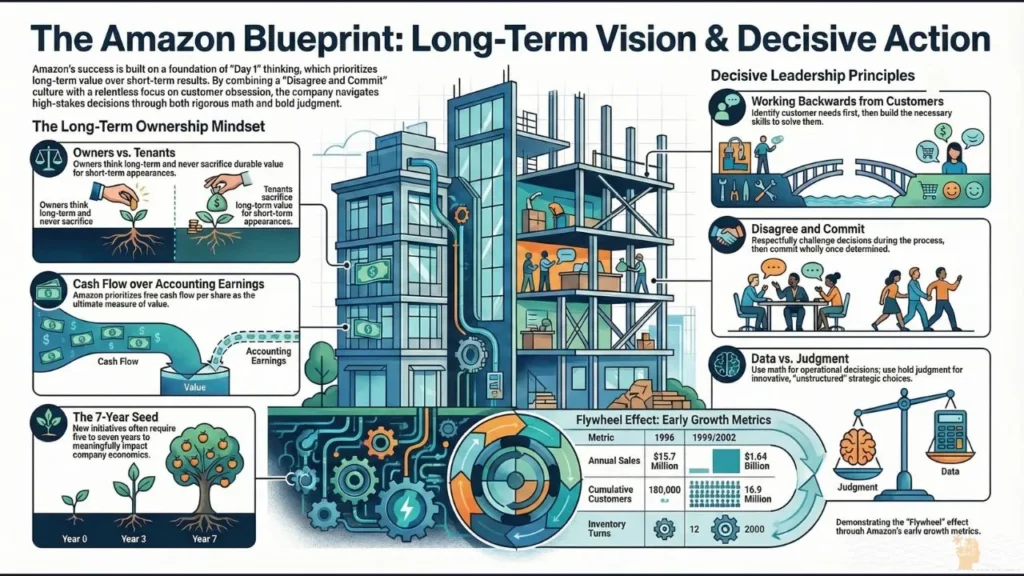
1. Disagree and Commit: The Antidote to Inaction
The consensus trap is a death sentence for speed. When a team waits for everyone to be in total agreement before moving, they aren’t practicing leadership; they are practicing bureaucracy. The principle of “Disagree and Commit” is the strategic antidote.
This management philosophy has a storied lineage in Silicon Valley, utilized by Scott McNealy at Sun Microsystems to demand that employees “get out of the way” if they couldn’t agree, and championed by Andrew Grove at Intel. Grove famously demanded that his teams argue vigorously but leave meetings fully aligned. As Patrick Lencioni notes in The Advantage, great teams avoid the consensus trap by recognizing that even without initial agreement, they “must still leave the room unambiguously committed to a common course of action.”
This is not a suggestion to ignore dissent; it is an obligation to voice it. As the Amazon Leadership Principles dictate:
“Leaders are obligated to respectfully challenge decisions when they disagree, even when doing so is uncomfortable or exhausting. Leaders have conviction and are tenacious. They do not compromise for the sake of social cohesion. Once a decision is determined, they commit wholly.”
2. Build Your Strategy on the Unchangeable
Strategy is usually an obsession with the transitory: Which competitor just launched a new app? What is the “trend” of the quarter? A more powerful—and counter-intuitive—approach is to ignore the noise and ask: “What is not going to change in the next five to ten years?”
In the early Amazon playbook, this meant identifying stable customer needs: lower prices, larger selection, and faster delivery. It is impossible to imagine a customer ten years from now saying, “I love Amazon, I just wish the prices were higher and the shipping was slower.”
By basing a strategy on these unchangeable pillars, a leader can create a “Virtuous Cycle”—a flywheel where every dollar of energy invested today pays dividends for a decade. This requires a “seed to tree” philosophy; as an empirical observation, it often takes five to seven years for a new initiative to have a meaningful impact on the economics of a company. When you invest in the unchangeable, you have the patience to let those seeds grow because you know the soil is stable.
3. The “Tenant” vs. “Owner” Mindset
Long-term thinking is both a requirement and a result of true ownership. Jeff Bezos famously illustrated the difference between a short-term “tenant” and a long-term “owner” with the story of a family who rented out their home only to find the tenants had nailed their Christmas tree directly to the hardwood floors. A tenant seeks the most expedient solution for their immediate comfort; an owner considers the value of the asset over decades.
In a corporate context, an owner’s mindset requires a “willingness to be misunderstood for long periods.” This often means making decisions that cannibalize your own business or hurt short-term sales to build long-term trust. A prime example occurred in 2000, when Amazon invited third-party sellers to compete directly on its own product detail pages. Internal critics worried this would “lose the detail page” to competitors and hurt retail margins. However, the “owner” judgment was simple: if a third party could offer a better price, the customer should have it.
As Bezos noted in the 2003 Shareholder Letter:
“Owners are different from tenants. I know of a couple who rented out their house, and the family who moved in nailed their Christmas tree to the hardwood floors instead of using a tree stand. Expedient, I suppose… but no owner would be so short-sighted.”
4. Weaponize Judgment Where Data Fails
Most corporate leaders are addicted to data. They seek “math-based” operating decisions—like where to locate a warehouse or how much inventory to buy—where the numbers provide a clear “right” or “wrong” answer. But the most vital strategic choices often defy calculation.
In their 1976 paper, The Structure of “Unstructured” Decision Processes, Henry Mintzberg and his colleagues warned that “excessive attention by management scientists to operating decisions may well cause organizations to pursue inappropriate courses of action more efficiently.” When you limit your innovation to only what the math can prove in advance, you limit your company to the status quo.
Consider the paradox of price elasticity. Quantitative data almost always suggests that raising prices is the “smart” move for short-term profit. It takes human judgment to realize that relentlessly returning efficiency gains to the customer through lower prices creates a virtuous cycle of scale. Any institution unwilling to endure the controversy of a judgment-based decision will ultimately be disrupted by one that is.
5. Free Cash Flow: The Real Weighing Machine
While Wall Street obsesses over GAAP earnings, the Strategic Leadership Consultant looks at free cash flow per share. Earnings can be a cosmetic illusion; free cash flow is the reality of value creation.
To see how earnings can lie, consider the “transportation machine” hypothetical. An entrepreneur builds a business with $160 million in capital expenditures. In Year 1, they perfectly utilize the machine, yielding $10 million in earnings—a respectable 10% net margin. Delighted, they scale to 8 machines by Year 4. On the income statement, it looks like a triumph: 100% compound earnings growth and $150 million in cumulative earnings.
However, the cash flow statement reveals a disaster: the business has generated a cumulative negative free cash flow of $530 million. The faster this earnings-positive business grows, the more value it destroys. As Benjamin Graham famously said: “In the short term, the stock market is a voting machine; in the long term, it’s a weighing machine.” To build a “heavy” company, you must weigh your success in cash, not accounting conventions.
Conclusion: Maintaining the Urgency of Day 1
Leadership is not a popularity contest; it is the courage to make bold, unconventional choices that prioritize the next decade over the next quarter. The “Day 1” philosophy reminds us that the potential for innovation is always in its infancy, provided we are willing to endure the discomfort of being misunderstood and the exhaustion of high-stakes debate.
As you evaluate your own organizational culture, ask yourself the most difficult question in the playbook: Are you building a strategy on what is changing, or are you investing in what stays the same?