
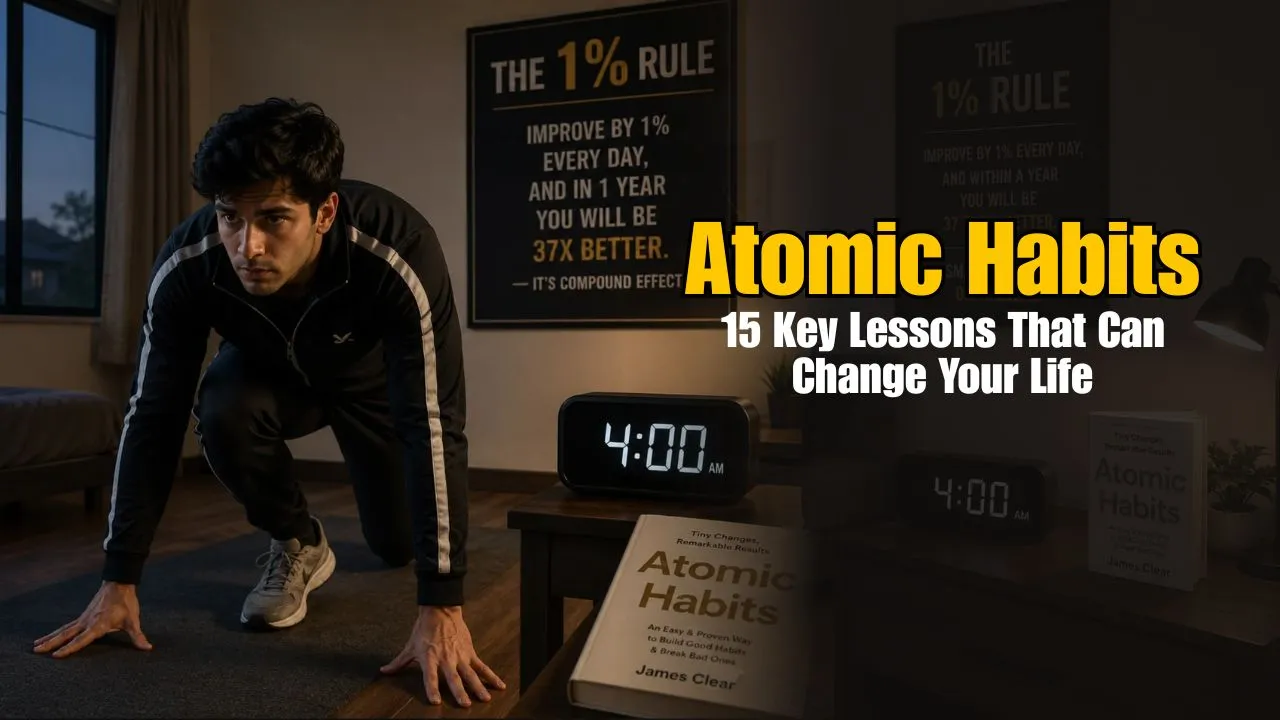
Few self-improvement books have left as deep a mark on modern habit-building as James Clear’s Atomic Habits. Since its release in 2018, it has sold millions of copies worldwide and spent years on bestseller lists — and it earned that spot for a simple reason: it doesn’t just tell people to “be more disciplined.” It hands them a practical, science-backed system for actually changing behavior.
Part of the book’s appeal is timing. It arrived at a moment when people were exhausted by willpower-based advice that rarely worked in the long run. Clear offered something different: the idea that habits are not about heroic effort, but about tiny, almost invisible actions that compound into massive results over time. The title itself captures the philosophy — “atomic” in the sense of being small, foundational building blocks, and also in the sense of holding outsized power when they accumulate.
James Clear is a writer and speaker who has spent over a decade studying habits, decision-making, and continuous improvement. Before Atomic Habits, he built a large following through his weekly newsletter and articles exploring behavioral science in plain, actionable language. He’s not a psychologist or an academic researcher himself — his strength lies in translating complex research from psychology, neuroscience, and behavioral economics into frameworks that ordinary people can use immediately. This accessibility is a major reason the book resonates with such a broad audience, from athletes and entrepreneurs to students and parents.
So what will readers actually take away from Atomic Habits? At its core, the book teaches that lasting change doesn’t come from setting big goals — it comes from building better systems. Clear argues that the quality of our lives depends on the quality of our habits, and that small, consistent improvements (even just 1% better each day) accumulate into remarkable transformation over months and years. He introduces a practical framework for understanding why habits form, called the habit loop, and pairs it with concrete strategies — like habit stacking, environment design, and identity-based change — that make new habits easier to start and old ones easier to break.
Readers will also come away with a new way of thinking about identity and behavior. Rather than focusing solely on outcomes (“I want to lose 20 pounds”), Clear encourages people to focus on becoming a certain kind of person (“I am someone who doesn’t miss workouts”). This shift, he argues, is what makes habits stick long after motivation fades.
In the sections that follow, we’ll break down the book’s core concepts and distill them into 15 key lessons you can start applying today.
Atomic Habits Summary
The Foundation: Why Tiny Changes Make a Big Difference
James Clear opens Atomic Habits with a simple but powerful idea: habits are the compound interest of self-improvement. Just as money multiplies through compounding, the effects of small habits multiply as you repeat them over time. The problem is that the results of good or bad habits are often invisible in the short term — a single workout doesn’t transform your body, and a single junk-food meal doesn’t ruin your health. But strung together over months and years, these small choices determine whether you end up fit or unfit, productive or scattered, calm or anxious.
This leads to what Clear calls the 1% Rule. The idea is straightforward: improving by just 1% each day doesn’t feel significant in the moment, but those small gains accumulate dramatically. Improving 1% daily for a year doesn’t lead to being 365% better — due to compounding, the gains multiply on top of each other, producing exponential rather than linear growth. The reverse is also true: getting 1% worse each day compounds into significant decline. This is why Clear insists that habits are a double-edged sword — they can build you up or quietly tear you down, depending on the direction you’re heading.
A key implication of this rule is that habits are the compound interest of self-improvement, but they’re also notoriously hard to notice while they’re forming. Clear describes this as the “valley of disappointment” — the period where you’re putting in consistent effort but don’t yet see meaningful results. Most people quit during this valley because they expect progress to be linear. Clear’s advice: trust the process and stay consistent, because the breakthrough often comes only after a long stretch of seemingly unrewarded effort.
Forget Goals — Focus on Systems
One of the more counterintuitive ideas in the book is that goals are not the key to lasting change — systems are. Clear points out that winners and losers often have the exact same goals (every Olympic athlete wants a gold medal; every team in a league wants a championship). If goals were the differentiator, everyone with the same goal would achieve the same result. What actually separates successful people is the system of habits they follow daily.
Clear lists several problems with a goals-only approach:
- Goals are about restricting happiness. If you only allow yourself to feel successful once you reach the goal, you delay satisfaction and risk a let-down once it’s achieved (or a sense of failure if it isn’t).
- Goals create an “either-or” conflict. You either meet the goal and succeed, or you fall short and feel like a failure — there’s no in-between.
- Goals are at odds with long-term progress. A goal is a single endpoint, but a system is what keeps you improving even after that endpoint is reached or changed.
This doesn’t mean goals are useless — Clear acknowledges that goals are good for setting direction, while systems are good for making progress. But the focus, day to day, should be on building and refining the process: the workout schedule, the writing routine, the budgeting habit. The goal might tell you where you want to go, but the system is what actually gets you there — and keeps you there once you’ve arrived.
Identity-Based Habits: Becoming the Type of Person
Perhaps the most transformative idea in Atomic Habits is the concept of identity-based habits. Clear distinguishes between three layers of behavior change:
- Outcome-based change — focused on results (e.g., losing weight, publishing a book).
- Process-based change — focused on habits and systems (e.g., exercising regularly, writing daily).
- Identity-based change — focused on beliefs, worldview, and self-image (e.g., seeing yourself as an athlete, or as a writer).
Most people start at the outcome level, but Clear argues true, lasting change works in the opposite direction — it should start with identity. The most effective way to change your habits is to focus not on what you want to achieve, but on who you wish to become. Every action you take is essentially a vote for the type of person you believe yourself to be. Skip a workout, and you cast a vote for “I am someone who doesn’t exercise.” Go for a run, even a short one, and you cast a vote for “I am a runner.”
Over time, these votes accumulate into a new self-image, and that self-image makes future behavior almost automatic — because now you’re not forcing yourself to do something foreign, you’re simply acting in line with who you believe you are. This is why Clear recommends a two-step process: first decide the type of person you want to be, and then prove it to yourself with small wins. The habit becomes a way of casting votes for the identity you want to build, rather than a chore imposed from the outside.
The Habit Loop: How Habits Actually Form
To change a habit, Clear argues, you first need to understand how it forms. He breaks every habit down into a four-step loop, drawing on decades of behavioral psychology research:
Cue — The trigger that initiates the behavior. This could be a time of day, a location, an emotional state, other people, or a preceding action. The cue’s job is to alert your brain that a reward is potentially nearby.
Craving — The motivational force behind every habit. You don’t crave the habit itself; you crave the change in state it promises. You don’t want to check your phone — you want to feel relief from boredom or uncertainty. Cravings differ from person to person, which is why the same cue can trigger different responses in different people.
Response — The actual habit you perform, whether it’s a thought or an action. Whether a response occurs depends on how much friction is associated with it, and on your ability to actually carry it out.
Reward — The end goal of every habit. Rewards satisfy the craving and also teach your brain which actions are worth remembering for the future. They serve two key purposes: satisfying your craving in the moment, and teaching you which actions are worth repeating.
Clear maps these four steps to four corresponding laws of behavior change, which form the backbone of the entire book’s practical advice:
- To build a good habit: make the cue obvious, the craving attractive, the response easy, and the reward satisfying.
- To break a bad habit: make the cue invisible, the craving unattractive, the response difficult, and the reward unsatisfying.
Understanding this loop is what allows the rest of Clear’s strategies — habit stacking, environment design, and so on — to work, because each one targets a specific stage of the loop.
Habit Stacking: Using What You Already Do
One of the most practical techniques Clear offers is habit stacking — pairing a new habit with a current habit you already do automatically. The formula is simple: “After [CURRENT HABIT], I will [NEW HABIT].” For example, “After I pour my morning coffee, I will meditate for one minute,” or “After I take off my work shoes, I will immediately change into my workout clothes.”
The logic behind habit stacking is rooted in how the brain organizes behavior into chains. Existing habits are already wired with strong neural connections; by attaching a new behavior to an established one, you essentially “borrow” the momentum of the old habit’s cue to launch the new one. This sidesteps the problem of relying on motivation or memory, since the old habit itself becomes the reminder.
Clear suggests building out a full habit stack over time — a sequence of small habits performed one after another, each one cued by the completion of the previous one. This can turn a morning or evening routine into a chain of positive behaviors that requires almost no conscious decision-making once it’s established.
Environment Design: Make Good Habits Obvious, Bad Habits Invisible
Clear places enormous emphasis on the environment as the invisible hand that shapes behavior. He argues that environment is often a more powerful driver of behavior than willpower or motivation. People assume their habits are a product of their character, but more often, they’re a product of their context — the layout of a room, the visibility of an object, or the convenience of an action.
The practical implication is to redesign your surroundings so that good habits are the path of least resistance and bad ones require effort to access. Some of Clear’s specific strategies include:
- Make cues for good habits visible: leave your running shoes by the door, keep a water bottle on your desk, place a book on your pillow if you want to read more before bed.
- Make cues for bad habits invisible: remove the TV remote from the living room, log out of social media apps, keep junk food out of the house entirely.
- Increase friction for unwanted behaviors: unplug the TV after each use, delete time-wasting apps, put your phone in another room while working.
- Decrease friction for wanted behaviors: prep your gym bag the night before, set out ingredients for a healthy breakfast in advance.
Clear also discusses the idea that one space, one use can help — assigning specific physical or digital spaces to specific behaviors (a desk only for work, a chair only for reading) so that the context itself becomes a strong, unambiguous cue.
Tracking Progress: Make It Satisfying
The final law of behavior change — making the reward satisfying — is closely tied to tracking progress, often called habit tracking. Clear is a strong advocate of measuring habits visually, because what gets measured and noticed changes behavior. A simple method he popularized is the habit tracker: literally marking an X on a calendar each day you complete a habit.
Tracking works for several reasons:
- It provides immediate, visible proof of progress, which is satisfying on its own.
- It keeps you honest, since the cue of looking at a habit tracker reminds you to act and reveals exactly how consistent you’ve actually been.
- It creates a visual chain you don’t want to break — the so-called “don’t break the chain” effect, where the growing streak itself becomes motivating.
That said, Clear also cautions against the trap of over-tracking. The goal of tracking is to make the habit itself easier and more rewarding, not to create a separate, complicated system of its own. He recommends keeping any tracking method as simple as possible — even a small notebook or a wall calendar will do — so it doesn’t become a burden that competes with the habit it’s meant to support.
Bringing It All Together
What makes Atomic Habits so practical is how these pieces interlock. The 1% Rule explains why small, atomic habits matter at all. Identity-based change explains why some habits stick and others don’t. The habit loop explains the underlying mechanics of any habit, good or bad. And habit stacking, environment design, and tracking give you concrete tools for engineering each part of that loop in your favor.
Clear’s overarching message is one of patience paired with precision: you don’t need radical transformation to change your life — you need a thoughtful system of small, well-designed habits, repeated consistently, and trusted to compound over time.
Key Takeaways
Lesson 1: Small improvements compound over time. Getting 1% better each day doesn’t seem like much in the moment, but compounded over months and years, it produces dramatic results — just as 1% worse each day compounds into significant decline.
Lesson 2: Focus on systems, not goals. Goals are useful for setting direction, but it’s the daily systems and processes you build that actually determine whether you reach — and sustain — your goals.
Lesson 3: Become the type of person you want to be. Lasting change starts with identity. Every habit is a “vote” for the kind of person you believe yourself to be, so focus on becoming that person rather than chasing a one-time outcome.
Lesson 4: Progress often feels invisible before it’s visible. Most results lag behind effort. Don’t quit during the “valley of disappointment” — consistency pays off, even when you can’t yet see it.
Lesson 5: Every habit follows a four-step loop. Cue, craving, response, and reward are the building blocks of every habit, good or bad. Understanding this loop is the first step to changing it.
Lesson 6: Make good habits obvious — and bad ones invisible. Shape your cues deliberately. Put healthy triggers in plain sight and hide or remove the triggers for habits you want to break.
Lesson 7: Make the habit attractive. You’re more likely to stick with a habit if you find ways to make it appealing — for example, by pairing it with something you enjoy (a strategy Clear calls “temptation bundling”).
Lesson 8: Reduce friction to make good habits easy. The less effort a behavior requires, the more likely you are to do it. Prep, simplify, and remove steps wherever possible.
Lesson 9: Increase friction to make bad habits hard. Add steps, distance, or obstacles between yourself and behaviors you want to avoid.
Lesson 10: Make the reward immediately satisfying. Habits that deliver a quick, tangible sense of accomplishment are far more likely to be repeated than ones whose payoff is distant or abstract.
Lesson 11: Use habit stacking to build new routines. Attach a new habit to an existing one (“After I do X, I will do Y”) to use established routines as launchpads for new behavior.
Lesson 12: Your environment shapes your behavior more than willpower does. Redesigning your physical and digital spaces is often more effective — and more sustainable — than relying on sheer self-discipline.
Lesson 13: Track your habits to stay accountable. Visual progress, like a simple habit tracker or calendar, makes consistency satisfying and keeps you honest about your real behavior.
Lesson 14: Master the basics before optimizing them. Clear emphasizes getting the fundamentals of a habit locked in — showing up consistently — before worrying about refining or perfecting it.
Lesson 15: Habits don’t restrict freedom — they create it. A strong foundation of good habits frees up mental energy and willpower for the things that actually require deliberate thought and creativity.
Quick Knowledge Check — tap to flip