
Agricultural Practices: A Comprehensive Grade 9 Science Guide
1. INTRODUCTION: THE HEARTBEAT OF OUR NATION
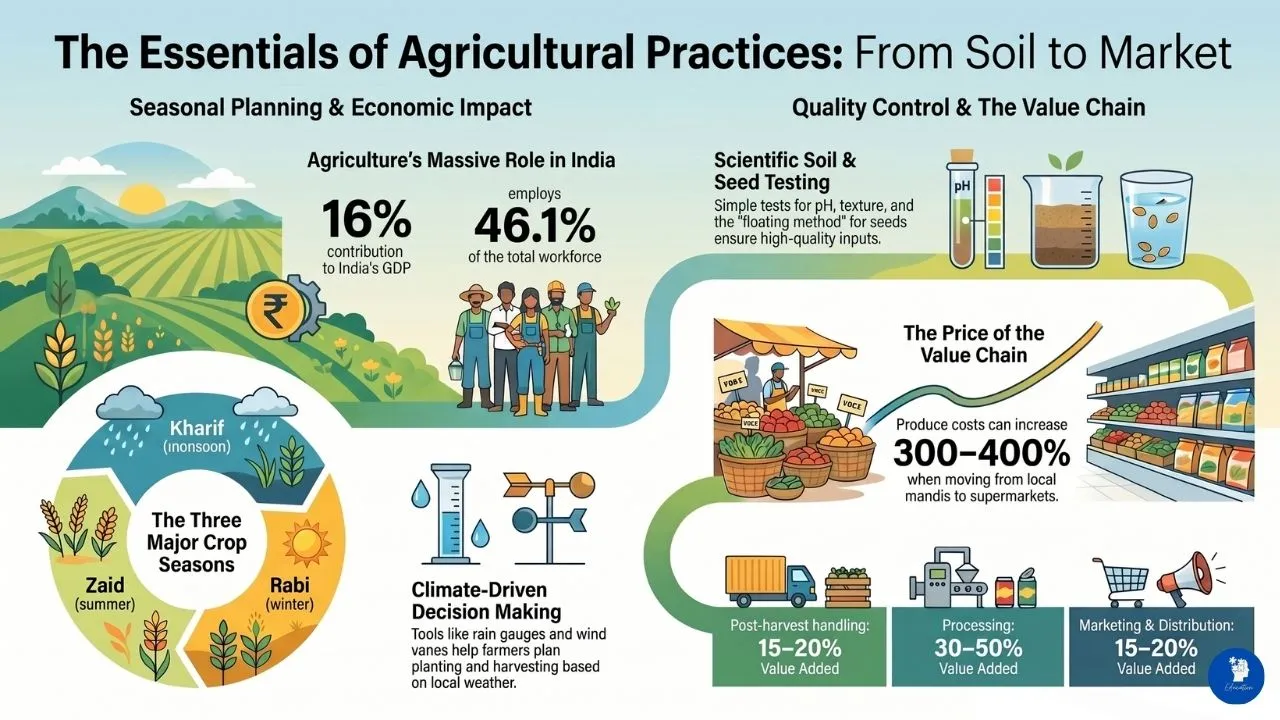
Agriculture is far more than the simple act of planting seeds; it is the strategic foundation of India’s socio-cultural and economic identity. As one of the world’s oldest agricultural civilizations, India remains a global leader in the overall production of milk, eggs, fruits, vegetables, and fish. According to the Economic Survey of India 2024-25, the agricultural sector contributes 16% to the nation’s Gross Domestic Product (GDP) and sustains the livelihood of 46.1% of the workforce. Understanding these practices is not just academic; it is a vital “life skill” that connects us to the food on our plates and the health of our environment.
Learning Objectives
- Understand the critical relationship between agro-climate conditions and crop success.
- Learn to set up a localized meteorological observatory.
- Master the techniques for testing and improving soil quality (pH and texture).
- Identify quality criteria for seeds and organic inputs.
- Explore diverse vocations and understand the agricultural value chain.
To grow food successfully, we must move beyond guesswork and learn to synchronize our efforts with the natural rhythm of the seasons.
2. TIMING THE HARVEST: AGRO-CLIMATE RELATIONSHIPS
Climate is the single most critical factor in agricultural success. From the snow-peaked Himalayas to the tropical coasts, India’s diverse regions dictate specific cropping patterns. Modern farmers gain a strategic advantage by using tools from the India Meteorological Department (IMD) and digital platforms like Gramin Krishi Mausam Sewa (GKMS) and the Bharat-VISTAAR app, which provide block-level forecasts and weather advisories to help farmers plan sowing and irrigation.
India’s Major Crop Seasons
| Season | Sowing Period | Harvesting Period | Typical Crops |
| Kharif (Monsoon) | June – July | September – October | Rice, Maize, Jowar, Bajra, Sugarcane, Cotton |
| Rabi (Winter) | October – November | March – April | Wheat, Barley, Pea, Mustard, Gram |
| Zaid (Summer) | March – April | June – July | Watermelon, Cucumber, Muskmelon, Pumpkin |
Case Study: The Weather Keepers of Ladakh In extreme environments like the cold desert of Ladakh, the farming window is exceptionally short (May to September). Here, temperatures range from 30°C in summer to -25°C in winter. High humidity (70-74%) leads to evaporation losses, while unpredictable icy winds can destroy hard labor in hours. Furthermore, weather alerts help protect livestock—such as goats, yaks, and double-humped camels—from disease outbreaks.
While national forecasts are helpful, the most successful farming often relies on localized data collected right at the source.
3. THE MINI-OBSERVATORY: MEASURING WEATHER AT SCHOOL
Hands-on meteorological observation develops a scientific temper, allowing students to track the specific micro-climate of their own region to make informed decisions.
Building Your Weather Tools
1. The Rain Gauge
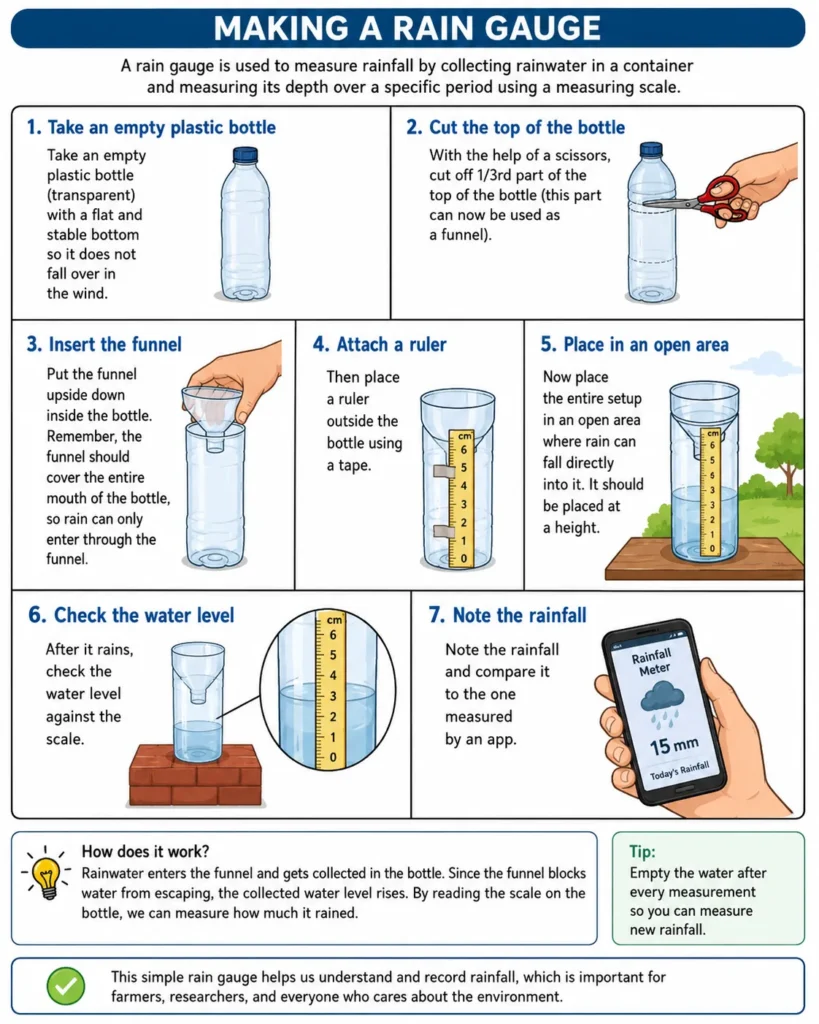
- Step 1: Use a transparent plastic bottle with a flat base.
- Step 2: Cut off the top 1/3 of the bottle to create a funnel.
- Step 3: Place the funnel upside down inside the bottle to prevent evaporation.
- Step 4: Tape a ruler (cm or mm) to the outside.
- Step 5: Place in an open area at a height.
- Step 6: After rain, check the water level against the scale.
- Step 7: Note the rainfall and compare it to data measured by a weather app.
2. The Dry-Wet Bulb Thermometer
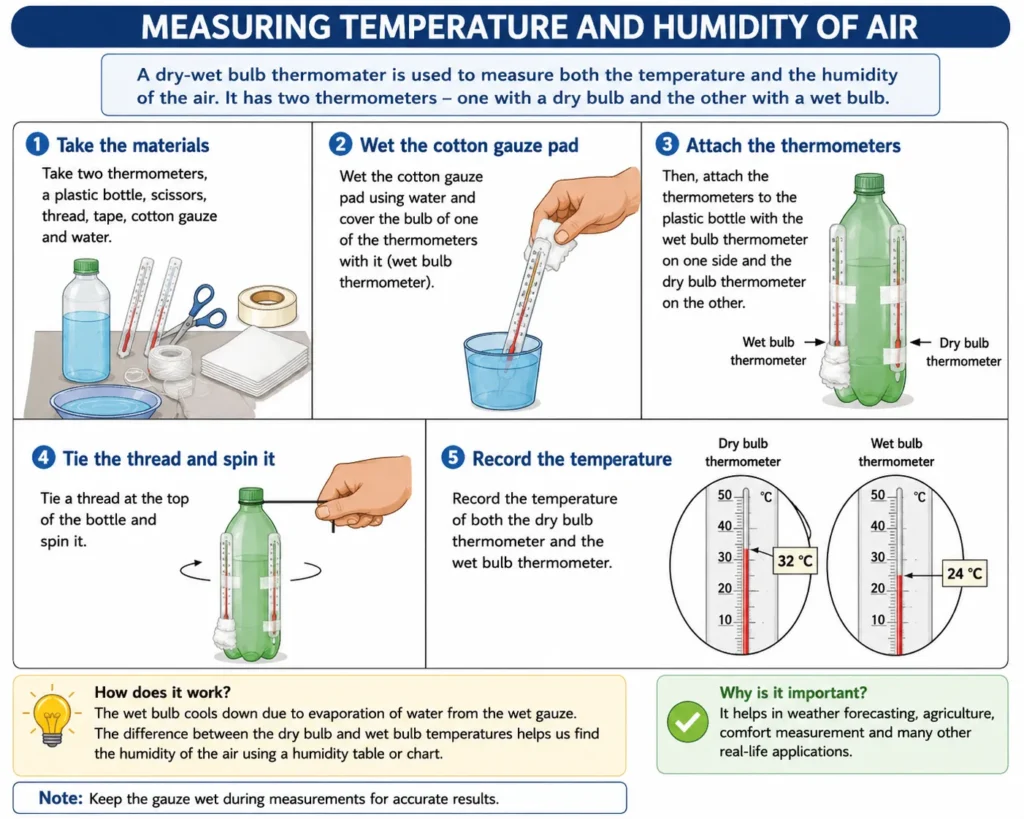
- Step 1: Take two thermometers and a plastic bottle.
- Step 2: Wrap the bulb of one in wet cotton gauze (the “wet bulb”).
- Step 3: Attach both to the bottle—wet bulb on one side, dry on the other.
- Step 4: Tie a thread to the bottle top and spin it.
- Step 5: Record both readings. The difference helps find humidity. For absolute precision, use a psychrometric chart.
3. The Wind Vane

- Step 1: Cut a circular cardboard disc and mark N, S, E, and W.
- Step 2: Cut a cardboard arrow and a separate “tail” and join them.
- Step 3: Push a pencil through the disc center.
- Step 4: Attach the arrow to the pencil eraser with a pin so it rotates freely.
Did You Know? The dry-wet bulb thermometer identifies air humidity. If the temperature difference is small, the air is humid; if the difference is large, the air is dry because water evaporated quickly from the wet bulb, cooling it down.
4. SOIL HEALTH: TESTING THE FOUNDATION
Soil fertility is not just about “dirt”; it is a dynamic, living ecosystem consisting of a precise balance of minerals, organic matter, and pore spaces filled with air and water.
Soil Sample Collection (The 9-Step Process)
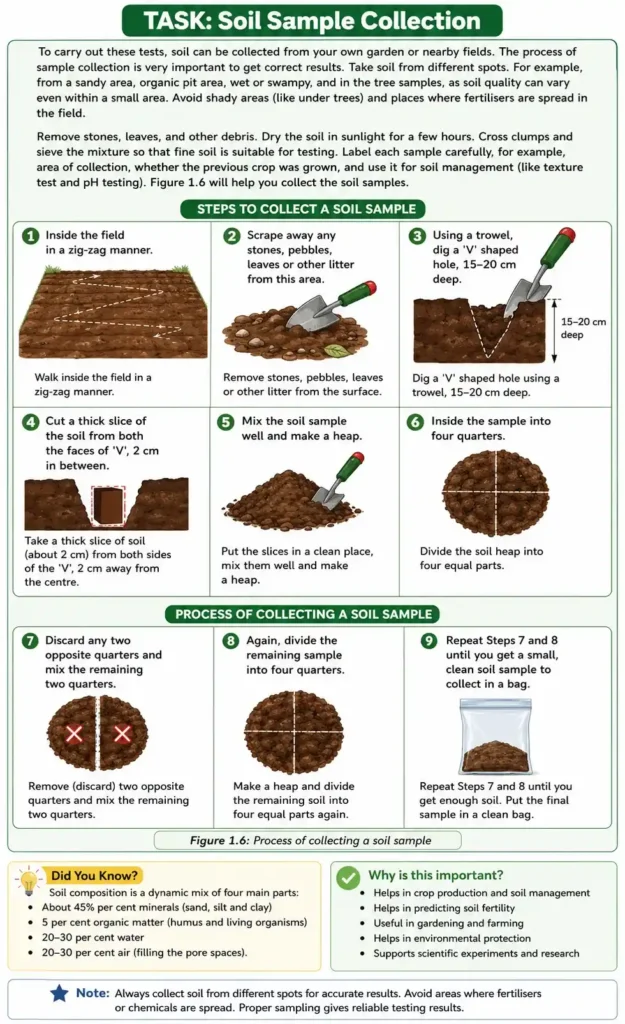
- Divide the field in a zig-zag manner to ensure a representative sample.
- Scrape away surface stones, leaves, and debris.
- Dig a “V” shaped hole 15–20 cm deep using a trowel.
- Remove a thick slice of soil from both faces of the “V,” top to bottom.
- Mix samples from different spots together in a heap.
- Divide the heap into four quarters.
- Discard two opposing quarters and mix the remaining two.
- Repeat quarters/discarding until only a small, clean sample remains.
- Bag the sample and label it with the date and previous crop history.
The Mason Jar Texture Test
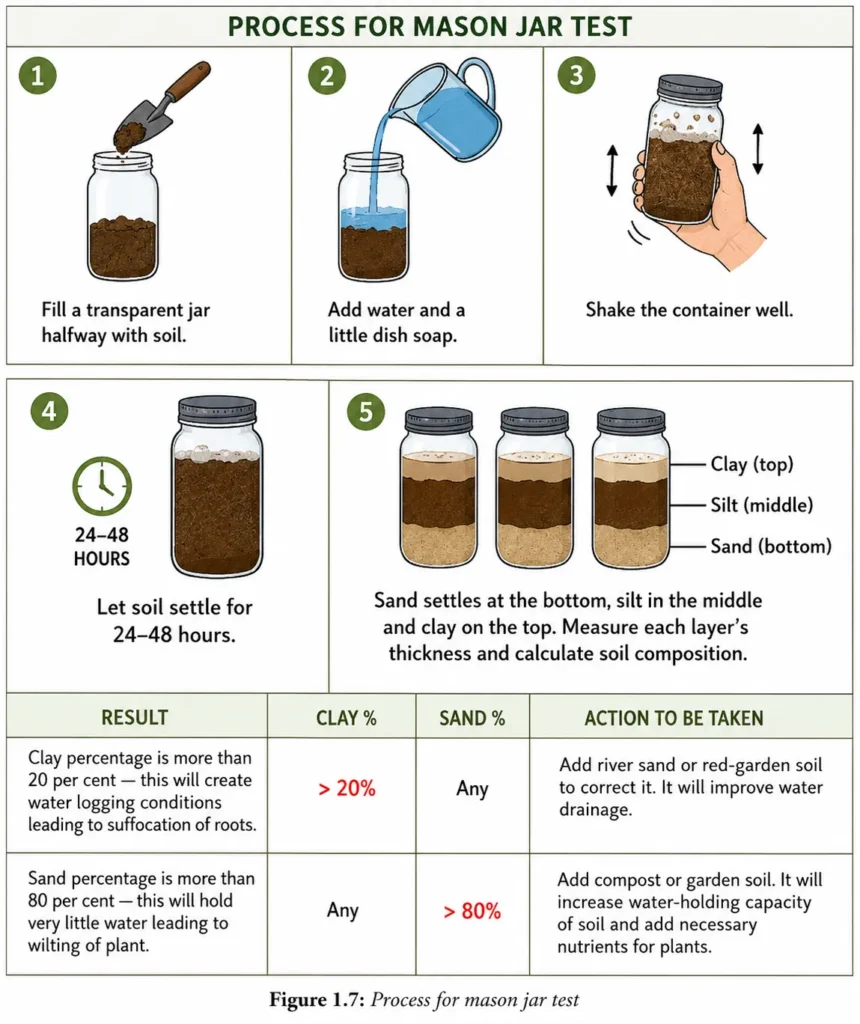
Determine the physical composition of your soil to prevent root suffocation or wilting.
| Result | Action to be Taken |
| Clay > 20% (Risk of waterlogging) | Add river sand or red-garden soil to improve drainage. |
| Sand > 80% (Risk of wilting) | Add compost or garden soil to increase nutrient and water retention. |
pH Testing & Amendments
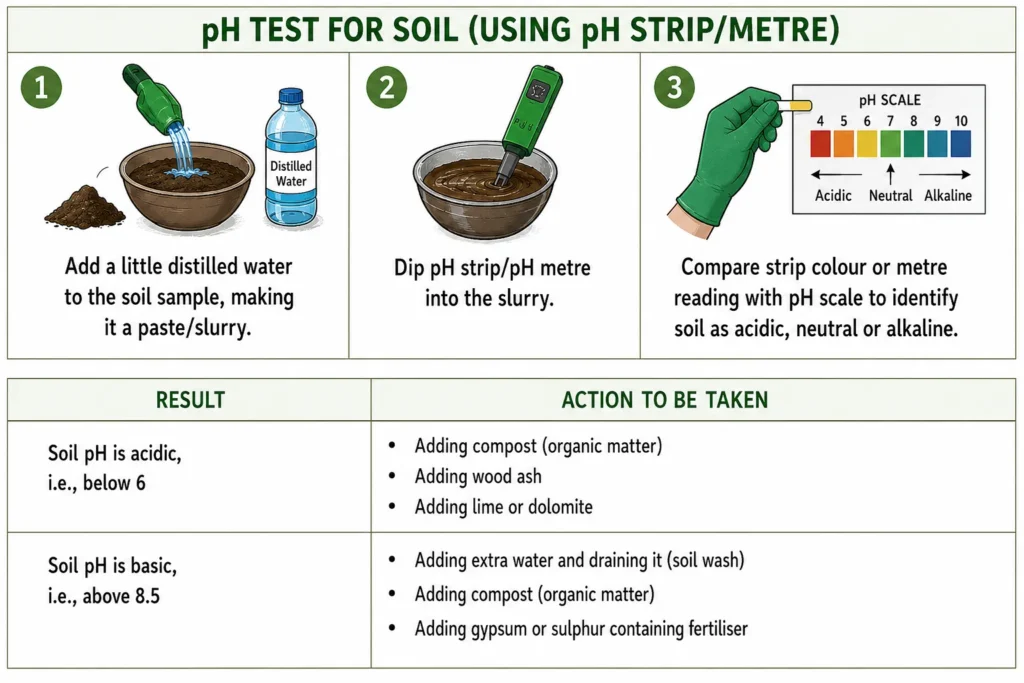
Soil pH determines how easily plants absorb nutrients. Most plants prefer slightly acidic to neutral soil (pH 6–7).
- Acidic Soil (pH < 6): Add compost, wood ash, or lime/dolomite to neutralize.
- Basic Soil (pH > 8.5): Add gypsum or sulphur fertilizers. Crucially, perform a “soil wash” by adding extra water and draining it to physically leach out excess salts.
5. SEED SELECTION & ORGANIC INPUTS
A fertile field cannot save a weak seed. Seed quality is a strategic defense against pests and poor germination.
The Floating Method for Seed Selection To ensure high germination rates, follow this precise recipe:
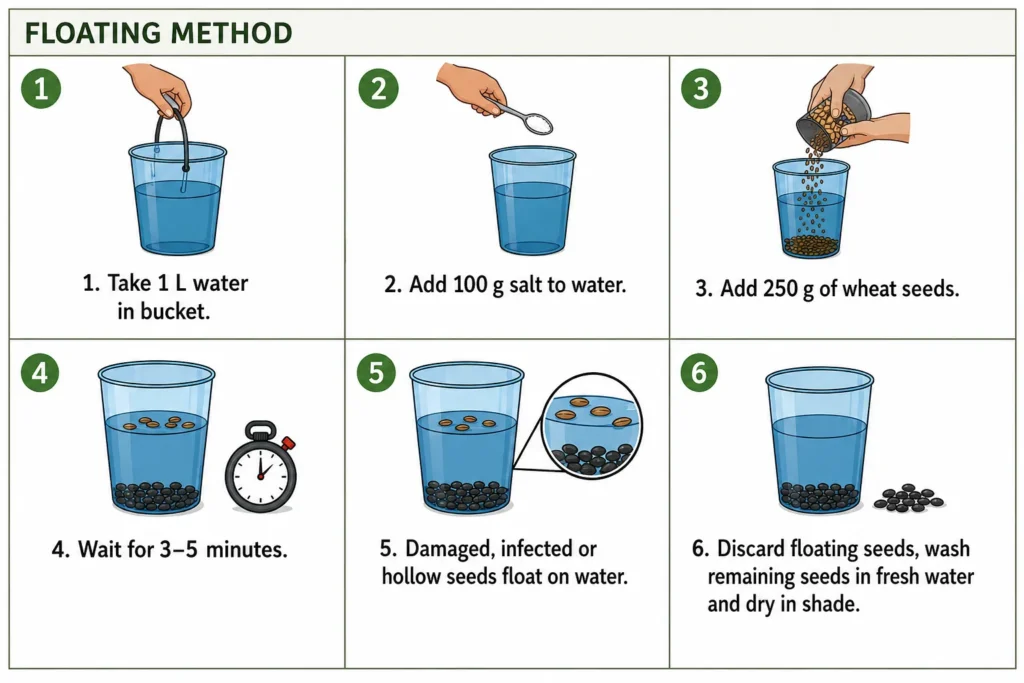
- Take 1L of water in a bucket.
- Add 100g of salt (NaCl) to increase water density.
- Add 250g of seeds (e.g., wheat).
- Wait 3–5 minutes.
- Identify: Hollow, damaged, or infected seeds will float. Healthy, viable seeds will sink.
- Discard floaters; wash and dry healthy seeds in the shade.
Seed Dormancy Dormancy is a natural survival state. To “wake up” seeds for faster sprouting, some—like rice—can be soaked in hot water for a few hours before sowing.
Organic Fortification (Student Recipes)
- Vermicompost: Mix 50kg of agro-waste and 50kg of cow dung in a pit. Introduce worms and keep moist. It is ready for harvest in just six days.
- Dashaparni Arka: A potent pesticide made from 10 materials. Remove leaves from stems and weigh 200g of leaves (Neem, Karanj, Tulsi, etc.). Add to a 20L bucket with 225g cow dung, 500ml cow urine, and 15L water. Ferment for 30–40 days. Dilute 15ml per 1L of water before spraying.
6. THE VALUE CHAIN & FUTURE CAREERS
The “Value Chain” evaluates how agricultural products reach consumers. The price of vegetables often increases by 300-400% from the mandi to the supermarket due to added costs at each step.
- Farming/Production: Base cost (₹100). Note: If hybrid seeds are used, research costs by scientists can increase the initial seed price by 20-400%.
- Post-harvest handling (15–20%): Refrigeration and warehouse storage.
- Processing (30–50%): Cleaning, grinding, or pasteurization.
- Marketing & Distribution (15–20%): Transport and advertising.
- Consumption (10–15%): Retailer profit margins.
Future Vocations Modern agriculture utilizes AI, drones, and biotechnology. High-value career paths include:
- Mushroom Cultivation & Backyard Poultry.
- Rooftop Gardening & Aquaponics.
- Precision Farming (using drones and robotics for automated spraying).
7. THE STUDENT’S TOOLKIT: GLOSSARY & FACTS
Key Terms
- Rabi: Winter crops (e.g., Wheat).
- Kharif: Monsoon crops (e.g., Rice).
- Zaid: Summer crops (e.g., Watermelon).
- Seed Dormancy: A natural state preventing seeds from sprouting in unsuitable conditions.
- pH: A scale measuring soil acidity or alkalinity.
- Krishi-parashara: An ancient Indian text detailing traditional agricultural techniques.
Fun Facts
- Soil Composition: It is a dynamic mix of 45% minerals, 5% organic matter, 20-30% water, and 20-30% air.
- Global Leader: India is a top producer of milk, eggs, fruits, vegetables, and fish!
8. COMPREHENSIVE ASSESSMENT
Multiple Choice Questions (MCQs
- Which season is associated with Watermelon? (a) Rabi (b) Zaid (c) Kharif (d) Winter
- What is the GDP contribution of Indian agriculture? (a) 46.1% (b) 5% (c) 16% (d) 300%
- Which tool uses a psychrometric chart? (a) Rain Gauge (b) Wind Vane (c) Dry-wet bulb thermometer (d) Compass
- Basic soil has a pH: (a) Below 6 (b) At 7 (c) Above 8.5 (d) At 0
- In the floating method, healthy seeds: (a) Float (b) Sink (c) Dissolve (d) Turn blue
- Dashaparni arka contains how many materials? (a) 2 (b) 5 (c) 10 (d) 20
- Which app is developed by the Government of India for farmers? (a) NASA (b) Bharat-VISTAAR (c) Instagram (d) WhatsApp
- Processing adds what percentage to the value chain? (a) 10-15% (b) 15-20% (c) 30-50% (d) 400%
- Adding gypsum helps correct: (a) Acidic soil (b) Sandy soil (c) Basic soil (d) Wet soil
- Ancient agricultural techniques are found in: (a) Kaushal Bodh (b) Krishi-parashara (c) IMD Manual (d) GKMS
Answer
Agriculture MCQs with Answers
1. Which season is associated with Watermelon?
- (a) Rabi
- ✅ (b) Zaid
- (c) Kharif
- (d) Winter
Answer: (b) Zaid
2. What is the GDP contribution of Indian agriculture?
- (a) 46.1%
- (b) 5%
- ✅ (c) 16%
- (d) 300%
Answer: (c) 16%
3. Which tool uses a psychrometric chart?
- (a) Rain Gauge
- (b) Wind Vane
- ✅ (c) Dry-wet bulb thermometer
- (d) Compass
Answer: (c) Dry-wet bulb thermometer
4. Basic soil has a pH:
- (a) Below 6
- (b) At 7
- ✅ (c) Above 8.5
- (d) At 0
Answer: (c) Above 8.5
5. In the floating method, healthy seeds:
- (a) Float
- ✅ (b) Sink
- (c) Dissolve
- (d) Turn blue
Answer: (b) Sink
6. Dashaparni Arka contains how many materials?
- (a) 2
- (b) 5
- ✅ (c) 10
- (d) 20
Answer: (c) 10
7. Which app is developed by the Government of India for farmers?
- (a) NASA
- ✅ (b) Bharat-VISTAAR
- (c) Instagram
- (d) WhatsApp
Answer: (b) Bharat-VISTAAR
8. Processing adds what percentage to the value chain?
- (a) 10–15%
- (b) 15–20%
- ✅ (c) 30–50%
- (d) 400%
Answer: (c) 30–50%
9. Adding gypsum helps correct:
- (a) Acidic soil
- (b) Sandy soil
- ✅ (c) Basic (alkaline) soil
- (d) Wet soil
Answer: (c) Basic (alkaline) soil
10. Ancient agricultural techniques are found in:
- (a) Kaushal Bodh
- ✅ (b) Krishi-Parashara
- (c) IMD Manual
- (d) GKMS
Answer: (b) Krishi-Parashara
Fill in the Blanks
- India leads in the production of vegetables, fruits, milk, eggs, and ___________.
- To correct clay-heavy soil, add ___________ or red-garden soil.
- The ___________ method uses salt water to find non-germinating seeds.
- Rabi crops are sown in the months of ___________.
- A ___________ identifies the direction of the wind.
- Soil contains approximately ___________ percent organic matter.
- The ___________ provides weather alerts via SMS and community radio.
- Basic soil can be improved by a ___________, which drains out salts.
- Hybrid seeds can increase costs by ___________ percent due to scientist research.
- ___________ involves using AI and drones for agriculture.
Answer
Fill in the Blanks (Answers)
- India leads in the production of vegetables, fruits, milk, eggs, and fish.
- To correct clay-heavy soil, add sand or red-garden soil.
- The salt-water floating method uses salt water to identify non-germinating seeds.
- Rabi crops are sown during October–November.
- A wind vane identifies the direction of the wind.
- Soil contains approximately 5% organic matter.
- The Gramin Krishi Mausam Sewa (GKMS) provides weather alerts via SMS and community radio.
- Basic soil can be improved by a subsurface drainage system, which drains out salts.
- Hybrid seeds can increase costs by 300–400% due to research and development.
- Precision farming involves using AI and drones in agriculture.
True or False
- Mustard is a Rabi crop. (True)
- Soil pH below 6 is considered basic. (False)
- Dormancy helps seeds survive adverse environments. (True)
- A rain gauge should be placed under a tree. (False)
- Dashaparni arka takes 30-40 days to ferment. (True)
- Value increases as produce travels further from the farm. (True)
- The IMD only provides national-level forecasts. (False)
- Clay particles are larger than sand particles. (False)
- Vermicompost can be ready in 6 days. (True)
- Agriculture sustains nearly 46.1% of the Indian workforce. (True)
Answer
| Statement | Answer |
|---|---|
| Mustard is a Rabi crop. | ✅ True |
| Soil pH below 6 is considered basic. | ❌ False |
| Dormancy helps seeds survive adverse environments. | ✅ True |
| A rain gauge should be placed under a tree. | ❌ False |
| Dashaparni Arka takes 30–40 days to ferment. | ✅ True |
| Value increases as produce travels further from the farm. | ✅ True |
| The IMD only provides national-level forecasts. | ❌ False |
| Clay particles are larger than sand particles. | ❌ False |
| Vermicompost can be ready in 60 days. | ✅ True (not 6 days) |
| Agriculture sustains nearly 46.1% of the Indian workforce. | ✅ True |
Short Answer Questions
- Explain the role of the India Meteorological Department (IMD).
- Why is salt added to the water in the seed floating method?
- List two crops each for Kharif and Zaid seasons.
- What are the four main components of soil?
- How can you “wake up” a dormant rice seed?
- Why does a supermarket charge more than a mandi?
- What amendments are needed for acidic soil?
- What does a narrow difference in a wet-dry bulb thermometer indicate?
- Name two modern technologies in precision farming.
- Why must soil samples be collected in a zig-zag manner?
Answer
Short Answer Questions (Answers)
1. Explain the role of the India Meteorological Department (IMD).
Answer:
The IMD provides weather forecasts, rainfall predictions, cyclone warnings, and agrometeorological advisories that help farmers plan irrigation, sowing, harvesting, and crop protection.
2. Why is salt added to the water in the seed floating method?
Answer:
Salt increases the density of water so that damaged or hollow seeds float while healthy seeds sink.
3. List two crops each for Kharif and Zaid seasons.
Kharif: Rice, Maize
Zaid: Watermelon, Cucumber
4. What are the four main components of soil?
- Mineral matter
- Organic matter
- Water
- Air
5. How can you “wake up” a dormant rice seed?
By soaking it in warm water or using appropriate seed treatment to break dormancy.
6. Why does a supermarket charge more than a mandi?
Because additional costs include transportation, storage, packaging, processing, marketing, and retailer profit.
7. What amendments are needed for acidic soil?
Agricultural lime (lime stone) or dolomite is commonly added to reduce soil acidity.
8. What does a narrow difference in a wet-dry bulb thermometer indicate?
It indicates high humidity in the atmosphere.
9. Name two modern technologies in precision farming.
- Artificial Intelligence (AI)
- Drones
10. Why must soil samples be collected in a zig-zag manner?
To obtain a representative sample of the entire field and minimize sampling bias.
Long Answer Questions
- Describe the 9-step process of collecting a soil sample for testing.
- How does climate affect livestock rearing and farming in Ladakh?
- Compare the sowing and harvesting periods of the three Indian crop seasons.
- Detail the preparation and dilution ratio of Dashaparni arka.
- Break down the agricultural value chain and explain where costs are added.
Answer
Long Answer Questions
1. Describe the 9-step process of collecting a soil sample for testing.
Answer (Summary):
- Divide the field into uniform areas.
- Remove surface debris.
- Dig a V-shaped pit.
- Collect soil from the sides.
- Repeat sampling in a zig-zag pattern.
- Mix all samples thoroughly.
- Remove stones and roots.
- Reduce the sample to about 500 g using quartering.
- Label and send it to the soil testing laboratory.
2. How does climate affect livestock rearing and farming in Ladakh?
Answer:
Ladakh’s cold desert climate limits crop cultivation due to short growing seasons and low rainfall. Farmers grow hardy crops such as barley and peas while relying heavily on livestock like yaks, sheep, and goats for milk, wool, meat, and transport.
3. Compare the sowing and harvesting periods of the three Indian crop seasons.
| Season | Sowing | Harvesting |
|---|---|---|
| Kharif | June–July | September–October |
| Rabi | October–November | March–April |
| Zaid | March–April | June |
4. Detail the preparation and dilution ratio of Dashaparni Arka.
Answer:
Dashaparni Arka is prepared by fermenting ten different plant leaves along with cow urine, cow dung, water, and other natural ingredients for about 30–40 days. Before spraying, it is generally diluted in water (commonly around 1:10) depending on crop recommendations.
5. Break down the agricultural value chain and explain where costs are added.
Answer:
The agricultural value chain includes:
- Farm production
- Harvesting
- Storage
- Transportation
- Processing
- Packaging
- Wholesale market
- Retail sale
Costs increase at each stage due to labor, transportation, storage, processing, packaging, taxes, and retailer margins, resulting in a higher final price for consumers.
Match the Following
| Column A (Crop) | Column B (Rainfall Requirement) |
|---|---|
| Rice | A. 400–500 mm |
| Wheat | B. 750–1500 mm |
| Jowar (Sorghum) | C. 1500–3000 mm |
| Pulses | D. 500–1000 mm |
| Sugarcane | E. 750–1000 mm |
Answer
| Crop | Correct Match |
|---|---|
| Rice | C |
| Wheat | E |
| Jowar (Sorghum) | D |
| Pulses | A |
| Sugarcane | B |
9. HANDS-ON LEARNING: ACTIVITIES & PROJECTS
- Activity 1: The Mason Jar Texture Race. Collect soil from three different locations. Use the jar test to calculate the percentage of sand, silt, and clay in each.
- Activity 2: DIY Humidity Check. Use your school observatory thermometers to find the humidity today. Consult a psychrometric chart for the result.
- Project 1: Farm-to-Plate Journey. Map the journey of a bag of wheat. Record the price from the farmer, the flour mill, and the final bread package at a store.
- Project 2: The School Weather Bulletin. Record rainfall and temperature for one week. Post a “Farmer’s Advisory” on the school board based on your data.
10. REVISION & EXAM PREP
Top 10 Critical Facts
- Agriculture = 16% GDP / 46.1% Workforce.
- Kharif = Monsoon; Rabi = Winter; Zaid = Summer.
- GKMS and IMD provide block-level weather forecasts.
- Soil = 45% Minerals, 5% Organic, 50% Air/Water spaces.
- Clay > 20% needs sand; Sand > 80% needs compost.
- pH < 6 (Acidic) needs lime; pH > 8.5 (Basic) needs gypsum + soil wash.
- Floating method: 1L water + 100g salt + 250g seeds.
- Vermicompost: 50kg agro-waste + 50kg cow dung (6 days).
- Dashaparni arka: 200g leaves in 20L bucket; dilute 15ml per 1L.
- Supermarket prices are 300-400% higher than farm prices.
Mind Map Summary
- Agricultural Practices
- Climate: Seasons (Kharif, Rabi, Zaid), IMD & GKMS Forecasting.
- Inputs: Seed Quality (Floating Test), Soil Quality (pH & Texture Tests).
- Organic Tools: Vermicompost (6 days), Dashaparni arka (10 leaves).
- Economics: Value Chain (Farming to Consumption), Modern Vocations (AI/Drones).
Exam Tips: When answering questions about soil or value chains, always draw the “zig-zag” sampling diagram or the “flowchart” of price increases to earn full marks!
CHAPTER SUMMARY
This guide bridges the gap between the traditional wisdom of Krishi-parashara and modern agricultural technology. By mastering agro-climate relationships, soil health, and seed selection, we ensure a sustainable future for our nation.
Agriculture is a living ecosystem that requires a balance of scientific observation and practical labor. From measuring rainfall with a DIY gauge to correcting soil pH, these skills allow us to improve farm outputs while reducing reliance on chemical fertilizers.
As we look toward the future, agriculture offers exciting career paths in precision farming and biotechnology. Whether through drones, AI, or organic pesticides, the next generation of agricultural scientists will play the most vital role in ensuring food security for the world.
Quick Knowledge Check — tap to flip
Agriculture Flashcards
Tap a card to reveal the answer