
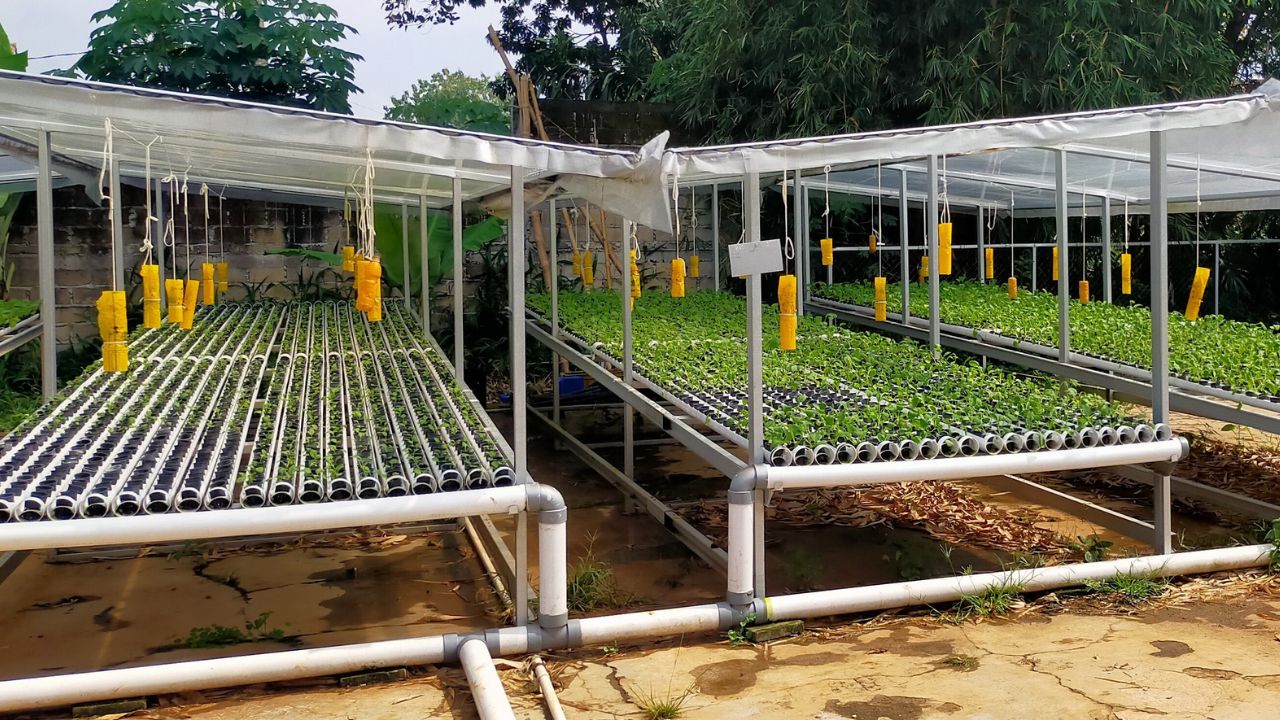
Hydroponics is a modern method of growing plants without using soil. Instead, plants are grown in water that is rich in essential nutrients. This technique allows farmers and gardeners to grow healthy crops in less space, with less water, and without worrying about poor soil quality. It is especially useful in cities, where space is limited, and also in places where the land is not suitable for farming. Hydroponics is fast becoming popular in India as a sustainable and clean farming solution that supports year-round cultivation.
Here are the answers to the questions from the “Hydroponics: Growing Plants without Soil” chapter of the Class 8 Kaushal Bodh book.
Activity 1: Field Visit to a Farm
Table 1.2: Field Visit Observation
- Date of Visit: 12 July 2025
- Name of Agri-Clinic/KVK/Farm: Krishi Vigyan Kendra
- Observations: Use of artificial lights, controlled humidity and temperature, nutrient-rich water, recirculation of water, protected polyhouse environment.
1. What are the advantages and disadvantages of the hydroponics system?
Answer:
Advantages: Grows plants without soil, saves water, uses less space.
Disadvantages: Needs setup cost and regular monitoring.
Q2. Is there any difference in the method or tools used for harvesting, transport, and storage?
Answer:
Yes, hydroponic plants are harvested by cutting above the roots, not pulling from the soil. Tools like scissors are used. Transport and storage are similar to soil-grown plants
Activity 2: Growing microgreens for preparing a healthy salad.
Table 1.4: Growing Microgreens
- Date of start of the activity: 5 July 2025
- Materials used: Tray size 30cm x 10cm, seeds: coriander, spinach, fenugreek; cocopeat: 200g
- Number of trays prepared: 3
- Days to sprout: 2 days
- Initial leaves appeared in: 4 days
- Date of harvest: 15 July 2025
- Quantity harvested per tray: 80g
- Challenges faced: Less sunlight, overwatering
Q1. What are the advantages and disadvantages of growing microgreens using hydroponics?
Answer:
Advantages: Fast growth, healthy food, clean and fresh.
Disadvantages: Needs regular care and water check.
Q2. Have you used the microgreens? How did you use them (raw salad or as a garnish)?
Answer:
Yes, I used them in raw salad and also as a garnish on sandwiches.
Q3. Can this method be applied to all crops? What are the probable limitations of microgreen production?
Answer:
No, not for all crops. Some crops need big roots and more time to grow.
Activity 3: Building a hydroponic system using “Wick Method.”
Table 1.5: Wick Method Plant Growth
- Number of wick bottles prepared: 10
- Quantity of soil used: 100g per bottle
- Number of seeds planted: 2 per bottle (total 20)
- Number of plants survived: 18
- Average plant height after 15 days: 10 cm
Q1. Which seeds, seedlings or plant cuttings did you use for the system?
Answer: I used spinach seeds and coriander seedlings for the wick hydroponic system.
Q2. Were you able to observe the soil getting wet in the upper pot?
Answer: Yes, I saw the soil in the upper pot getting wet because the wick pulled water up from the bottom reservoir. This is called capillary action.
Q3. List three key difficulties you experienced while building the system. What did you do to overcome them?
Answer: Cutting bottle, fixing wick, and keeping balance. I took help from my teacher and used proper tools.
Activity 4: Building a hydroponic system using Deep Water culture (DWC) or bucket Method.
Table 1.6: DWC Hydroponic System Cost
| System Component | Approx. Cost (Rs.) |
|---|---|
| Water reservoir | Rs. 100 |
| Planting cups | Rs. 60 |
| Plant cup holder | Rs. 50 |
| Air blower/aerator | Rs. 250 |
| Growth media | Rs. 100 |
| Plants | Rs. 50 |
| Total | Rs. 610 |
Table 1.8: NFT Hydroponic System Cost
| System Component | Approx. Cost (Rs.) |
|---|---|
| PVC pipe | Rs. 150 |
| Net pots | Rs. 100 |
| Support structure | Rs. 200 |
| Water pump | Rs. 250 |
| Timer | Rs. 150 |
| Total | Rs. 850 |
Q: List three key challenges you faced during the construction and maintenance of the system. What will you do differently next time?
Answer:
Fixing lid, keeping water level, and aerator setup. Next time, I will plan better and check all parts before starting.
Activity 5: Building a hydroponic system using Nutrient Film Technique (NFT)
Table 1.8: NFT Hydroponic System Cost
| System Component | Approx. Cost (Rs.) |
|---|---|
| PVC pipe | Rs. 150 |
| Net pots | Rs. 100 |
| Support structure | Rs. 200 |
| Water pump | Rs. 250 |
| Timer | Rs. 150 |
| Total | Rs. 850 |
Table 1.9: NFT System – Plant Growth Observation
- Crops: Lettuce
- Date of planting: 15 July 2025
- Number of plants planted: 8
- Observations: Leaves were healthy and green, no major disease observed.
Q1. Why did you use an aerator in the DWC system but not in the NFT system?
Answer:
DWC has standing water, so it needs oxygen. NFT has flowing water, so oxygen mixes naturally.
Q2. Make a comparative chart for DWC vs NFT systems.
| Feature | DWC System | NFT System |
|---|---|---|
| Ease of construction | Easy | Bit complex |
| Water usage | More | Less |
| Oxygen supply | Needs aerator | No aerator needed |
| Plant growth | Good | Very good |
Activity 6: Making compost Tea
Table 1.10: Compost Tea Preparation Observations
| Parameter | Your Observation | Usual Observation | Remark |
|---|---|---|---|
| Colour of compost tea | Dark brown | Dark brown | Good quality |
| Smell of compost tea | Earthy | Should smell earthy | Normal |
| Any other difficulties | Foam formed | Sometimes foam forms | Due to microbial activity |
Activity 7: Maintaining water pH
Table 1.11: Water pH Test Observations
- Date: 25 July 2025
- Initial pH of water: 7.5
- Acid used: Vinegar
- pH after adding acid: 6.5
- Effect after 4 days: plant leaves looked greener and roots healthy.
Q1. Have you come across any other advanced farming technology in your locality?
Answer: Yes, I saw drip irrigation in a nearby farm. It uses pipes to send water directly to plant roots, saving water and helping plants grow better.
Q2. Name any three things that you learnt while setting up the hydroponic system.
Answer: How to grow without soil, prepare compost tea, and adjust water pH.
Think and Answer
Q1. What did you enjoy doing the most?
Answer: I enjoyed planting seeds and watching them grow.
Q2. What were the challenges you faced?
Answer: Cutting bottles, managing water, and building the system.
Q3. What will you do differently next time?
Answer: I will plan better and arrange all materials in advance.
Q4. Do you think it is economical and practically feasible to grow all crops using hydroponics? Give reasons.
Answer: No. Some big crops need soil and space. Hydroponics is good for small plants.
Q5. Identify a few examples of jobs related to the work you just did.
Answer: Gardener, farmer, agriculture scientist, botanist, nursery worker.